
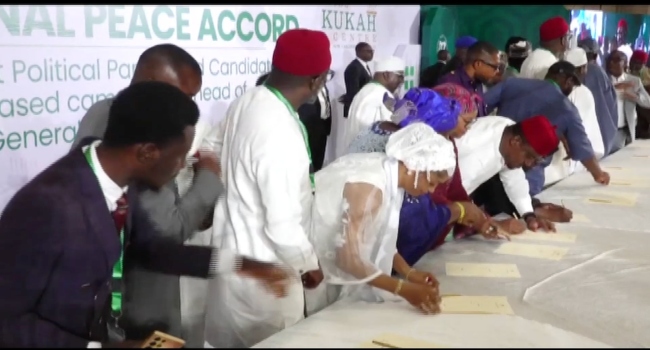
Political rivals commit to peaceful campaigns as INEC promises neutrality, while peace advocates demand credible elections, issue-based politics and greater citizen participation ahead of Nigeria’s 2027 polls.
By John Ishaku
ABUJA, Nigeria — August 19, 2026
Nigeria’s political class has renewed its pledge to pursue a peaceful and credible electoral process ahead of the 2027 general elections, with President Bola Ahmed Tinubu, Labour Party presidential contender Peter Obi, African Action Congress candidate Omoyele Sowore and other political actors endorsing a peace accord designed to prevent violence before, during and after the polls.
The accord was signed in Abuja on Tuesday, August 18, 2026, one day before the commencement of campaigns for the presidential and National Assembly elections.
President Tinubu, who was represented at the ceremony by Secretary to the Government of the Federation, George Akume, joined representatives of other presidential candidates, political parties, governorship and National Assembly contestants, electoral officials and senior political leaders at the ceremony.
The event, held at the Bola Ahmed Tinubu International Conference Centre in Abuja, was organised by the National Peace Committee (NPC), which has facilitated similar political agreements in previous election cycles.
The initiative is intended to establish minimum standards for political conduct and discourage violence, inflammatory rhetoric, intimidation, misinformation and other actions capable of undermining Nigeria’s democratic process.
Peace Accord Puts Political Conduct Under Scrutiny
The 2027 peace initiative comes at a politically sensitive moment, with major parties already positioning themselves for what is expected to be one of Nigeria’s most closely contested presidential elections.
The first phase of the accord was signed before the commencement of campaigns, while the second phase is expected to take place after the elections.
The significance of the agreement, however, will ultimately depend not on the ceremony itself but on whether candidates, political parties and their supporters honour its provisions when electoral competition becomes more intense.
Nigeria has repeatedly witnessed political violence, inflammatory campaign rhetoric, allegations of vote-buying, intimidation and disputes over electoral outcomes. Previous peace agreements have helped establish a framework for restraint, but enforcement has often remained a major challenge.
The 2027 accord therefore places renewed attention on whether political actors are prepared to subordinate personal and partisan ambitions to national stability.
Obi Demands Elections Where Votes Will Count
Peter Obi, former Anambra State governor and presidential candidate of the Labour Party, used the occasion to demand an electoral process in which Nigerians can trust that their votes will determine the outcome.
Obi said his principal concern going into the 2027 election was not personal fear but the need to ensure that Nigerian voters are allowed to exercise their constitutional rights without manipulation.
“I don’t have any fear [going into next year’s election] except to say that, please, for the sake of the children of Nigeria, can we have an election where people’s votes will count?” he said.
The former governor also proposed a direct political consequence for candidates who violate the peace agreement.
Asked what punishment should apply to politicians who breach the accord, Obi said Nigerians should deny such politicians their votes.
“Well, the punishment is that Nigerians should not vote for them,” he said.
His position places considerable responsibility on voters, suggesting that electoral accountability should extend beyond INEC and include citizens who ultimately determine which political actors gain access to public office.
Obi also urged contestants to demonstrate exemplary conduct.
“You can’t answer ‘His Excellency’ without being an excellent person,” he said, arguing that the political process through which candidates acquire public office must itself reflect integrity and responsibility.
Tinubu: Elections Must Not Become a Do-or-Die Contest
President Tinubu, through SGF George Akume, endorsed the principles of the peace accord and praised the National Peace Committee for sustaining the initiative since 2014.
The President specifically recognised the contributions of former Head of State Abdulsalami Abubakar, Sultan of Sokoto Muhammad Sa’ad Abubakar and Catholic Bishop Matthew Hassan Kukah in promoting peaceful political engagement.
Tinubu argued that improvements in electoral technology, particularly the Bimodal Voter Accreditation System (BVAS), had strengthened the credibility of elections by making certain forms of electoral malpractice more difficult.
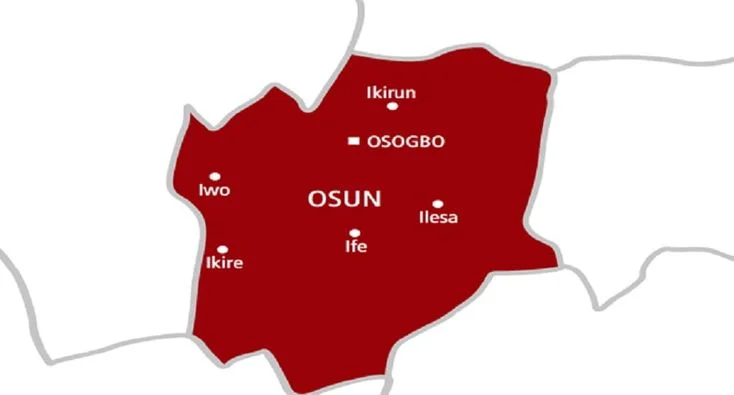
He cited recent off-cycle governorship elections in Anambra, Osun and Ekiti as examples of elections in which different political parties emerged victorious.
According to the President, the outcomes of those elections demonstrated that Nigeria’s electoral process was becoming more competitive and transparent.
He further argued that transparent electoral processes could reduce post-election litigation because candidates and political parties would have greater confidence in the integrity of election results.
The President said politicians were becoming more accountable to voters because electoral technology had strengthened the ability of citizens to influence outcomes.
However, the claims also place pressure on electoral institutions and political actors to ensure that technological safeguards translate into broader improvements in electoral credibility.
Tinubu reaffirmed the commitment of the All Progressives Congress to the peace accord and condemned electoral violence, hate speech, misinformation and incitement through social media.
“Let us remember that elections are not a do-or-die affair. We are partners in the project of nation-building. Win or lose, our country, Nigeria, must be the ultimate winner,” he said.
INEC Promises Neutrality Ahead of 2027
The Independent National Electoral Commission used the ceremony to restate its neutrality and commitment to conducting the 2027 elections without favouring any candidate or political party.
INEC Chairman, Professor Joash Amupitan, said the commission had no preferred candidate or political platform.
“INEC has no interest in who wins or loses any election. The commission does not have a candidate, nor does it favour any political platform,” Amupitan said.
The declaration is particularly significant because public confidence in the electoral umpire remains one of the central factors determining whether election results are accepted by competing parties.
Amupitan urged politicians to transform the 2027 campaign into a contest of policy proposals rather than personal attacks.
“Let the 2027 election campaign be a marketplace of ideas, not a theatre of war,” he said.
According to the INEC chairman, Nigerians were less interested in insults and political hostility than in concrete solutions to the country’s economic and social problems.
“Nigerians do not want insults; they want solutions. They deserve to hear clear, concrete, and measurable manifestos,” he said.
1.4 Million Electoral Personnel Expected
INEC also disclosed the scale of the logistical operation required for the 2027 elections.
Amupitan said preparations were progressing, with the commission planning for a nationwide ad hoc workforce of approximately 1.4 million personnel across more than 176,000 polling units.
The figures illustrate the enormous administrative challenge facing the electoral body.
Beyond technology, the credibility of the election will depend on the recruitment, training and deployment of election officials; the security of sensitive materials; accessibility of polling units; transmission and collation of results; effective dispute resolution; and the ability of institutions to respond rapidly to electoral incidents.
The scale of the operation also means that electoral integrity cannot depend solely on INEC headquarters in Abuja. State-level structures, local government officials, security agencies, political parties, civil society organisations, observers and voters will all have significant roles to play.
Kukah: Citizens Must See Improvements in Their Lives
Bishop Matthew Hassan Kukah, a leading member of the National Peace Committee, broadened the discussion beyond electoral peace to the quality of governance Nigerians receive after elections.
Speaking before the signing ceremony, Kukah argued that elections should produce measurable improvements in the lives of ordinary citizens.
“Ordinary Nigerians need to see a qualitative and measurable improvement in the quality of their lives. We are not just handing you our votes, and then you take the votes and run with them,” he said.
His argument highlights a recurring problem in Nigeria’s democratic system: the tendency for political accountability to focus heavily on election day while paying insufficient attention to governance between elections.
For many citizens, the real test of democracy is not merely whether ballots are cast peacefully but whether elected officials subsequently deliver public services, protect citizens’ rights, create economic opportunities and manage public resources responsibly.
Kukah also cautioned against placing the entire burden of electoral credibility on INEC.
He called for greater public awareness and participation, stressing that ordinary Nigerians have an important role in ensuring that elections are credible.
“I think that critical to all of this is the need to sensitise ordinary citizens. I think we often underrate the capacity of the ordinary citizen,” he said.
The Enforcement Question
While the signing of the peace accord represents an important political signal, its effectiveness will ultimately depend on enforcement.
The key question is what happens when a candidate or political party allegedly breaches the agreement.
A peace accord can establish principles, but without credible consequences, compliance may depend largely on political goodwill.
Obi’s suggestion that voters should punish violators at the ballot box provides one possible mechanism: electoral accountability.
But voter sanctions alone may not address acts of violence, intimidation, incitement or electoral malpractice that occur before citizens reach the polling booth.
The effectiveness of the 2027 peace framework will therefore depend on the combined actions of INEC, security agencies, courts, political parties, candidates, civil society groups, traditional and religious leaders and, ultimately, voters.
Technology Alone Cannot Guarantee Electoral Integrity
The emphasis on BVAS and other technological improvements also raises a broader issue.
Electoral technology can strengthen voter accreditation and reduce certain forms of manipulation, but technology cannot independently eliminate political violence, inducement of voters, intimidation, misinformation, abuse of state resources or interference with election officials.
Nor can technology determine whether political parties respect campaign rules.
A credible election therefore requires more than functional machines and digital systems. It requires institutional independence, transparent procedures, competent personnel, security neutrality, credible dispute-resolution mechanisms and political actors willing to accept legitimate outcomes.
The real test for the 2027 election will be whether these components work together effectively.
Campaigns Shift Political Contest Into Full Gear
With campaigns for the presidential and National Assembly elections beginning, the peace accord now moves from symbolism to implementation.
Political parties are expected to sell their policies and programmes to voters while resisting the temptation to exploit ethnic, religious, regional or socioeconomic divisions.
For the electorate, the coming campaign period presents an opportunity to demand measurable commitments from candidates on issues including economic growth, unemployment, insecurity, education, healthcare, infrastructure, corruption, energy and the cost of living.
The National Peace Committee’s call for restraint will therefore be tested against the realities of a highly competitive political environment.
What the 2027 Peace Accord Means for Nigerians
The agreement provides a framework for political actors to commit themselves publicly to peaceful engagement.
But the ultimate responsibility for a credible election cannot be delegated entirely to politicians or INEC.
Political parties must discipline their members. Candidates must control their supporters. Security agencies must remain professional and impartial. INEC must demonstrate operational independence. Courts must resolve electoral disputes efficiently and transparently. Civil society must monitor compliance. And voters must be prepared to reject candidates who undermine democratic standards.
The agreement is therefore best understood as a starting point rather than a guarantee.
From Signing Ceremony to Democratic Accountability
Nigeria’s 2027 election will test whether the country’s political system has moved beyond the recurring cycle of election-season promises and post-election disputes.
The peace accord signed by Tinubu, Obi, Sowore and other political actors provides an opportunity to establish a different standard of political competition—one based on issues rather than violence, persuasion rather than intimidation, and accountability rather than impunity.
But the credibility of the agreement will not be measured by the number of politicians who sign it or the speeches delivered at the Abuja ceremony.
It will be measured in polling stations across Nigeria.
If candidates respect the rules, if INEC maintains neutrality, if security agencies protect voters without partisan interference, if citizens can vote freely and if political actors accept legitimate outcomes, the accord could become an important instrument for democratic consolidation.
If violations occur without consequences, however, the document risks becoming another political pledge whose significance ends when the campaign begins.
For Nigeria, the real challenge is therefore clear: turn the peace accord from a signed document into enforceable political behaviour—and ensure that, in 2027, the ultimate winner is not merely a candidate or party, but the Nigerian electorate.




Leave a Reply