
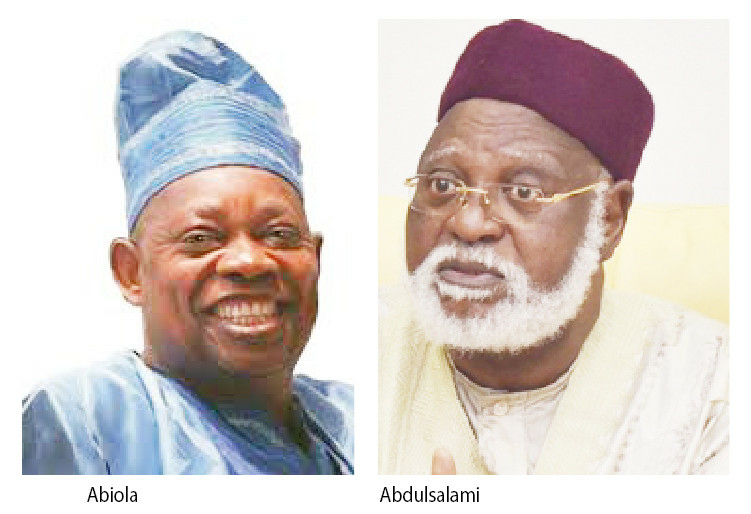
Former Military Ruler Opens Up on Succession Crisis, June 12 Dilemma, Abacha’s Final Plans and Nigeria’s Fragile Transition to Democracy
By Baron Eloagu
ABUJA, Nigeria — June 15, 2026
Former Head of State, General Abdulsalami Abubakar (rtd), has offered one of the most revealing accounts yet of the political intrigues, military power struggles, and constitutional uncertainties that followed the sudden death of General Sani Abacha in June 1998, disclosing that the transition to democracy—and the question of whether Chief Moshood Kashimawo Olawale (MKO) Abiola should immediately assume the presidency—was far more complicated than many Nigerians understood at the time.
In excerpts from his newly released autobiography, Call to Duty, Abdulsalami recounts how Abacha was preparing a major shake-up of Nigeria’s military leadership before his unexpected death, a development that could have abruptly ended Abdulsalami’s own military career.
The former military ruler also sheds fresh light on the fierce succession battles that erupted within military circles after Abacha’s death and explains why demands by pro-democracy activists to install Abiola as president presented challenges that extended beyond public sentiment and political symbolism.
Abacha’s Final Military Reshuffle Before Death
According to Abdulsalami, on June 7, 1998—just one day before Abacha died—the late military ruler summoned him for discussions regarding changes within the military high command.
Abacha reportedly requested recommendations for new Service Chiefs as part of an impending restructuring.
However, Abdulsalami declined to make suggestions, reminding the Head of State that previous advice he had offered on military appointments had been ignored.
The discussion took an unexpected turn when Abacha began nominating officers himself before asking who should replace Abdulsalami as Chief of Defence Staff.
For Abdulsalami, the message was unmistakable.
The question suggested that his retirement after nearly 35 years of military service was imminent.
“I knew immediately what that meant,” Abdulsalami recalled. “There was no other interpretation.”
Ironically, less than 24 hours later, Abacha was dead.
The Morning Nigeria Changed Forever
Abdulsalami narrated how he received an emergency summons to the Presidential Villa on the morning of June 8, 1998.
Initially believing he was being dispatched to represent Nigeria at an ECOWAS summit in Togo, he hurriedly left home wearing a tracksuit and slippers.
Upon arriving at the Villa, he met Major-General Ishaya Bamaiyi.
The two officers soon realised they had been locked inside a waiting room.
Moments later, then Inspector-General of Police Ibrahim Coomassie arrived with shocking news.
General Sani Abacha was dead.
The announcement instantly plunged Nigeria into uncertainty.
Abdulsalami said he immediately joined other top government officials, including then Chief Justice of Nigeria Justice Muhammadu Uwais and senior government figures, to determine how the country could avoid a constitutional vacuum.
Battle for Power Begins
While preparations were underway for Abacha’s burial in Kano, Abdulsalami revealed that influential figures within what he described as an “inner caucus” were already manoeuvring to install their preferred successor.
According to him, some power brokers attempted to exploit the confusion surrounding Abacha’s death to orchestrate an alternative succession arrangement.
He credited then Chief of Naval Staff Admiral Mike Akhigbe and Major-General Sarki Mukhtar with preventing what could have become an unconstitutional transfer of power.
“They frustrated attempts to impose a preferred candidate,” he wrote.
Abdulsalami disclosed that some senior officers lobbied for Major-General Ishaya Bamaiyi to become Head of State.
However, he rejected the proposal.
Eventually, a vote within the Provisional Ruling Council narrowed the contest to Abdulsalami and Lt-General Jeremiah Useni.
Abdulsalami emerged victorious.
Why Abiola’s Presidency Was Not Straightforward
One of the most significant revelations in the memoir concerns the controversy surrounding the June 12, 1993 presidential election won by Chief MKO Abiola.
Abdulsalami acknowledged that many Nigerians expected his administration to immediately release Abiola and install him as president.
However, he argued that the reality was far more complicated.
Following Abacha’s death, leaders of the National Democratic Coalition (NADECO) demanded that Abiola be released and sworn in as president.
During a meeting at the Presidential Villa on June 29, 1998, prominent pro-democracy figures including Chief Abraham Adesanya, Chief Bola Ige, Chief Ayo Adebanjo and Chief Ayo Opadokun reportedly insisted that there could be no genuine democratic transition without recognising Abiola’s mandate.
Yet Abdulsalami said multiple political interests were pulling in different directions.
According to him, several politicians who publicly supported Abiola had simultaneously participated in Abacha’s political transition programme.
Additionally, members of the National Assembly elected under that same transition framework opposed any move to invalidate their own mandates while validating Abiola’s.
This created a constitutional and political dilemma.
“Releasing Abiola and making him President was not going to be as smooth and easy as many imagined,” Abdulsalami stated.
Nigeria on the Brink
The former military ruler painted a grim picture of the nation he inherited in June 1998.
Politically, Nigeria faced deep divisions following years of military rule.
Within the armed forces, tensions remained high due to the detention and convictions of officers linked to the alleged Diya coup plot.
Economically, the situation was equally troubling.
Nigeria’s refineries were largely non-functional.
Fuel shortages persisted across the country.
Government obligations exceeded $3 billion while crude oil prices traded below $10 per barrel.
Multiple exchange-rate systems fuelled corruption and economic distortions.
At the same time, unrest in the Niger Delta was escalating.
Abdulsalami described the period as one of the most delicate moments in Nigeria’s post-independence history.
How Democracy Was Eventually Restored
Despite enormous pressures, Abdulsalami initiated consultations with pro-democracy groups, political leaders, traditional rulers and international stakeholders.
His administration eventually organised a transition programme that culminated in democratic elections and the inauguration of civilian rule in May 1999.
Former South African President Thabo Mbeki, who spoke at the launch of Abdulsalami’s autobiography, praised the former military ruler for resisting the temptation to remain in power.
Mbeki described Abdulsalami’s decision to hand over power within eleven months as an act of statesmanship that helped stabilise Nigeria.
Former President Olusegun Obasanjo similarly commended Abdulsalami for guiding the country through one of its most difficult political transitions and laying the groundwork for the Fourth Republic.
June 12 Legacy Still Shapes Nigeria
Nearly three decades after the annulment of the June 12 election, Abdulsalami’s revelations provide fresh insight into the political calculations, military rivalries and constitutional complexities that shaped Nigeria’s return to democracy.
His account also highlights why the struggle for democratic governance extended beyond the simple question of electoral victory and involved difficult negotiations among competing political interests, military institutions and constitutional realities.
As Nigeria continues to celebrate June 12 as Democracy Day, the memoir serves as a reminder that the nation’s democratic journey was neither inevitable nor straightforward—but the product of difficult choices made during one of its most turbulent periods.
Abdulsalami Abubakar’s memoir offers a rare insider account of the dramatic events that followed General Sani Abacha’s death and reveals why the immediate installation of MKO Abiola was far more politically complex than many Nigerians believed. The disclosures illuminate a critical chapter in Nigeria’s democratic evolution and underscore the delicate balancing act that ultimately led to the restoration of civilian rule in 1999.



Leave a Reply