
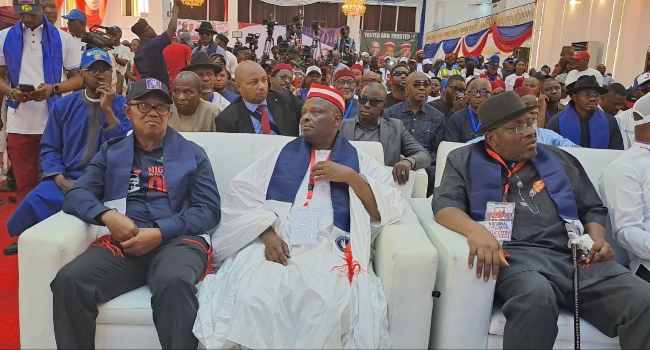
Opposition party says it has learnt hard lessons from the 2023 elections as it vows to stop political defectors and “portfolio politicians” from hijacking its platform ahead of 2027.
By Angela Udende / May 29, 2026
ABUJA, NIGERIA —The Nigeria Democratic Congress has declared that it will not allow political opportunists to exploit the popularity of Peter Obi and Rabiu Musa Kwankwaso to secure elective positions ahead of the 2027 general elections.
The party’s spokesperson, Osa Director, disclosed that the NDC had adopted stricter screening mechanisms for aspirants following lessons learnt from the 2023 election cycle, during which several little-known politicians allegedly rode on the popularity of opposition figures to gain office before defecting to the ruling All Progressives Congress.
The development signals growing anxiety within opposition circles over political loyalty, ideological consistency, and the increasing culture of post-election defections in Nigeria’s political landscape.
NDC Says 2023 Political Experience Was A Wake-Up Call
Speaking during an appearance on Channels Television’s Sunrise Daily programme, Osa Director said the party had become more cautious about individuals seeking tickets merely to capitalise on rising opposition popularity.
According to him, the NDC noticed a surge of aspirants — particularly Nigerians in the diaspora and first-time political entrants — rushing to obtain nomination forms under the party’s platform.
“We have learnt from the incident of the past that happened in the Labour Party,” Director stated.
“A lot of people, especially people from the diaspora who have never participated in politics, rushed to get a form under the platform of the Nigeria Democratic Congress.”
He suggested that many aspirants viewed the NDC as an emerging political force capable of replicating the momentum generated by Obi and Kwankwaso during the 2023 elections.
The ‘Obi Effect’ And Kwankwaso Influence
Political analysts say the remarkable performances of Peter Obi and Rabiu Musa Kwankwaso in the 2023 presidential election reshaped Nigeria’s political calculations and weakened the traditional dominance of the country’s two major parties.
Peter Obi, who contested under the Labour Party, attracted massive youth support and urban voter mobilisation through the widely popular “Obidient Movement.”
Similarly, Rabiu Musa Kwankwaso strengthened the national visibility of the New Nigeria Peoples Party through his grassroots “Kwankwasiyya” political structure.
Their growing popularity encouraged many political newcomers to join the two parties shortly before the elections.
However, several elected officials later defected to the ruling APC, triggering accusations that some politicians merely used the opposition parties as temporary electoral vehicles.
NDC Promises Tougher Screening Process
Determined to avoid a repeat of that scenario, the NDC said it would rigorously investigate the background, political history, and commitment level of every aspirant seeking the party’s ticket.
“So, flowing from that experience, the NDC has also told all the aspirants that it is not going to be business as usual,” Director said.
“We are going to check your pedigree.”
According to him, aspirants lacking verifiable political credibility or ideological alignment with the party’s values would not be allowed to contest under the NDC platform.
“If you don’t have a verifiable pedigree and commitment to the party, to the principles and values that the party is espousing, then you are not going to pick a ticket and fly the flag of the NDC,” he added.
The party insists the measures are aimed at building a stronger, more ideologically stable opposition movement capable of surviving beyond electoral cycles.
Fear Of Political Defections Ahead Of 2027
The issue of political defections has become one of the most contentious concerns in Nigeria’s democratic process.
Since the 2023 elections, dozens of lawmakers and elected officials have switched political allegiance, often citing internal party crises, political survival, or strategic realignments.
Critics argue that the trend weakens opposition parties, undermines voter trust, and reduces ideological accountability in governance.
Civil society organisations have repeatedly called for constitutional reforms that would make defections more difficult, especially for elected officials who gained office under a party’s platform.
The NDC’s latest position appears designed to reassure supporters that the party intends to avoid becoming another temporary political shelter for ambitious politicians.
Opposition Politics Intensifying Ahead Of 2027
The comments by the NDC spokesman come amid growing political manoeuvring ahead of the 2027 presidential election.
Opposition parties are increasingly attempting to position themselves as credible alternatives to the ruling All Progressives Congress amid widespread public dissatisfaction over economic hardship, inflation, insecurity, and governance concerns.
Political observers believe that the next election cycle may witness:
- New opposition coalitions
- Realignment of political blocs
- Increased youth participation
- Fierce competition for influential political figures
- Strategic recruitment of defectors and technocrats
However, analysts also warn that opposition parties risk internal instability if ideological discipline and loyalty mechanisms are not strengthened early enough.
Questions Over Internal Democracy
While the NDC’s tougher screening policy may strengthen party discipline, some political analysts caution that stricter controls could also raise concerns over transparency and internal democracy.
Observers say opposition parties must strike a balance between preventing opportunism and ensuring open participation for genuine newcomers seeking political change.
The party, however, maintains that its new approach is necessary to protect its long-term credibility.
According to Director, the NDC intends to build what he described as “a vibrant alternative platform” capable of offering Nigerians a sustainable political option.
As Nigeria’s political landscape gradually shifts toward the 2027 general elections, the Nigeria Democratic Congress appears determined to avoid the mistakes that weakened opposition parties after the 2023 polls.
By tightening its screening process and warning against political opportunism, the party is signalling an attempt to build a more disciplined and ideologically consistent political structure.
Whether the strategy succeeds may ultimately depend on the NDC’s ability to balance loyalty, competence, internal democracy, and public trust in an increasingly volatile political environment.









Leave a Reply