
Military launches investigation after $109 million stealth fighter goes down near Marine Corps Air Station Miramar, raising renewed focus on aviation safety and the reliability of advanced combat aircraft.
By A1NEWS International
SAN DIEGO, California — August 1, 2026
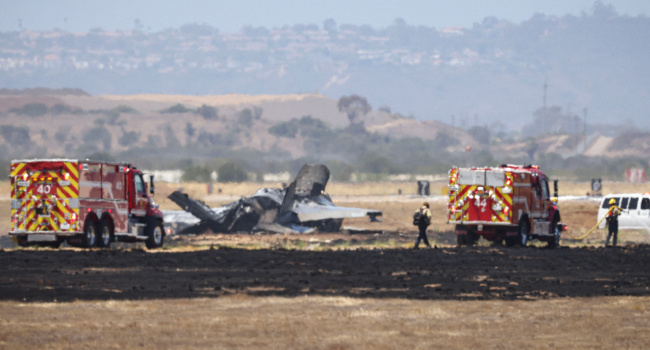
The United States military has launched an investigation after a Marine Corps F-35B Lightning II stealth fighter jet crashed near Marine Corps Air Station (MCAS) Miramar in San Diego, California, with the pilot ejecting safely moments before impact.
The incident, which occurred around 10:00 a.m. local time (1700 GMT) on Friday, has renewed scrutiny over the operational safety and maintenance of one of the world’s most sophisticated and expensive combat aircraft. While the pilot survived with non-life-threatening injuries, the crash marks another setback for the F-35 programme, a cornerstone of U.S. and allied military air power.
Military authorities have yet to determine the cause of the crash, while investigators are expected to examine flight data, aircraft systems, maintenance records and environmental conditions.
Pilot Ejects Safely Before Impact
Officials at Marine Corps Air Station Miramar confirmed that the aircraft was involved in what they described as an “aviation mishap” in the vicinity of the military installation.
According to the base’s spokesperson, the pilot successfully activated the aircraft’s emergency ejection system before the jet crashed.
The pilot was quickly recovered by emergency responders and transported to a nearby medical facility.
In a subsequent statement, military officials confirmed that the aviator remained in stable condition and was receiving treatment for non-life-threatening injuries.
The military has not released the pilot’s identity, pending standard operational procedures.
Emergency Response Mobilised
Shortly after the crash, emergency crews, including firefighters and rescue personnel, were deployed to the crash site to contain the resulting fire and secure the area.
Videos circulating on social media showed thick black smoke rising from the wreckage as firefighters battled the flames.
Authorities established a security perimeter around the crash scene while military investigators began documenting evidence.
No civilian casualties or injuries have been reported.
Officials also said there were no immediate reports of damage to nearby civilian infrastructure.
Investigation Underway
The U.S. Marine Corps has initiated an official investigation to determine what caused the aircraft to go down.
Military aviation investigations typically examine several factors, including:
- Mechanical failure.
- Engine performance.
- Flight control systems.
- Weather conditions.
- Pilot actions.
- Maintenance history.
- Possible manufacturing defects.
Investigators are expected to recover the aircraft’s onboard recording systems and analyse maintenance logs before issuing preliminary findings.
The Marine Corps has not indicated how long the investigation is expected to take.
Understanding the F-35B Lightning II
The aircraft involved in the incident is the F-35B Lightning II, one of three variants of the fifth-generation F-35 stealth fighter developed by Lockheed Martin.
The F-35B is specifically designed for the U.S. Marine Corps and possesses Short Take-Off and Vertical Landing (STOVL) capability, allowing it to operate from:
- Amphibious assault ships.
- Short runways.
- Expeditionary bases.
- Remote operational environments.
According to Lockheed Martin, each F-35B carries an estimated price tag of approximately $109 million, making it one of the world’s most advanced—and costly—combat aircraft.
The aircraft combines stealth technology, advanced sensors, electronic warfare capabilities and network-centric operations to support a wide range of military missions.
Miramar’s Historic Military Legacy
The crash occurred near Marine Corps Air Station Miramar, one of America’s most prominent military aviation facilities.
The base gained worldwide recognition as the original home of the U.S. Navy’s elite “Top Gun” Fighter Weapons School, popularised by the 1986 Hollywood film Top Gun, starring Tom Cruise.
Today, Miramar serves as a major operational base for Marine Corps aviation units and hosts numerous training exercises involving advanced combat aircraft.
Its strategic location makes it a vital component of U.S. military readiness along the Pacific Coast.
Growing Focus on Military Aviation Safety
Although military aircraft operate under demanding conditions, aviation accidents involving advanced fighter jets continue to attract close public and congressional scrutiny because of their operational significance and high financial cost.
Defence analysts note that while the F-35 programme has significantly enhanced combat capabilities for the United States and allied nations, each accident prompts renewed examination of:
- Fleet maintenance.
- Pilot training.
- Aircraft reliability.
- Operational readiness.
- Long-term sustainment costs.
The outcome of the investigation could influence future maintenance procedures and safety protocols across Marine Corps aviation units.
No Immediate Impact on Operations Announced
As of the time of this report, the U.S. Marine Corps had not announced any temporary grounding of the F-35B fleet.
Military authorities also have not indicated whether the crash was linked to technical issues affecting other aircraft of the same type.
Defence officials are expected to provide further updates once preliminary findings become available.
The crash of a U.S. Marine Corps F-35B near San Diego underscores the inherent risks associated with operating some of the world’s most technologically advanced military aircraft.
While the pilot’s successful ejection prevented a potential loss of life, the destruction of a multi-million-dollar stealth fighter has once again drawn attention to military aviation safety, aircraft reliability and the importance of rigorous investigative procedures.
As investigators work to determine the cause of the incident, defence observers around the world will closely monitor the findings for their potential implications on one of the most sophisticated fighter programmes in modern military history.













Leave a Reply