
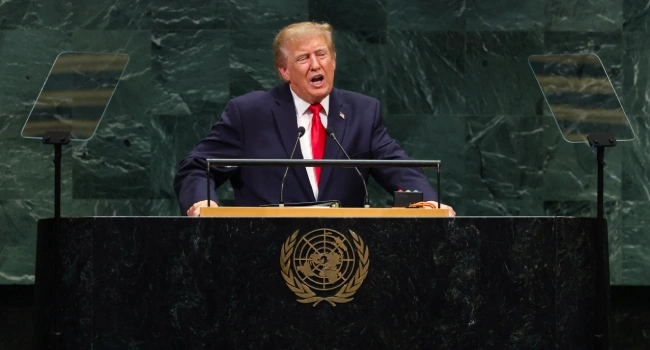
U.S. President tells UNGA the ICC is a “rogue institution,” vows to oppose any probes of Americans by the court, while simultaneously pushing a new U.S. term for artificial intelligence amid global calls for binding AI safety rules
By A1NEWS International
NEW YORK, United States — Tuesday, September 22, 2026 — U.S. President Donald Trump has called on all nations that are members of the International Criminal Court (ICC) to quit the court immediately, describing the institution as “out of control.”
Speaking at the 81st United Nations General Assembly (UNGA) in New York, Trump said Washington opposed the ICC as an “out-of-control institution,” warning that the United States would never allow Americans, including service members, to be subjected to investigations or “show-trials” by what he called an anti-American tribunal.
At the same UNGA session, Trump also announced that the U.S. government will rename artificial intelligence in official communications as “super intelligence,” as world leaders intensified debate over the risks and governance of rapidly advancing AI systems.
Trump Calls ICC “Rogue” and Demands Mass Resignation
Trump told the UNGA that the United States is opposed to the ICC, which he characterised as a “rogue institution.”
He urged ICC member countries to formally resign from the court, asserting that Washington views the ICC as lacking jurisdiction to probe Americans or close U.S. allies.
Trump said the U.S. would not permit investigations of U.S. service members or anyone else by an “anti-American tribunal with no jurisdiction over us.”
The U.S. is not an ICC member and has never ratified the Rome Statute that established the court. Israel, Russia and China are also not members.
Rubio Vows to “Dismantle” the Court Over Sovereignty Concerns
The remarks came as U.S. diplomacy remains locked in confrontation with the ICC. Earlier, U.S. Secretary of State Marco Rubio said Washington would dismantle the ICC “brick by brick,” calling the tribunal an “intolerable threat” to U.S. sovereignty.
Washington has also imposed sanctions on ICC officials, according to reporting referenced in the statement, after the court issued an arrest warrant for Israel’s Prime Minister Benjamin Netanyahu, an ally of the United States.
Trump Renames AI as “Super Intelligence,” Rejects Global Regulation
While the ICC debate dominated much of the political framing at the UN, Trump pivoted to a separate controversy—AI governance—calling for resistance to what he described as attempts to control AI through global arrangements.
He said the term “super intelligence” “sounds much better” and is “more accurate,” arguing that the word “artificial” understates the technology’s significance.
Trump further rejected efforts to create a global oversight framework for AI, saying the U.S. rejects attempts to build a “globalist scheme” to control AI. He also drew comparisons between AI safety warnings and earlier climate change narratives, portraying fears of AI as alarmist.
Global Pressure Mounts for Binding AI Safety Standards
Ahead of and during the UN meetings, leaders—particularly from parts of Europe—called for binding safety measures, warning that AI development could move faster than human systems for control and governance.
Major AI powers China and the United States did not endorse the idea of binding rules in the same way, according to the reporting referenced.
Meanwhile, U.S.-based AI companies have increasingly signalled interest in international coordination on AI safety, and OpenAI’s Sam Altman is set to address the UN Security Council on Wednesday, alongside other senior AI figures participating remotely.
Macron Calls for Open-Source AI Not Dominated by Great Powers
French President Emmanuel Macron told the UNGA that Europe should pursue AI development independent of the major powers, warning against dependency and “vassal” dynamics in technological leadership.
Macron proposed pooling investment capabilities to build a cutting-edge open-source AI model that countries could share—arguing that reliance on one outside power would undermine long-term strategic autonomy.
UN Chief Urges Dialogue on AI, Cites Shared Existential Risks
UN Secretary-General Antonio Guterres urged the U.S. and China to begin dialogue on AI governance, describing it as necessary at a time when existential risks require communication channels.
He compared the moment to Cold War dynamics, when rivals recognised the need to manage shared threats, saying governments with the greatest AI capabilities also carry the greatest responsibility to establish dialogue mechanisms.
China and the U.S. are reportedly discussing a communications channel for AI concerns ahead of a potential summit meeting between Trump and Chinese President Xi Jinping on Thursday.
From the rostrum of the UNGA, President Donald Trump delivered two high-stakes messages: a direct push for ICC member states to abandon the court, and a parallel push for U.S. rebranding of AI as “super intelligence,” while resisting international regulation.
As European leaders and UN officials argue for stronger AI safety governance and diplomatic dialogue between major AI powers, the U.S. continued to signal that sovereignty and technology framing will remain central to its approach at the global stage.








Leave a Reply