
Regional rights watchdogs warn that weak institutional independence, inadequate funding, shrinking civic space and persistent justice gaps could undermine democracy and human rights across the ECOWAS region
By A1NEWS International
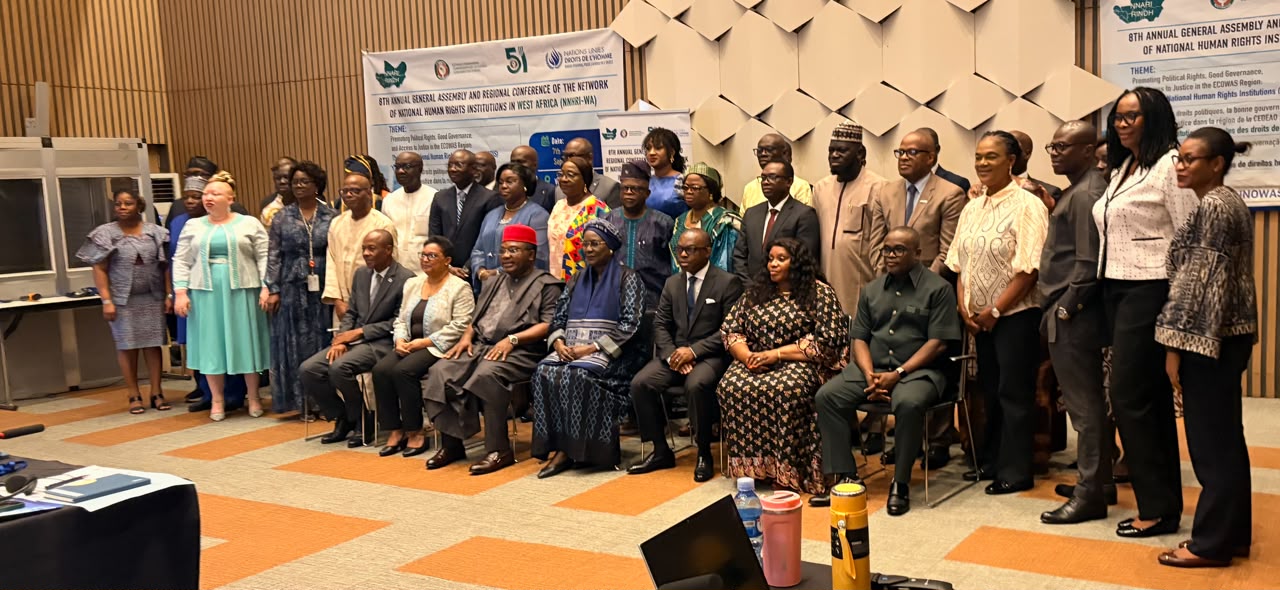
ABIDJAN, Côte d’Ivoire — Sept. 8, 2026: The Network of National Human Rights Institutions in West Africa (NNHRI-WA) has called for urgent strengthening of national human rights institutions across the sub-region, warning that inadequate institutional independence, funding constraints, insecurity, shrinking civic space and barriers to justice are increasingly testing West Africa’s democratic and human-rights architecture.
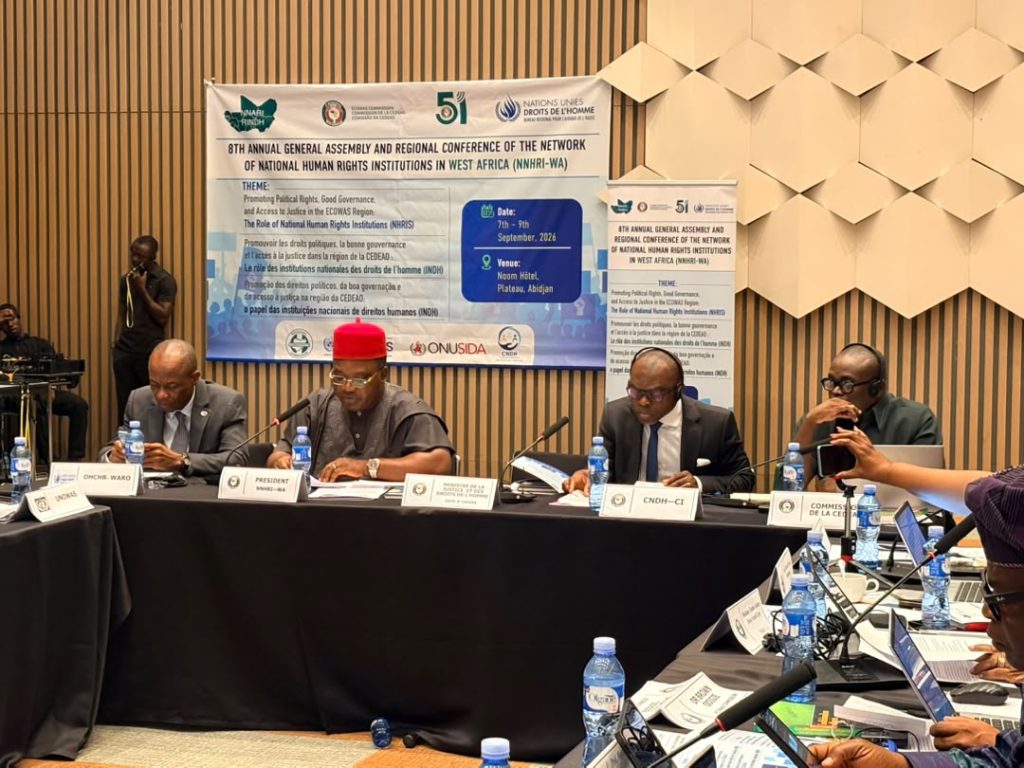
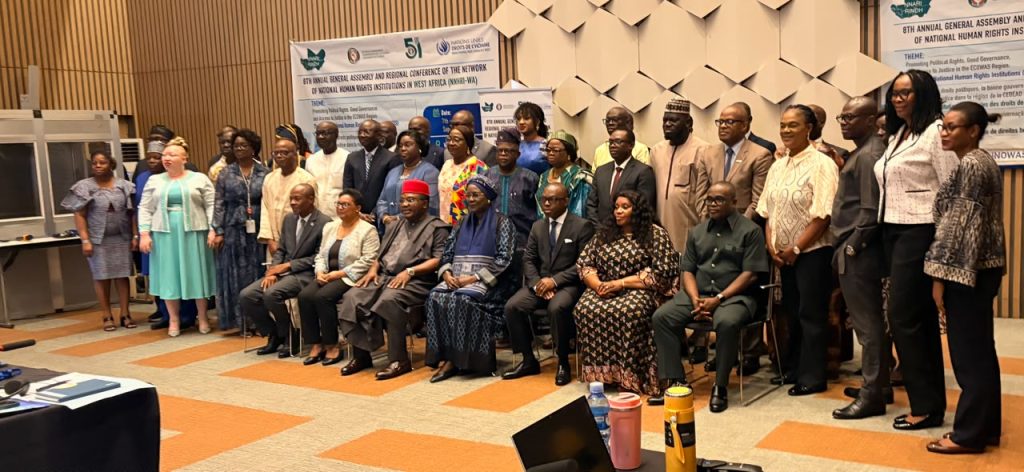
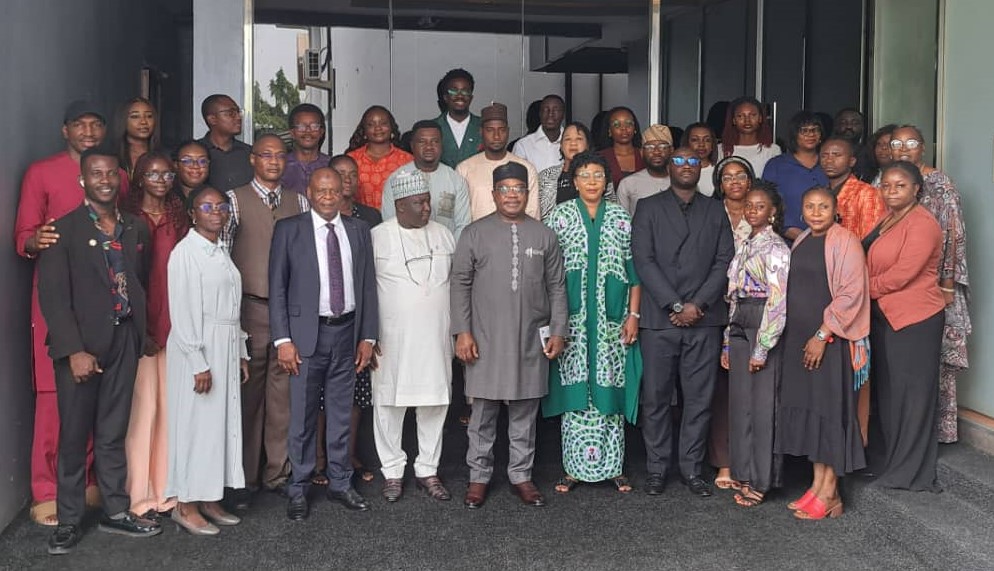
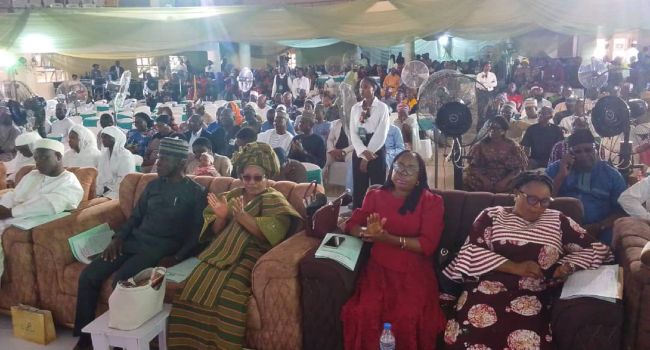
The call came at the conclusion of the Network’s Eighth Regional Conference and Annual General Assembly, held in Abidjan from September 7 to 8, where representatives of 12 National Human Rights Institutions (NHRIs), alongside regional and international partners, examined the state of human rights, democracy, justice and governance across the ECOWAS region.
The conference was hosted by the Commission Nationale des Droits de l’Homme de Côte d’Ivoire (CNDH-CI) with support from the ECOWAS Commission, OHCHR-WARO, UNOWAS and UNAIDS.
Participating institutions came from Benin, Cabo Verde, Côte d’Ivoire, The Gambia, Ghana, Guinea-Bissau, Liberia, Mali, Nigeria, Senegal, Sierra Leone and Togo.
At the heart of the conference was a question with significant implications for West Africa’s democratic future: Can national human rights institutions effectively protect citizens when the institutions themselves face financial, political and operational constraints?
From reaction to prevention
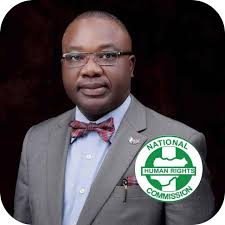
Declaring the conference open, NNHRI-WA President and Executive Secretary of Nigeria’s National Human Rights Commission, Dr. Tony Ojukwu, OFR, SAN, argued that human rights protection could no longer be confined to responding to violations after they had occurred.
He described human rights, democracy, development, peace and good governance as mutually reinforcing pillars, while acknowledging that progress in democratic governance across the region has been accompanied by serious setbacks.
Among the challenges highlighted were unconstitutional changes of government, violent extremism, poverty, displacement and declining public confidence in public institutions.
Ojukwu urged NHRIs to strengthen their preventive capacity by moving beyond conventional complaint-handling and post-violation interventions toward early warning, risk assessment, preventive monitoring and coordinated action.
That shift could prove particularly significant in a region where political instability, armed conflict, terrorism, forced displacement and governance crises increasingly intersect.
The institutional independence question
The conference’s call for stronger NHRIs comes against a broader challenge facing rights institutions: their ability to operate independently while depending on governments and public institutions for legal recognition, appointments and funding.
For NHRIs, independence is not merely an administrative issue. It can determine whether an institution is capable of investigating allegations involving government agencies, security forces, detention facilities and politically sensitive actors without fear or institutional retaliation.
NNHRI-WA therefore placed independence, adequate funding and stronger regional cooperation among its central priorities.
The objective, according to the conference, is to enable NHRIs to respond more effectively to violations while also developing mechanisms capable of identifying emerging threats before they escalate into major human-rights crises.
Detention crisis exposes justice-system weaknesses
One of the clearest areas of concern emerging from the conference was the condition of detention facilities and the continuing problem of prolonged pre-trial detention.
Almost all participating institutions reportedly identified prison overcrowding and prolonged remand detention as persistent problems.
The situation reported by Ghana was particularly striking, with remand overcrowding said to be above 130 per cent of capacity.
Ghana also highlighted the passage of a new Community Service Act, providing an alternative to incarceration for certain offenders and potentially reducing pressure on correctional facilities.
Nigeria reported the operation of its toll-free 6472 human-rights complaint line and the work of criminal justice committees aimed at identifying cases of wrongful detention.
Sierra Leone and Togo, meanwhile, reported nationwide prison-monitoring activities.
The regional picture suggests that prison overcrowding is not simply a correctional-services problem. It is closely linked to the efficiency of criminal justice systems, access to legal representation, judicial capacity, bail procedures and the length of time suspects remain in custody before trial.
Pre-trial detention: the hidden justice burden
Prolonged pre-trial detention raises a particularly difficult human-rights concern because individuals who have not been convicted may spend months or years in custody.
Beyond the immediate deprivation of liberty, prolonged detention can have economic and social consequences for detainees and their families.
The conference discussions therefore point toward the need for reforms extending beyond prison construction to include faster case processing, effective bail systems, legal aid, non-custodial sentencing and stronger judicial oversight of detention.
Elections and the protection of political rights
The conference also examined the role of NHRIs in safeguarding political rights throughout the electoral cycle.
The Gambia, Côte d’Ivoire and Senegal presented models involving NHRI participation in electoral monitoring, hate-speech tracking and voter education.
Delegates argued that political participation must extend beyond the formal right to vote.
They called for greater inclusion of women, young people, persons with disabilities and diaspora communities, groups that can face structural barriers to political participation.
The emphasis on hate-speech monitoring is particularly relevant as elections across the region increasingly take place in an environment shaped by social media, political polarisation and rapidly circulating misinformation.
For NHRIs, the challenge is to protect political rights without becoming political actors themselves — requiring credible methodologies, institutional neutrality and transparent reporting.
Business and human rights enters the mainstream
The conference also considered the growing relationship between economic activity and human rights.
Nigeria reported an amendment to the NHRC Act providing the Commission with an express mandate on business and human rights.
The development potentially broadens the scope of human-rights oversight beyond traditional government-related violations to include corporate activities and their effects on communities, workers and consumers.
Senegal reported that it was finalising a draft National Action Plan on Business and Human Rights, while The Gambia said it remained at an early stage following stakeholder consultations.
If implemented effectively, such frameworks could strengthen corporate accountability and provide clearer standards for preventing and addressing human-rights abuses connected to business operations.
However, the effectiveness of these initiatives will ultimately depend on enforcement, institutional capacity and the willingness of both governments and businesses to comply with human-rights obligations.
Free movement faces a reality check
Despite the long-standing ECOWAS commitment to regional integration and free movement, delegates identified continuing difficulties with intra-regional movement of people.
The concerns raise questions about the gap between regional protocols and their implementation at national borders.
For citizens of West Africa, restrictions or inconsistent enforcement of free-movement arrangements can affect employment, education, trade, family connections and access to services.
The issue also illustrates one of the recurring challenges confronting regional institutions: the existence of legal frameworks does not automatically guarantee their implementation on the ground.
Reparations remain unresolved
Another unresolved issue identified at the conference concerned eligibility and cut-off points in reparations processes.
Reparations programmes can become particularly contentious where governments attempt to determine who qualifies for compensation or other forms of redress following conflict, political violence or historical human-rights violations.
Questions about eligibility can leave victims excluded while disagreements over cut-off dates may generate new grievances within communities already affected by injustice.
The conference’s identification of these issues underscores the need for transparent criteria, accessible procedures and victim-centred approaches to transitional justice.
Climate change and migration add new pressures
The review of the 2025 Abuja Communique showed that NHRIs had made progress in areas including OPCAT detention monitoring, transitional justice, migration, climate change and election observation.
The inclusion of climate change and migration reflects an expanding understanding of human rights in West Africa.
Climate-related displacement, environmental degradation, resource competition and migration can create overlapping vulnerabilities, particularly for poor and marginalised populations.
For NHRIs, this means traditional human-rights monitoring increasingly has to intersect with environmental governance, displacement, public health, security and economic policy.
ECOWAS urged to strengthen institutional partnership
The ECOWAS Commission, represented by Mr. Ebenezer Asiedu, reaffirmed its commitment to placing human rights at the centre of the regional architecture and encouraged NHRIs to be bold and innovative.
OHCHR-WARO Regional Representative Mr. Robert Kotchani similarly stressed the importance of NHRIs in protecting vulnerable groups, including women, children and persons with disabilities.
The conference ultimately resolved to deepen peer learning, joint monitoring missions and engagement with ECOWAS, the African Union and the United Nations.
Such cooperation could help reduce duplication, improve information-sharing and enable NHRIs to respond collectively to cross-border human-rights challenges.
The bigger challenge: turning resolutions into results
The most consequential test for NNHRI-WA may not be the strength of its conference declarations but what happens after delegates return to their respective countries.
Regional human-rights conferences routinely generate recommendations. The harder task is translating those recommendations into legislation, funding, institutional reforms, investigations, prosecutions, compensation and measurable improvements in citizens’ lives.
The problems identified in Abidjan — overcrowded prisons, prolonged detention, political exclusion, insecurity, displacement, barriers to movement and weak accountability — are not new.
What remains critical is whether NHRIs can acquire the independence, resources and political space necessary to confront them effectively.
A test for West Africa’s democratic architecture
In his closing remarks, Ojukwu captured the central challenge when he said the legitimacy of NHRIs should be measured “not by the offices we occupy, but by the difference we make in the lives of ordinary citizens.”
That standard places the burden squarely on the institutions themselves, governments, regional bodies and international partners.
The Abidjan conference has placed institutional independence and preventive human-rights protection at the centre of West Africa’s regional agenda.
But stronger NHRIs will require more than declarations of support.
They will need predictable financing, operational independence, credible appointment processes, professional investigative capacity, access to detention facilities, protection for complainants and witnesses, transparent reporting and meaningful cooperation with courts, legislatures, civil society and regional institutions.
As West Africa confronts insecurity, political instability and growing pressure on civic space, the strength of its human-rights institutions could become an important indicator of the resilience of its democratic systems.
The Ninth Regional Conference and General Assembly of NNHRI-WA is scheduled to be convened in 2027, providing the Network with an opportunity to assess whether the commitments made in Abidjan have translated into measurable institutional and human-rights gains.







Leave a Reply