
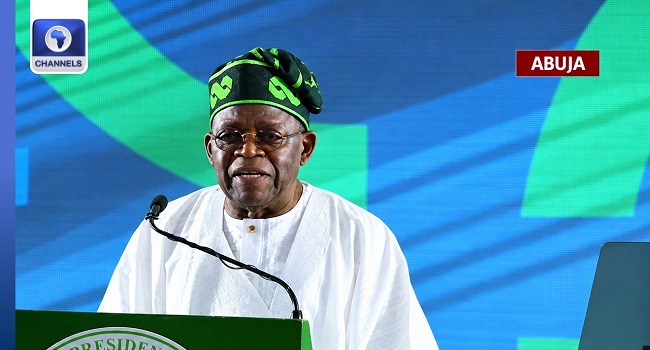
An administration-backed report cites billions of naira in funding, expanded student loans and teacher programmes. But the figures provided in a statement by APC spokesperson Dele Alake do not include underlying data, independent audits or clear measurement methods to verify the reported outcomes.
By A1NEWS International
ABUJA, Nigeria — Wednesday 05 / 11 / 2026
President Bola Tinubu’s administration says its education reforms have returned more than one million out-of-school children to learning and expanded support for students, teachers and institutions.
The figures were publicised by Dele Alake, spokesperson for the APC Presidential Campaign Council, who cited the Federal Ministry of Education’s Nigerian Education Sector Renewal Initiative (NESRI) 2026 report. The claims cover basic and secondary education, technical and vocational training, and tertiary education.
However, the information made public through Alake’s statement does not include the full report, detailed methodology or independently verified data. It is therefore not possible from the statement alone to establish how the reported results were measured, when they were achieved or how many beneficiaries remain in education.
More than one million children reportedly returned to learning
Alake said the Basic Education Service Delivery for All (BESDA) programme had returned more than one million out-of-school children to learning. He also said the programme trained 1,400 Tsangaya teachers and established 200 bilingual centres across 17 northern states.
The statement did not provide a breakdown of the children by state, age or gender, or explain how enrolment and continued attendance were confirmed. It also did not specify the period covered by the one-million figure.
For the Adolescent Girls Initiative for Learning and Empowerment (AGILE), Alake reported that 7.19 million girls had been reached, including 3.7 million enrolled in secondary schools. More than 10,000 schools, he said, had benefited from facility improvements. The statement did not define “reached” or give details of the facilities upgraded.
Funding figures do not establish spending or impact
The NESRI figures cited by Alake include a ₦3.52 trillion education allocation in the 2026 federal budget and $552 million secured for the HOPE-EDU programme. The latter is described as targeting 29 million children, more than 500,000 teachers and 65,000 public schools.
A budget allocation is not, by itself, evidence that the full amount has been released or spent. The statement did not provide disbursement records, project-level expenditure or a breakdown of the HOPE-EDU funding and its implementation timetable.
The distinction matters in assessing whether announced resources have translated into classrooms, trained staff and improved learning outcomes.
Teacher programmes and curriculum changes
Alake said a revised national curriculum had reintroduced Nigerian History and strengthened Civic and Heritage Studies. He also cited the restoration of the National Learning Assessment to monitor pupil performance and identify learning gaps.
Under the EduRevamp initiative, 53,553 teachers have registered, while 51,794 joined the first cohort of the Accelerated Teacher Professionalisation Pathway, according to the statement. The six-month programme is intended to provide professional qualifications, certification and licensing. Backed by ₦2 billion, it reportedly aims to reach 250,000 teachers by 2027.
The figures do not show how many participants have completed the programme, obtained certification or secured licences. The statement also offered no assessment results showing whether the curriculum changes or teacher training have improved pupil performance.
Alake further said Inspire Live provides online lessons from Primary One to Senior Secondary School Three, with certified teachers and AI-assisted learning. The statement did not give usage data, access figures or information on how the programme reaches pupils without reliable internet or devices.
TVET and student loan claims
The Technical and Vocational Education and Training (TVET) scheme has received more than 2.8 million applications, with 156,446 verified trainees receiving training, monthly stipends and start-up support, Alake said.
He reported that more than ₦65.7 billion had been disbursed to trainees and ₦30.2 billion to training centres. The administration has also rehabilitated 38 technical colleges and introduced free technical education covering tuition, boarding, textbooks and uniforms, according to the statement.
The application total is substantially higher than the number of verified trainees. The statement did not explain how applicants are selected, how many have completed training, or what employment or business outcomes have followed. It also did not provide a list of the rehabilitated colleges or specify how the reported disbursements were audited.
For the Nigerian Education Loan Fund (NELFUND), Alake said 1,659,853 student loan applications had been processed and ₦372.62 billion disbursed across 319 tertiary institutions. The total comprises ₦192.89 billion for tuition and ₦179.73 billion for upkeep allowances.
The statement did not clarify how many applications resulted in loans to individual students, how many institutions received funds, or whether the figures refer to approved, paid or fully reconciled loans.
Welfare, medical education and research
Alake said the government had implemented an agreement providing a 40 per cent increase in academic staff remuneration and improved welfare benefits, following the resolution of a long-running dispute with the Academic Staff Union of Universities (ASUU). The statement did not provide the agreement’s implementation details or evidence of its effect on staff welfare and university operations.
It also cited ₦28 billion in disbursements through the Tertiary Institutions Staff Support Fund to 15,000 workers at 153 public institutions. Eligible staff can reportedly access loans of up to ₦10 million for housing, healthcare, transport and education.
In medical and science education, the government is investing ₦110 billion in the rehabilitation of 18 federal medical schools, Alake said. He reported that nursing enrolment rose from 81,480 in 2023 to 114,300 in 2025, while 20 STEM-focused tertiary institutions had been approved and 12 engineering and technology faculties were targeted for rehabilitation.
The statement did not provide enrolment records, project timelines or completion status for the rehabilitation work.
For research and entrepreneurship, Alake cited annual funding of ₦365 million for research and innovation through the National Laureate Prize, and more than ₦2.5 billion in Student Venture Capital Grant funding for 45 student entrepreneurs. Each beneficiary can reportedly access up to ₦50 million in equity-free funding.
He also said entrepreneurship certification was under way in 14 federal universities. The Diaspora BRIDGE initiative, according to the statement, had registered 1,141 Nigerian experts abroad and reached 16,675 students at 107 tertiary institutions. No further breakdown of participation or programme outcomes was provided.
Minister says impact—not programme counts—will define success
Education Minister Tunji Alausa said the reforms should be judged by their impact on students, teachers and institutions, rather than by spending totals or the number of programmes launched.
“Our measure of success is not merely the amount of money allocated to education or the number of programmes introduced. It is the difference these interventions make in the lives of our children, students, teachers and institutions,” he said.
That standard places the reported figures in context: applications, registrations, funding allocations and people “reached” are not necessarily evidence of sustained attendance, improved learning, completed training or better employment outcomes.
The NESRI figures cited by Alake describe a wide-ranging government education programme, with reported spending and activity across schools, technical training and universities. But the statement does not provide enough underlying data to independently verify many of its headline claims or assess their long-term impact.
Publication of the full NESRI report, supporting disbursement records and measurable outcome data would allow the public to assess whether the reported investments are producing lasting improvements in access, learning and teacher welfare.







Leave a Reply