
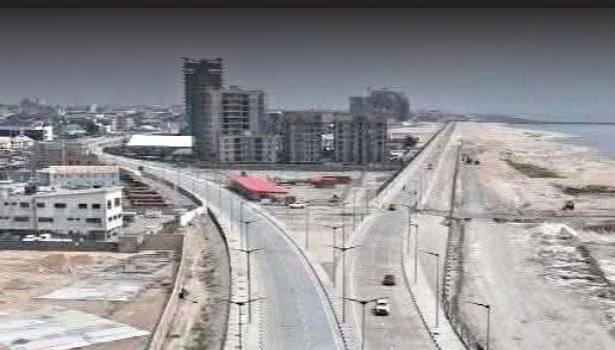
Federal Government’s decision to redirect sections of the controversial Lagos-Calabar Coastal Highway through Edo State has reignited questions about environmental assessments, project feasibility, contract transparency and the demolition of businesses, including Landmark Leisure Beach.
A1 News International
Commentary by: Hajia Hadiza Mohammed
LONDON, UNITED KINGDOM
The Federal Government’s decision to alter the proposed route of the Lagos-Calabar Coastal Highway has reopened a contentious national debate about infrastructure planning, public expenditure, environmental responsibility and accountability in Nigeria.
On October 12, 2026, the Minister of Works, David Umahi, announced that Sections 4A and 4B of the highway, originally expected to traverse parts of Ogun and Ondo States along the coastline, would be redirected inland through Edo State to connect with the existing East-West Road.
The Minister reportedly attributed the decision to significant engineering difficulties, including deep peat soils, swampy terrain and the risk of flooding along the proposed coastal alignment.
Although the government has presented the adjustment as an engineering response to difficult terrain, the announcement has revived concerns about whether adequate technical investigations, environmental assessments and stakeholder consultations were conducted before the commencement of a project of such enormous financial and national significance.
For critics of the project, the latest development raises a fundamental question: how could a major national infrastructure project commence construction before some of its most significant engineering and environmental challenges were adequately resolved?
The controversy surrounding the highway is therefore no longer limited to its construction cost or political significance. It has become a broader examination of the government’s approach to public infrastructure delivery, transparency and the responsible management of national resources.
THE LAGOS-CALABAR COASTAL HIGHWAY: A 700-KILOMETRE AMBITION
The Lagos-Calabar Coastal Highway is an ambitious infrastructure project designed to cover approximately 700 kilometres, connecting Victoria Island in Lagos State with Calabar in Cross River State.
The proposed highway is expected to traverse Ogun, Ondo, Edo, Delta, Bayelsa, Rivers and Akwa Ibom States before terminating in Calabar.
The Federal Government has presented the project as a strategic transportation corridor intended to improve regional connectivity, facilitate the movement of people and goods, stimulate economic activities and strengthen commercial relations across Nigeria’s southern corridor.
If successfully completed, the highway could potentially improve access to coastal communities, create new commercial opportunities, support tourism and facilitate the transportation of agricultural and industrial products.
However, the scale of the project also presents enormous financial, environmental and engineering responsibilities.
For a country struggling with deteriorating roads, inadequate public infrastructure and competing demands for limited public resources, the decision to undertake such an expensive project requires particularly rigorous planning, transparent procurement and demonstrable economic justification.
A PROJECT WITH ROOTS IN PREVIOUS ADMINISTRATIONS
Contrary to suggestions that the Lagos-Calabar Coastal Highway originated with the administration of President Bola Ahmed Tinubu, the idea of establishing a major transportation corridor along Nigeria’s southern coastline predates the present government.
According to Hajia Hadiza Mohammed, the concept can be traced to earlier national infrastructure proposals, including transportation plans developed during the colonial period.
The administration of former President Olusegun Obasanjo initiated the East-West Road project, which was designed to connect important oil-producing communities across the Niger Delta.
Subsequently, the administration of the late President Umaru Musa Yar’Adua incorporated a coastal highway concept into its broader Niger Delta development and amnesty framework in 2007.
The administration of former President Goodluck Jonathan also advanced the regional transportation vision by proposing a $12 billion Lagos-Calabar coastal railway network in 2014.
These earlier initiatives demonstrate that the idea of establishing a major transportation corridor linking Nigeria’s southern states was not conceived exclusively by the Tinubu administration.
The present government, however, assumed responsibility for translating the long-standing concept into an actual highway project.
Consequently, the central issue is not necessarily who first conceived the project, but whether the current implementation strategy is technically sound, economically justified and consistent with the principles of transparent public administration.
THE COST CONTROVERSY: QUESTIONS OVER VALUE FOR MONEY
One of the most contentious aspects of the Lagos-Calabar Coastal Highway is its reported financial cost.
The source article places the estimated project cost at approximately $12.5 billion, equivalent to about N15.6 trillion at the exchange-rate assumptions used in the original commentary.
The scale of this expenditure has generated considerable public concern, particularly against the background of Nigeria’s infrastructure deficit, rising public debt, inflation and the deteriorating condition of many existing federal highways.
Critics argue that the government should demonstrate why such a massive investment is necessary and establish how the project will deliver measurable economic returns.
They also question whether rehabilitating existing highways, improving rural road networks and completing abandoned infrastructure projects might offer greater immediate benefits to millions of Nigerians.
Beyond the financial commitment, the project has attracted scrutiny over the procurement process.
Hajia Hadiza Mohammed alleges that the contract was awarded without adequate competitive bidding, open tendering and the necessary legislative appropriation.
The commentary also identifies Hitech Construction Company Limited as the contractor and describes its owner, Gilbert Chagoury, as a longstanding associate of President Tinubu.
These are serious allegations that require documentary examination, including the original contract, procurement records, project approvals and applicable budgetary authorisations.
The government and relevant procurement authorities should provide clear information about the contract award, its financial structure, payment arrangements and the safeguards established to protect public funds.
In a democratic society, a project involving trillions of naira should not depend on public assurances alone. It should be supported by accessible documentation and independent scrutiny.
ENVIRONMENTAL IMPACT ASSESSMENT: THE QUESTIONS THE DIVERSION HAS REOPENED
Perhaps one of the most significant concerns surrounding the coastal highway relates to its environmental implications.
The proposed coastal alignment passes through environmentally sensitive areas, including wetlands, mangrove ecosystems and swampy terrain.
These environments perform important ecological functions, including supporting biodiversity, protecting coastal communities against erosion and providing natural habitats for numerous plant and animal species.
Large-scale construction activities in such areas require comprehensive environmental investigations to determine their potential effects on the surrounding ecosystem.
An adequate Environmental Impact Assessment should examine soil conditions, drainage patterns, flood exposure, biodiversity, vegetation, wildlife habitats and the potential consequences of construction activities.
It should also identify mitigation measures and establish monitoring mechanisms to ensure that environmental damage is minimised.
However, the original commentary questions whether the necessary environmental assessments and stakeholder consultations were adequately completed before construction commenced.
The October 12 announcement by the Works Minister has given fresh urgency to these questions.
If deep peat deposits, swampy terrain and flood risks were significant enough to necessitate a change in the highway’s alignment, it is reasonable for Nigerians to demand clarification about when these engineering challenges were identified and whether they had been fully investigated during the initial planning process.
The government should publish the relevant environmental and engineering assessment documents to demonstrate that the project is being implemented in accordance with established environmental standards.
Public consultation is equally important.
Communities, environmental experts, businesses, civil society organisations and other affected stakeholders should have meaningful opportunities to participate in decisions concerning infrastructure projects that could fundamentally alter their environment and livelihoods.
LANDMARK LEISURE BEACH: THE HUMAN AND ECONOMIC COST OF DEMOLITION
One of the most controversial developments associated with the Lagos-Calabar Coastal Highway is the demolition of Landmark Leisure Beach in Lagos.
The original commentary identifies the resort as a major private-sector investment owned by businessman Paul Onwuanibe.
According to the author, the business represented an investment estimated at $200 million and occupied approximately 13 hectares of developed land.
The resort reportedly operated for nearly two decades and provided direct employment for more than 4,000 people.
It also accommodated between 60 and 80 small and medium-sized enterprises, which allegedly supported more than 10,000 indirect employment opportunities within the surrounding business environment.
The demolition therefore raised concerns extending beyond the loss of a recreational facility.
For employees, entrepreneurs, investors and businesses operating within the resort, the destruction represented a potential disruption of livelihoods, commercial relationships and years of private investment.
The author particularly questions the government’s decision to demolish the facility in the name of the coastal highway, followed by subsequent announcements indicating that the highway would no longer follow the route associated with the affected location.
This sequence of events has fuelled suspicions about the planning and decision-making processes surrounding the demolition.
However, establishing whether the demolition was unnecessary or whether alternative considerations influenced the decision requires examination of the original alignment, acquisition notices, compensation records, engineering documents and subsequent route revisions.
The Federal Government should therefore clarify the circumstances surrounding the demolition, the basis for the acquisition of the affected property and the compensation arrangements applicable to the owners and other affected interests.
The wider implication is significant.
Nigeria cannot credibly promote foreign investment, tourism, entrepreneurship and private-sector development while failing to demonstrate that investors’ legitimate interests are protected through transparent and predictable public policies.
ROUTE DIVERSION: ENGINEERING NECESSITY OR EVIDENCE OF INADEQUATE PLANNING?
The October 12, 2026 announcement concerning Sections 4A and 4B represents another important turning point in the development of the Lagos-Calabar Coastal Highway.
The Minister of Works, David Umahi, reportedly explained that the original coastal alignment presented serious engineering difficulties.
Deep peat soils, swampy terrain and flood risks were identified as factors making the proposed route challenging.
From an engineering perspective, changing a road alignment is not inherently evidence of administrative failure.
Infrastructure projects sometimes require adjustments when further technical investigations reveal geological conditions, environmental constraints or construction risks that make the original design impractical.
However, the circumstances surrounding such changes matter.
A major infrastructure project should ordinarily undergo detailed feasibility studies, geotechnical investigations, environmental assessments and cost-benefit evaluations before construction begins.
Where significant challenges emerge after commencement, the government should explain whether they were genuinely unforeseen or whether inadequate preliminary investigations contributed to the situation.
The diversion also raises questions about the financial implications.
Will the new alignment increase or reduce the project’s overall cost?
Will previously completed construction work become redundant?
What additional compensation, land acquisition or engineering expenditure will be required?
How will the change affect the completion timetable?
These are legitimate questions that deserve transparent answers.
Without such information, Nigerians may find it difficult to determine whether the route adjustment represents prudent engineering management or the consequences of inadequate project preparation.
GOVERNMENT PRIORITIES AND THE CONDITION OF EXISTING ROADS
The Lagos-Calabar Coastal Highway has also generated a broader debate about the Federal Government’s infrastructure priorities.
Across Nigeria, motorists and transport operators continue to contend with deteriorating highways, abandoned road projects, failed bridges and dangerous driving conditions.
Poor road infrastructure contributes to increased transportation costs, vehicle damage, road accidents, delays in the movement of agricultural produce and higher costs of doing business.
Against this background, critics question the wisdom of committing enormous public resources to ambitious new highway projects while existing transportation infrastructure remains in poor condition.
The original commentary also raises concerns about the Federal Government’s reported plans for the 1,068-kilometre Badagry-Sokoto Highway.
The central argument is that infrastructure development should be driven by clearly established national priorities rather than the political attraction of announcing monumental projects.
A responsible infrastructure strategy must balance new construction with the maintenance, rehabilitation and completion of existing assets.
It must also establish transparent financing arrangements, credible implementation schedules and measurable economic benefits.
The objective should not simply be to build impressive roads but to develop an efficient transportation network capable of supporting sustainable economic growth.
THE ACCOUNTABILITY QUESTION: WHO WILL ANSWER FOR PROJECT DECISIONS?
The controversies surrounding the Lagos-Calabar Coastal Highway ultimately bring the issue of public accountability into focus.
Infrastructure projects funded with public resources must be subjected to institutional oversight, independent technical assessment and transparent financial reporting.
The Federal Government should provide Nigerians with clear information concerning:
The original feasibility and engineering studies undertaken before construction commenced.
The Environmental Impact Assessment and associated environmental approvals.
The procurement process and contractual arrangements with Hitech Construction Company Limited.
The approved project cost, funding structure and expenditure incurred.
The technical justification and financial implications of the Sections 4A and 4B diversion.
The circumstances surrounding the demolition of Landmark Leisure Beach and the treatment of affected businesses and employees.
The project’s implementation timetable, completed sections and independently verified progress reports.
These disclosures would help establish whether the project is being implemented in accordance with public procurement requirements, environmental regulations and responsible infrastructure management principles.
They would also provide an opportunity for the government to address allegations of impropriety through verifiable evidence rather than political arguments.
INFRASTRUCTURE DEVELOPMENT MUST NOT COME AT THE EXPENSE OF ACCOUNTABILITY
The Lagos-Calabar Coastal Highway represents an ambitious attempt to transform transportation connectivity across Nigeria’s southern corridor.
Its potential economic benefits cannot simply be dismissed because of the controversies surrounding its implementation.
However, the scale of the project makes transparency, technical competence, environmental responsibility and public accountability indispensable.
The decision to divert Sections 4A and 4B through Edo State has brought renewed attention to questions about the quality of the original feasibility studies, the adequacy of environmental investigations and the government’s preparedness before construction commenced.
The concerns surrounding the reported project cost, contract award, demolition of Landmark Leisure Beach and the condition of existing roads also deserve credible institutional examination.
The government has a responsibility to demonstrate that public infrastructure projects are conceived and executed in the national interest, not merely as political symbols or monuments to particular administrations.
Nigeria needs roads, bridges, railways and other critical infrastructure. But it equally needs transparent procurement, responsible public spending and institutions capable of holding decision-makers accountable.
The ultimate measure of the Lagos-Calabar Coastal Highway should therefore not be the number of kilometres announced, the size of the contract or the political prominence of those associated with it.
It should be whether the project delivers sustainable economic value, protects the environment, respects legitimate private interests and improves the lives of ordinary Nigerians.
A country cannot build sustainable infrastructure on the foundation of inadequate planning, questionable transparency and weak accountability.
A1 NEWS INTERNATIONAL EDITORIAL NOTE
This report is based on a commentary submitted by Hajia Hadiza Mohammed. Allegations concerning procurement irregularities, environmental compliance, project costs and the circumstances surrounding the demolition of Landmark Leisure Beach are attributed to the original author and should not be treated as independently established findings.
The Federal Government, Federal Ministry of Works, Hitech Construction Company Limited and other relevant parties should be given the opportunity to respond to the issues raised.
AUTHOR’S PROFILE
Hajia Hadiza Mohammed is an actress, social activist and politician based in London, United Kingdom.




Leave a Reply