
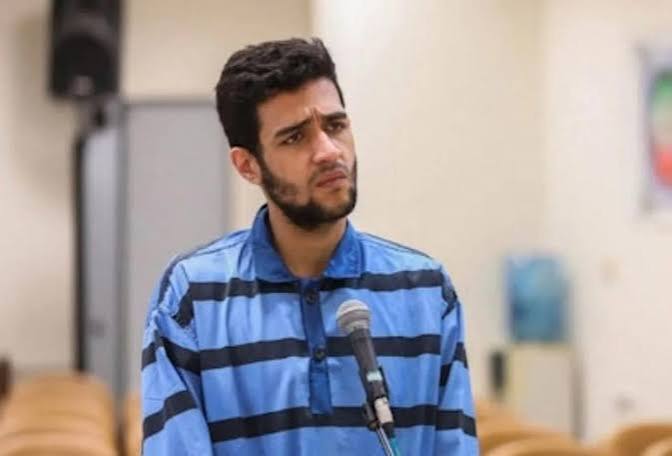
Majid Adineh put to death after Supreme Court upholds conviction over alleged arson and support for “hostile groups” during nationwide unrest
By A1NEWS International
TEHRAN, Iran — August 23, 2026
Iranian authorities have executed Majid Adineh, a man accused of supporting the United States and Israel during anti-government protests, in another death-penalty case arising from the unrest that swept the country amid worsening economic hardship.
Iran’s judiciary said Adineh was executed on Sunday morning after the Supreme Court upheld his death sentence for what authorities described as “operational action in favour of hostile groups.”
The case has drawn renewed attention to Iran’s use of capital punishment against people accused of involvement in the protests, particularly as Tehran continues to frame the unrest as part of a broader foreign-backed effort to destabilise the Islamic Republic.
According to the judiciary’s Mizan Online website, Adineh was also convicted of deliberate arson, gathering and collusion allegedly intended to commit crimes against Iran’s internal security.
The judiciary said the Karaj Revolutionary Court relied on documents, other evidence and statements attributed to the defendant before imposing the death sentence and ordering the confiscation of his property.
Arrest Followed Alleged Possession Of Weapons
Iranian authorities said Adineh and another suspect were arrested on January 9 in Alborz Province, west of Tehran, during the height of the demonstrations.
According to Mizan, the suspects were allegedly found carrying:
- A revolver and ammunition;
- Two tasers;
- Two tear-gas canisters;
- A rechargeable chainsaw; and
- A bottle of gasoline.
The authorities’ account did not, in the material available for this report, independently establish how each item was allegedly used during the protests or provide independent verification of the circumstances surrounding the arrest.
The judiciary nevertheless maintained that the evidence supported the charges against Adineh.
His appeal was unsuccessful, and the Supreme Court subsequently upheld the verdict, clearing the way for his execution.
From Economic Protest To National-Security Crisis
The demonstrations began in late December amid public anger over high living costs and economic hardship.
What initially appeared to be an expression of economic frustration rapidly developed into broader anti-government protests across several parts of Iran.
The demonstrations reportedly reached their peak on January 8 and 9, when clashes and violence intensified.
Iranian authorities subsequently described elements of the unrest as terrorist activity and accused the United States and Israel of orchestrating or supporting violent attempts to destabilise the country.
That characterisation has become a central part of Tehran’s justification for prosecuting individuals accused of involvement in the unrest.
Tehran Blames US And Israel
Iran’s government has repeatedly accused its foreign adversaries of exploiting domestic grievances to weaken the Islamic Republic.
The allegations became even more prominent as the protests expanded and violence was reported in several locations.
Iranian authorities have attributed more than 3,000 deaths to the unrest, describing some of the violence as the result of terrorist actions allegedly backed by Washington and Tel Aviv.
The figures and attribution remain matters of dispute, while independent verification of the full casualty count and the circumstances surrounding individual deaths has been difficult.
The distinction is important because the government’s classification of protesters as national-security suspects has direct consequences for the severity of charges and potential punishments.
Death Penalty At The Centre Of Iran’s Response
Adineh’s execution is part of a wider pattern of capital punishment involving individuals prosecuted over the protests.
For Iranian authorities, the cases represent the prosecution of people accused of serious crimes, violence and threats to national security.
Human-rights organisations, however, have repeatedly expressed concern that political protesters can be subjected to severe charges and death sentences following proceedings that may not meet international fair-trial standards.
The competing narratives make independent scrutiny of individual cases particularly important.
In Adineh’s case, the official account says the conviction was based on evidence and the defendant’s statements. However, the information available does not independently establish the circumstances in which those statements were obtained or provide a complete account of the defence presented during the proceedings.
Executions Rise Amid Regional War
The execution comes against the backdrop of a wider escalation in the Middle East.
According to the supplied report, the regional war began on February 28 with US-Israeli strikes against Iran, triggering a further deterioration in relations between Tehran and its principal adversaries.
Since the beginning of the conflict, Iranian authorities have carried out additional executions, with some cases reportedly linked to the protests and others to allegations arising from the war.
The convergence of domestic unrest and external military confrontation has significantly intensified Iran’s national-security environment.
Individuals accused of espionage, collaboration with hostile states or other security-related offences face particularly severe consequences.
Iran’s Execution Record Under Scrutiny
Iran’s broader use of capital punishment has attracted sustained international criticism.
According to Iran Human Rights, a Norway-based organisation, and Together Against the Death Penalty (ECPM), headquartered in Paris, Iranian authorities executed at least 1,639 people in 2025.
The organisations described the figure as the highest annual number of executions in Iran since 1989.
The reported figure covers a wide range of criminal convictions and is not limited to protesters or political cases.
Nevertheless, the scale of executions has intensified international scrutiny of Iran’s judicial system.
Amnesty Raises Global Concern
Amnesty International has consistently identified Iran as one of the world’s most prolific users of the death penalty.
The organisation’s assessment cited in the supplied report places Iran second globally in the number of executions, behind China.
Exact comparisons are complicated because China’s execution figures are classified and not publicly disclosed.
Iran’s publicly documented executions, however, have consistently placed the country among those carrying out the highest number of capital punishments worldwide.
The Evidence And Due-Process Questions
The most contentious aspect of protest-related executions is often not whether an accused person committed a criminal act, but whether the prosecution and trial met appropriate standards of due process.
In cases carrying the death penalty, questions about access to lawyers, admissibility of evidence, the treatment of detainees and the reliability of confessions become particularly consequential.
Iran’s judiciary maintains that Adineh’s conviction was supported by evidence and statements attributed to him.
However, independent information about the full evidentiary record was not available in the material reviewed for this report.
That makes it difficult for outside observers to independently assess the strength of the prosecution’s case.
What Adineh’s Execution Signals
The execution sends another powerful message from Tehran that alleged collaboration with foreign adversaries will attract the most severe criminal penalties.
It also illustrates how Iran’s response to domestic dissent has increasingly intersected with its confrontation with the United States and Israel.
The result is a security environment in which an individual accused of participating in protests can potentially face charges extending far beyond ordinary public-order offences if authorities allege links to foreign powers.
For human-rights organisations, the concern is whether such national-security allegations are being applied narrowly to genuine acts of violence and espionage or more broadly against political dissent.
A Wider Pattern Emerging
The Adineh case cannot be examined in isolation from the broader pattern of executions following the protests.
The combination of economic grievances, political opposition, accusations of foreign interference and regional warfare has created a highly volatile environment inside Iran.
For the Iranian government, harsh punishment may be intended to deter further unrest and demonstrate state authority.
For critics of the government, however, the executions risk deepening repression and eliminating legitimate avenues for political expression.
The competing interpretations are likely to remain central to international debate over Iran’s domestic policies.
The execution of Majid Adineh represents another consequential chapter in Iran’s post-protest crackdown.
Iranian authorities maintain that Adineh was convicted not merely for protesting but for offences including alleged arson, conspiracy against internal security and operational support for hostile groups.
Yet the case raises fundamental questions about evidence, due process, proportionality and the use of capital punishment in politically sensitive cases.
Those questions have become even more urgent as Iran confronts simultaneous domestic economic pressures and an escalating military confrontation with the United States and Israel.
The central issue now extends beyond one execution: whether Iran’s expanding use of national-security prosecutions and capital punishment will deter violence—or further deepen the country’s political and human-rights crisis.









Leave a Reply