
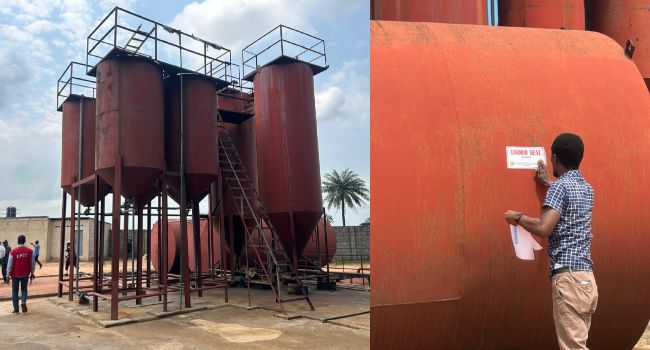
Whistleblower intelligence exposes a sprawling three-hectare illegal refining operation in Ogere-Remo, with underground storage facilities exceeding 90,000 litres; EFCC vows to track down alleged foreign financiers as investigators probe possible years of illicit operations.
By A1NEWS Investigative Desk
OGERE-REMO, OGUN STATE, NIGERIA | NOVEMBER 5, 2026
A joint enforcement operation involving the Economic and Financial Crimes Commission (EFCC) and the Nigerian Midstream and Downstream Petroleum Regulatory Authority (NMDPRA) has uncovered a suspected sophisticated illegal petroleum refining facility in Ogere-Remo, Ikenne Local Government Area of Ogun State, raising fresh concerns over the scale of illicit activities within Nigeria’s petroleum value chain.
The facility, reportedly spread across more than three hectares of fenced land, was discovered following whistleblower information and intelligence gathering that exposed an underground processing and storage network allegedly designed to convert petroleum sludge and other refinery waste products into substances suspected to be Automotive Gas Oil (AGO), commonly known as diesel.
Following an inspection of the premises, NMDPRA officials declared the operation illegal, citing the absence of regulatory authorisation, while the EFCC commenced investigations into the individuals and interests allegedly connected to the facility.
The discovery has also raised questions about how such an extensive operation could have been established and potentially operated for years without attracting regulatory scrutiny.
UNDERGROUND STORAGE, HEATING SYSTEMS EXPOSE SCALE OF OPERATION
An examination of the facility reportedly revealed an elaborate network of underground storage tanks, heating installations, cooling hydrants, locally fabricated processing tanks and silos designed for separating petroleum substances.
According to the Ogun State Coordinator of NMDPRA, Dr Atilola Akinyemi, the underground storage infrastructure alone has an estimated capacity exceeding 90,000 litres.
Investigators believe the installations were used in processing sludge oil, petroleum waste and other materials into products resembling commercially available diesel.
The presence of underground heating systems and separation equipment suggests that the operation involved more than simple storage or distribution of petroleum products.
However, the precise nature, chemical composition and quality of the recovered substances remain subject to laboratory examination.
NMDPRA officials subsequently sealed the facility, while petroleum products recovered from the premises were confiscated by the Federal Government.
NMDPRA: FACILITY OPERATED WITHOUT REGULATORY APPROVAL
Speaking during the inspection, Akinyemi described the installation as an illegal operation that had no authorisation from any recognised regulatory authority.
He stressed that although the operators appeared to possess some technical knowledge of petroleum processing, their activities were designed to circumvent established regulatory requirements.
“This facility you see here is very crude and completely illegal. This is not a refinery by any standard. It does not have a permit from any regulatory authority, and its operations are unknown to the relevant authorities,” he said.
The regulatory official also cautioned against prematurely identifying the recovered products as diesel, explaining that visual appearance alone was insufficient to establish their quality or suitability for use.
According to him, laboratory analysis would be necessary to determine their actual composition and compliance with petroleum product specifications.
He warned that introducing improperly processed or adulterated petroleum products into the Nigerian market could expose vehicles, industrial equipment and other machinery to serious mechanical damage.
The warning raises wider concerns about the potential consequences of unregulated petroleum processing, particularly where products are distributed without quality assurance, environmental safeguards or compliance with established industry standards.
EFCC: WHISTLEBLOWER INTELLIGENCE LED TO DISCOVERY
The EFCC Zonal Director, Lagos Zonal Directorate 2, Bawa Usman Kaltungo, who led the enforcement operation, disclosed that intelligence provided through whistleblowing was instrumental in uncovering the facility.
According to him, the installation contained an extensive processing arrangement through which sludge reportedly passed before being converted into substances marketed or described as diesel.
Kaltungo expressed concern that the sophistication and scale of the installation suggested that the operation might have been active for several years.
“What we have seen here is an illegal refinery with a complete setup, featuring all the processes through which sludge passes before being converted into what is commonly referred to as diesel. Judging by the nature of this facility, it has been operating for years,” he said.
His disclosure raises important investigative questions about the identity of the operators, the source of their petroleum feedstock, the possible distribution channels for their products and the financial interests sustaining the operation.
However, the commission has yet to publicly establish the full ownership structure or disclose the identities of all individuals allegedly connected to the facility.
OGERE AXIS UNDER INVESTIGATION OVER FOREIGN NATIONALS’ ACTIVITIES
In a development that could broaden the scope of the investigation, the EFCC zonal director linked the latest discovery to concerns about other suspected illegal industrial activities within the Ogere axis.
He recalled that 14 Chinese nationals had been arrested approximately one week earlier over alleged illegal lithium processing activities in the same area.
Kaltungo said investigations into the separate incident revealed immigration-related concerns involving some of the foreign nationals.
According to him, some individuals possessed passports, while others allegedly had no passports. Among those with travel documents, some reportedly had expired visas dating back approximately three months before their discovery.
The EFCC official also alleged that some individuals were operating without valid identification documents.
He subsequently declared the commission’s intention to pursue the ultimate owners of the illegal refinery, whom he said were based in China, and ensure that they were brought to Nigeria to answer questions concerning their alleged involvement.
The disclosure introduces a potentially significant international dimension to the investigation, particularly regarding beneficial ownership, foreign financing, immigration compliance and the accountability of individuals allegedly coordinating illegal industrial operations from outside Nigeria.
Nevertheless, the relationship, if any, between the illegal refinery and the separately investigated lithium-processing operation has not been established.
EFCC WARNS AGAINST ECONOMIC SABOTAGE, DEFENDS LEGITIMATE INVESTMENT
Also speaking during the inspection, the Director of the EFCC Department of Proceeds of Crime Management, Mr Gbolahan Latona, called on Nigerians to demonstrate patriotism and support collective efforts to protect the country’s economic interests.
He warned that illegal petroleum operations could undermine legitimate investments in the downstream petroleum sector and weaken confidence in Nigeria’s regulatory environment.
Latona specifically referenced the Dangote Refinery, arguing that allowing illegal operators to function freely could undermine the efforts of legitimate investors who have committed substantial resources to developing the country’s refining capacity.
“Imagine allowing saboteurs like these to operate freely and undermine the efforts of legitimate investors like Dangote Refinery. Ultimately, it is Nigerians who will suffer,” he said.
He maintained that combating economic and financial crimes required cooperation among government institutions, private-sector operators and members of the public.
Latona urged Nigerians to provide credible information to relevant authorities whenever they encountered suspicious economic activities, stressing that protecting national resources was a shared responsibility.
PROSECUTION AND ASSET FORFEITURE AHEAD
The EFCC has indicated that the investigation will extend beyond sealing the premises and confiscating the recovered petroleum products.
Latona explained that the commission would gather sufficient evidence before proceeding with prosecution, adding that individuals found culpable would be brought before a competent court.
He further stated that assets and proceeds established to be connected to criminal activities could be forfeited to the Federal Government, subject to applicable legal procedures.
“Once investigation has been concluded and sufficient evidence gathered, they will have their day in court. That is essentially the process. They will face prosecution, and if convicted, the proceeds of their crimes will be forfeited to the government and subsequently put to appropriate use,” he added.
The EFCC’s position underscores the importance of tracing the financial transactions behind the suspected operation, identifying its beneficiaries and determining whether the facility was supported by a wider network of suppliers, financiers and distributors.
THE BIGGER PICTURE: REGULATORY OVERSIGHT AND PETROLEUM SECURITY
The discovery of the Ogere-Remo facility highlights persistent challenges confronting Nigeria’s petroleum regulatory and enforcement institutions.
Illegal refining, petroleum adulteration, unauthorised storage and the diversion of petroleum resources pose potential threats to public safety, environmental protection, government revenue and legitimate investments.
Beyond the immediate enforcement operation, the discovery raises several questions requiring further investigation:
- Who owns the land and the processing infrastructure?
- Who financed the construction and installation of the underground facilities?
- Where did the operators obtain the crude oil, sludge and other petroleum feedstock?
- Were the suspected products supplied to filling stations, industrial consumers or independent distributors?
- How long did the operation remain active, and were regulatory or security officials aware of its activities?
- What environmental impact has resulted from the alleged underground processing and storage activities?
Answers to these questions will be essential in determining whether the facility represents an isolated criminal enterprise or part of a broader organised network operating within Nigeria’s petroleum supply chain.
The sealing of the suspected illegal refinery in Ogere-Remo represents a significant enforcement development, but the ultimate success of the operation will depend on what investigators uncover beyond the facility’s walls.
Tracing the alleged financiers, identifying the operators, establishing the source and destination of petroleum products, conducting forensic financial investigations and securing credible evidence for prosecution will be critical.
For Nigeria, the case is another test of the ability of regulatory and law enforcement agencies to protect the petroleum sector from criminal exploitation while ensuring that legitimate businesses operate within a transparent and accountable regulatory environment.
The public will now expect the EFCC and NMDPRA to move beyond the initial discovery and provide answers about the ownership, operational history, financial beneficiaries and possible environmental consequences of the facility.
A1NEWS will continue to monitor developments surrounding the investigation, including possible arrests, laboratory findings, prosecution and asset recovery.
Important editorial note: The report distinguishes allegations and preliminary investigative observations from established facts. The EFCC’s allegations concerning foreign ownership and years of operation should not be presented as judicially established findings until supported by evidence.







Leave a Reply