
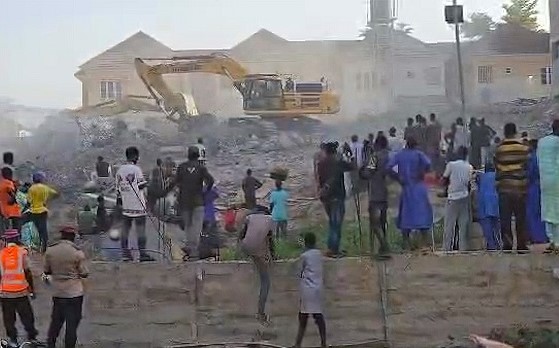
Stark Reality: Preliminary findings point to possible compromise in cement quality as rescue agencies battle to save trapped victims in Nigeria’s capital.
By Baron Eloagu
ABUJA — May 17, 2026 — Tragedy struck the Federal Capital Territory on Saturday morning after a building collapsed in the Durumi 3 area of Abuja, near the busy Gudu Market axis, killing at least five persons and leaving several others injured in yet another incident raising concerns over construction standards and regulatory enforcement in the nation’s capital.
The collapse, which occurred around 9:00 a.m., triggered a large-scale emergency response involving health officials, rescue teams, and regulatory agencies as frantic efforts were launched to pull victims from the debris.
Authorities confirmed that 15 persons were recovered from the rubble, with nine rescued alive, five confirmed dead, and one victim battling for survival in critical condition.
The incident has renewed scrutiny over the quality of building materials used by developers and the apparent disregard for approved construction standards across Abuja’s rapidly expanding urban districts.
Rescue Operation Uncovers Scale of Disaster
Speaking on behalf of the emergency response agencies, the Mandate Secretary for Health and Human Services in the Federal Capital Territory, Dr. Adedolapo Fasawe, disclosed that coordinated rescue efforts prevented the casualty figure from rising further.
According to her, emergency responders arrived shortly after distress calls were received from residents and traders around the Gudu Market vicinity.
“The rescue teams were able to pull out 15 persons from the collapsed structure. Nine were rescued alive, five were confirmed dead, while one victim remains in critical condition and is receiving medical attention,” she said.
Eyewitnesses described scenes of panic and confusion as residents and passersby rushed toward the collapsed structure, with some attempting to assist trapped victims before professional rescuers arrived.
Several nearby traders reportedly abandoned their shops as heavy dust and loud cracking sounds preceded the collapse.
Preliminary Probe Points to Possible Structural Compromise
In what may become a major focal point of the investigation, Dr. Fasawe revealed that preliminary assessments by the Standards Organisation of Nigeria (SON) suggest that the quality of cement mixture used in the construction may have been compromised.
Although a comprehensive structural analysis is still ongoing, officials believe substandard building practices may have contributed significantly to the collapse.
The revelation has intensified public concern over the increasing number of structural failures recorded across Nigeria, particularly in fast-growing urban centres where weak regulatory oversight and cost-cutting practices by some developers continue to endanger lives.
Construction experts have repeatedly warned that the use of inferior materials, poor engineering supervision, and unauthorized modifications remain among the leading causes of building collapses nationwide.
Questions Mount Over Regulatory Enforcement
The latest tragedy has also reignited debate about the effectiveness of the Federal Capital Territory Development Control Department and other regulatory agencies tasked with monitoring compliance in Abuja’s construction sector.
Urban planning analysts argue that many developers bypass approval procedures, ignore safety regulations, or alter approved building specifications after permits are granted.
Dr. Fasawe urged developers and property owners to strictly adhere to official guidelines before embarking on construction projects.
She emphasized the need for mandatory approvals and professional supervision to prevent avoidable disasters.
“We urge all residents and developers intending to build within the FCT to obtain proper approvals from the Development Control Department and comply fully with building regulations,” she stated.
Growing Pattern of Building Disasters in Nigeria
Saturday’s collapse adds to a growing list of structural failures across Nigeria that have claimed dozens of lives in recent years.
Experts say weak enforcement mechanisms, corruption in building approvals, and the proliferation of unqualified contractors continue to undermine safety standards in the construction industry.
Residents around the Durumi-Gudu corridor also questioned whether routine structural inspections were conducted on the collapsed building before the incident.
As rescue and recovery operations continue, authorities are expected to launch a full investigation to determine the exact cause of the collapse and whether criminal negligence was involved.
The Abuja building collapse has once again exposed the deadly consequences of regulatory lapses and alleged substandard construction practices in Nigeria’s urban centres. With five lives already lost and families thrown into mourning, pressure is mounting on authorities to move beyond routine condolences and enforce stricter accountability within the construction sector.
As investigators examine the rubble for answers, many Nigerians are asking whether another preventable tragedy could have been avoided through stronger oversight, professional compliance, and tougher sanctions against erring developers.









Leave a Reply