
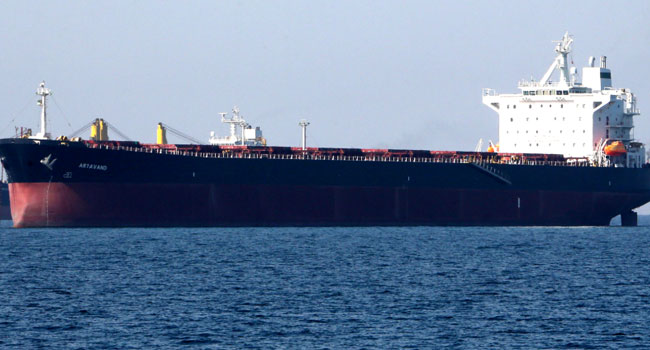
Limited vessel movement resumes under tight military coordination as global energy corridor cautiously reopens
By A1 News International Desk — April 8, 2026
The first vessels have successfully passed through the Strait of Hormuz following Iran’s agreement to reopen the critical maritime corridor under a temporary ceasefire arrangement with the United States.
Maritime tracking firm MarineTraffic confirmed on Wednesday that two ships completed transit through the strait, marking the first movement since restrictions were imposed amid escalating regional tensions.
First Movements Since Ceasefire
According to the tracking data, the Greek-owned bulk carrier NJ Earth crossed the strait at 08:44 UTC, while the Liberia-flagged vessel Daytona Beach transited earlier after departing Bandar Abbas.
The crossings followed a two-week ceasefire agreement reached between Iran and the United States, which allows controlled access to the waterway under coordination with Iranian armed forces.
Iran’s Foreign Minister, Abbas Araghchi, confirmed that vessel passage would be permitted during the ceasefire period, though under strict monitoring.
Cautious Reopening, Not Full Recovery
Analysts have warned against interpreting the initial crossings as a full restoration of maritime operations.
Ana Subasic, an analyst at Kpler, noted that while the transit of the vessels is a positive signal, it remains unclear whether it represents a broader reopening or isolated, pre-approved movements.
The vessels reportedly navigated via Iranian-designated routes near Larak Island — a controlled passage used during the recent restrictions.
Severe Disruption to Global Shipping
Access to the Strait of Hormuz had been heavily restricted since late February, following retaliatory measures by Iran in response to US and Israeli military actions.
The disruption significantly reduced shipping activity, with data showing a sharp 95 percent drop in vessel crossings compared to normal levels.
Approximately 800 vessels are currently estimated to be stranded in the Gulf, as shipowners and charterers cautiously assess the evolving security landscape.
Global Energy Market Implications
The Strait of Hormuz remains one of the world’s most critical energy chokepoints, with nearly one-fifth of global crude oil and liquefied natural gas (LNG) shipments passing through the route under normal conditions.
Any sustained disruption to the corridor has immediate implications for global energy supply, pricing, and geopolitical stability.
Outlook: Fragile Stability
While the ceasefire has opened a narrow window for maritime movement, industry observers emphasize that risks remain high.
Further vessel transits are expected in the coming days, but shipping operators are likely to proceed cautiously until clearer signals emerge regarding the durability of the ceasefire and long-term security guarantees in the region.













Leave a Reply