
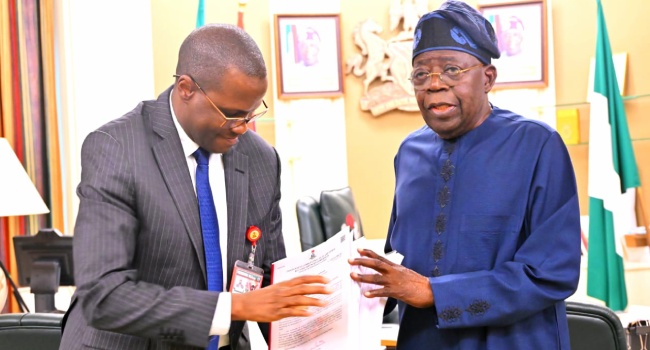
Anti-graft agency tells President Tinubu preliminary investigation found no legal basis for PFIPC, alleges forged appointment letters, gazettes and enabling documents, recommends criminal prosecution and reforms.
By Amarachi Odenigbo
ABUJA, Nigeria — August 6, 2026
The Independent Corrupt Practices and Other Related Offences Commission (ICPC) has submitted an interim investigative report to President Bola Ahmed Tinubu, recommending the criminal prosecution of Adeniyi Adeyemi, the man alleged to have fraudulently presented himself as the Director-General of the Presidential Foreign Investment Promotion Council (PFIPC)—an organisation the Federal Government has declared non-existent.
The interim report, submitted exactly 30 days after President Tinubu ordered a comprehensive investigation, paints a troubling picture of alleged forgery, impersonation, institutional negligence and systemic failures that investigators say enabled a fictitious government agency to operate with apparent legitimacy.
ICPC Chairman Dr. Musa Aliyu (SAN) disclosed the findings after briefing the President at the Presidential Villa, Abuja, stating that preliminary investigations established that Adeyemi was never appointed by the Federal Government and that documents purportedly creating and legitimising the PFIPC were forged.
The report also raises broader concerns about weaknesses in Nigeria’s administrative verification processes, warning that unless urgent institutional reforms are implemented, similar schemes could emerge within the public sector.
Forgery Allegations at the Heart of PFIPC Scandal
According to the ICPC, investigators found no evidence that the Federal Government established the Presidential Foreign Investment Promotion Council.
Aliyu revealed that documents used to portray the council as an official government institution—including an alleged presidential appointment letter, official gazette and enabling instruments—were all found to be fraudulent.
“Our investigation established that Mr. Adeniyi Adeyemi was never appointed by the Federal Government,” Aliyu said.
“The appointment letter, gazette and other documents relied upon to establish the agency were forged.”
The findings reinforce earlier declarations by the Presidency distancing itself from the PFIPC and denying any official recognition of the organisation.
No Government Funds Released to Fake Agency
One of the key revelations contained in the interim report is that investigators found no evidence that Federal Government funds were approved or disbursed directly to the disputed agency.
According to the ICPC Chairman, although the fake institution succeeded in projecting an appearance of legitimacy, investigators established that no official financial allocation was released to it.
“Our interim report found weaknesses in verification, inter-agency oversight and government processes.
“We discovered that those weaknesses were exploited by Adeniyi, with some level of negligence.
“Our investigation found that no Federal Government funds were approved or disbursed to the fake PFIPC/PEAC.”
The disclosure may narrow one aspect of the investigation while shifting attention to how the alleged scheme managed to gain official visibility despite lacking legal existence.
Probe Uncovers Two Additional Alleged Fake Agencies
Beyond PFIPC, investigators say they uncovered two additional organisations allegedly established by Adeyemi using similar methods.
According to ICPC, the agencies include:
- FCT Investment Promotion Agency (FIFA);
- Foreign Investment Promotion Agency and Public-Private Partnership (PIPA-PPP).
The Commission alleged that forged legislative instruments were used to create the impression that these entities had statutory backing.
Aliyu further disclosed that the documents were subsequently relied upon to facilitate the opening of bank accounts and other administrative activities.
The findings have intensified concerns about regulatory loopholes that could permit unauthorised entities to operate under the guise of government institutions.
ICPC Recommends Criminal Charges and Administrative Sanctions
Based on its preliminary findings, the anti-corruption agency has formally recommended that Adeyemi be prosecuted.
The Commission also called for disciplinary action against public officials whose negligence allegedly enabled the fake agency to function without detection.
“Our recommendation is that Mr. Adeniyi Adeyemi should be prosecuted,” Aliyu stated.
“Administrative sanctions should also be imposed on public officers whose acts of omission and negligence facilitated the illegal operation of PFIPC.”
He added that government institutions must strengthen internal control systems to prevent similar occurrences.
According to the report, institutional reforms across Ministries, Departments and Agencies (MDAs) should include stronger verification procedures, improved inter-agency collaboration and stricter document authentication mechanisms.
Investigation Continues as ICPC Seeks Additional Collaborators
Although the interim report identifies Adeyemi as the principal suspect, the ICPC says investigations remain ongoing.
Aliyu explained that investigators are pursuing additional leads to determine whether other individuals or public officials knowingly collaborated in establishing or promoting the disputed agency.
“We have continued with the investigation of the activities of Mr. Adeniyi Adeyemi and his collaborators so that we can unravel more facts and file criminal charges that can stand the test of time before a court of competent jurisdiction,” he said.
The Commission indicated that a comprehensive final report would be submitted after completing further forensic and documentary investigations.
How the PFIPC Controversy Unfolded
The PFIPC controversy first attracted national attention after the Presidency publicly disowned the organisation, declaring that no such Federal Government agency existed.
The controversy deepened when it emerged that the council appeared in the 2026 Appropriation Act with a reported budgetary allocation of ₦1.3 billion, raising questions about how a non-existent institution found its way into official government documents.
The revelation prompted widespread public concern and triggered multiple investigations.
In response, President Tinubu directed the ICPC to conduct a comprehensive probe into the circumstances surrounding the alleged creation and operation of the organisation.
Separately, the House of Representatives commenced its own investigation into the scandal.
During one of its hearings, a businessman alleged that he paid ₦400 million to Adeyemi for contract facilitation linked to the disputed agency—an allegation that has added another dimension to the unfolding investigation.
Broader Governance Questions
While the interim report recommends criminal prosecution, governance experts argue that the PFIPC affair raises deeper institutional concerns beyond the actions of one individual.
Analysts say the ability of an allegedly fictitious agency to operate, issue documents, engage stakeholders and appear within government processes points to significant weaknesses in administrative oversight.
The scandal has renewed calls for:
- stronger verification of presidential appointments;
- centralised authentication of government agencies;
- tighter legislative scrutiny of budget proposals;
- improved coordination among MDAs;
- enhanced digital verification systems for official documents.
Public policy observers believe addressing these structural weaknesses will be critical to restoring confidence in Nigeria’s public administration.
The ICPC’s interim report marks a significant development in one of Nigeria’s most unusual governance scandals in recent years.
If the Commission’s findings are upheld through further investigations and judicial proceedings, the case could become a landmark test of the country’s commitment to combating forgery, impersonation and abuse of public institutions.
Beyond the fate of the principal suspect, the investigation has exposed vulnerabilities within government systems that may require far-reaching reforms.
As investigators continue to identify possible collaborators and strengthen the evidence for prosecution, Nigerians will be watching closely to see whether accountability extends beyond individuals to the institutions whose failures allegedly allowed the scheme to flourish.











Leave a Reply