
How the memory of the annulled 1993 election is being repackaged into a human rights-driven reform agenda amid persistent questions about Nigeria’s electoral credibility
By A1News International / Abuja, Nigeria/ May 11, 2026
DEMOCRACY BORN FROM ANNULLMENT, STILL STRUGGLING FOR DEFINITION
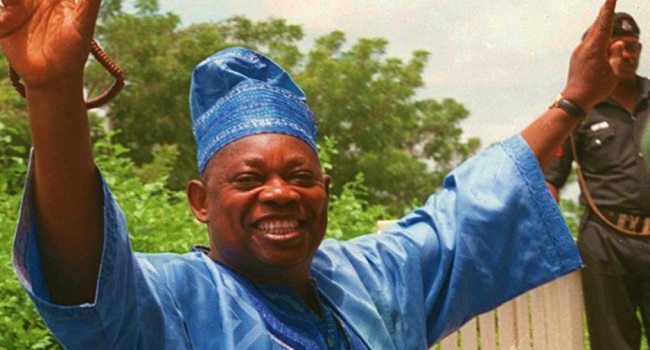
Nigeria’s June 12 Democracy Day is officially a commemoration of the 1993 presidential election—an electoral contest widely regarded as the most credible in the nation’s history, yet permanently scarred by its annulment.
Held under military rule, the election produced a decisive national mandate for Moshood Kashimawo Olawale (M.K.O.) Abiola of the Social Democratic Party against Bashir Tofa of the National Republican Convention. But before results were formally completed, the process was halted and ultimately annulled by the military administration of General Ibrahim Babangida.
What followed was not merely political controversy but a national rupture: protests, repression, prolonged military rule, and a democratic struggle that claimed lives and reshaped Nigeria’s political identity.
At the centre of that struggle stands a lingering question: has Nigeria truly resolved the democratic deficit born on June 12?
THE JUNE 12 QUESTION: LEGITIMACY WITHOUT RESOLUTION
The annulment of the 1993 election transformed a ballot into a symbol of contested sovereignty.
The crisis triggered:
- Nationwide protests and civic resistance
- Detention and persecution of pro-democracy actors
- Institutional distrust of electoral processes
- Deepening military authoritarianism until 1999
The eventual death of Abiola in detention in 1998 further cemented June 12 as a national grievance rather than a concluded historical episode.
Even after the return to civilian rule in 1999, the legitimacy question remained unresolved in public consciousness—despite the state later elevating June 12 to Democracy Day in 2018, replacing May 29.
The symbolic recognition did not automatically translate into structural electoral reform.
NHRC AND THE SHIFT FROM MEMORY TO MONITORING
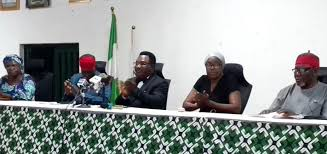
Against this backdrop, the National Human Rights Commission (NHRC) has positioned itself as a quiet but increasingly strategic actor in Nigeria’s democratic ecosystem.
Its role is not electoral administration, nor judicial enforcement, but a form of human rights-based electoral oversight that blends monitoring, advocacy, and institutional pressure.
This approach has placed the Commission at the intersection of democracy and accountability.
ELECTORAL MONITORING: DOCUMENTING WHAT OTHERS CANNOT PROSECUTE
During elections, the NHRC deploys observers to track:
- Voter intimidation and suppression
- Violence at polling units
- Misconduct by political actors and security operatives
- Breaches of electoral rights
Unlike enforcement agencies, its strength lies in documentation.
Its reports frequently complement those of electoral and civil society institutions, but more importantly, they establish an independent human rights record of election-day conduct.
CITIZEN COMPLAINTS: THE RIGHTS PIPELINE
The Commission also functions as a repository for electoral grievances, receiving complaints related to:
- Arrests and harassment
- Disenfranchisement
- Political violence
- Abuse by security personnel
While it lacks prosecutorial authority, its records often feed into legal, investigative, and policy processes, shaping post-election accountability narratives.
ADVOCACY AGAINST ELECTORAL ABUSE
NHRC’s public interventions consistently target systemic weaknesses in Nigeria’s elections, including:
- Vote buying and inducement politics
- Misuse of security agencies
- Suppression of civic participation
- Violence during campaigns and polling
Its advocacy frames elections not only as political contests but as human rights environments where freedoms are either protected or violated in real time.
SECURITY SECTOR ENGAGEMENT: TRAINING THE ARBITERS OF ORDER
A significant operational dimension of NHRC’s work involves collaboration with security institutions, including:
- Nigeria Police Force
- Civil Defence Corps
- Other election-duty agencies
Through training and sensitization, the Commission promotes:
- Proportional use of force
- Respect for voter rights
- Reduction of arbitrary arrests
- Protection of civilians during elections
This engagement reflects an implicit acknowledgment: electoral integrity is often determined not only by ballots but by the conduct of armed institutions.
EARLY WARNING AND PREVENTION: BEFORE THE VIOLENCE BREAKS
In recent cycles, NHRC has expanded into early-warning monitoring by:
- Identifying potential hotspots of electoral violence
- Tracking rising political tensions
- Issuing alerts for preventive intervention
This shift from reactive reporting to preventive monitoring signals an evolution toward conflict mitigation within electoral systems, especially in volatile regions.
POST-ELECTION ACCOUNTABILITY: DOCUMENTS THAT OUTLIVE CAMPAIGNS
After elections, the Commission compiles:
- Human rights violation reports
- Data on electoral violence trends
- Recommendations for reform
These outputs rarely carry immediate legal force but often become reference points in governance debates, reform proposals, and institutional reviews.
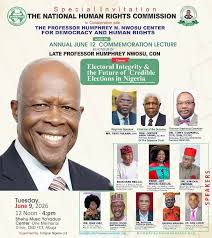
THE HUMPHREY NWOSU CENTRE: HISTORY REPACKAGED INTO POLICY
The establishment of the Prof. Humphrey Nwosu Centre for Democracy and Human Rights by NHRC represents a deliberate institutionalisation of historical memory.
Named after the electoral official associated with the 1993 election process, the centre reflects an attempt to transform June 12 from symbolic commemoration into policy infrastructure.
Its objectives are structured around four pillars:
Preserving Electoral Memory
It institutionalises lessons from the 1993 election, widely regarded as Nigeria’s most credible electoral exercise, while keeping alive unresolved debates on annulment and legitimacy.
Strengthening Electoral Reform Discourse
The centre provides a platform for:
- Electoral system reform proposals
- Reduction of electoral violence
- Improved institutional independence
- Anti-corruption safeguards in elections
Reframing Elections as Human Rights Issues
It advances the argument that voting is not merely procedural, but a protected civil right requiring:
- Safety
- Freedom from coercion
- Equal political participation
- Protection from intimidation
Creating a Policy Dialogue Hub
The centre convenes:
- Electoral officials
- Lawmakers
- Security agencies
- Civil society actors
It also supports research, civic education, and annual June 12 policy engagements.
CRITICAL ASSESSMENT: POWER WITHOUT ENFORCEMENT
Despite its growing visibility, NHRC’s influence remains structurally limited.
Its constraints include:
- No prosecutorial authority
- Dependence on institutional cooperation
- Limited operational reach during nationwide elections
- Resource and enforcement gaps
These limitations mean its impact is largely interpretive rather than coercive—it documents, advises, and pressures, but does not compel compliance.
Yet in Nigeria’s contested electoral environment, documentation itself becomes a form of power.
BETWEEN SYMBOLISM AND SYSTEM
June 12 remains a political marker of unfinished democratic consolidation.
The NHRC’s interventions—through monitoring, advocacy, and the creation of the Humphrey Nwosu Centre—reflect an attempt to convert historical grievance into institutional learning.
But the central tension remains unresolved: Nigeria’s democracy continues to rely on institutions that can describe electoral failure more effectively than they can prevent it.
Until that gap closes, June 12 will remain both a celebration and an indictment—of progress made, and of democratic promises still under strain.




Leave a Reply