
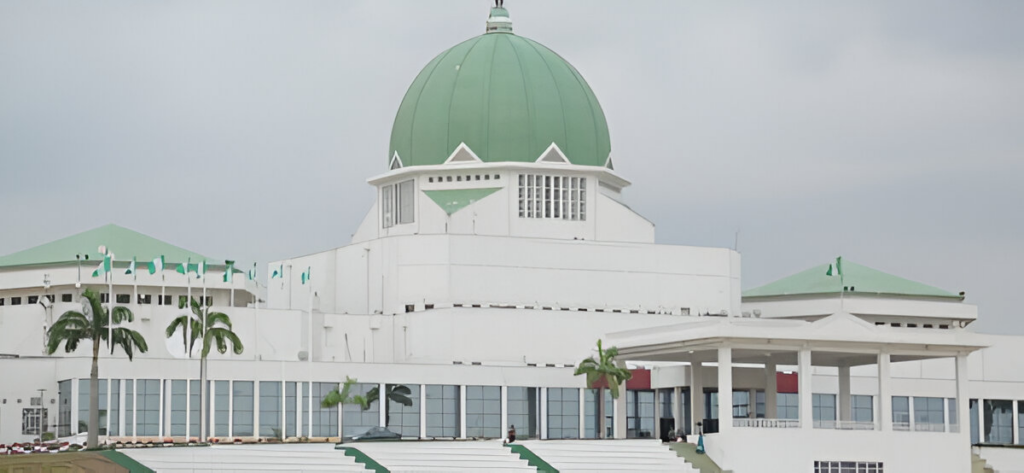
Tension persists between citizens’ right to protest and security restrictions at Nigeria’s federal legislature.
By Idris Abubakar | Abuja, Nigeria
The National Assembly Arcade in Abuja has emerged as a contested civic space, reflecting the growing tension between citizens seeking direct access to lawmakers and authorities enforcing security restrictions.
While many Nigerians view the forecourt as a symbolic gateway to democratic engagement, security officials insist it remains a controlled zone within a sensitive government facility.
Located at the front of the National Assembly complex, the arcade is one of the most recognisable areas within Nigeria’s federal legislature. Over the years, it has increasingly drawn attention as a potential protest ground, despite not being designed for that purpose.
Originally conceived during the military era, the space serves as a ceremonial corridor linking key parts of the legislative complex. It is routinely used by lawmakers, dignitaries, and officials during formal state functions.
However, public perception has gradually redefined its role. Civil society groups, labour unions, and activists now see the arcade as a natural point to channel grievances directly to elected representatives.
This divergence in perception has repeatedly led to confrontations between protesters and security personnel, particularly at entry points to the complex.
Security Restrictions and Controlled Access
According to officials within the National Assembly, access to the arcade has been significantly restricted due to security concerns.
The Assistant Director, Sergeant-at-Arms, Ikechukwu Alaribe, explained that the space was originally intended as an interface point where lawmakers could engage directly with constituents and organised groups.
In practice, however, demonstrations are now largely confined to the outer security perimeter, commonly known as the Mopol Gate. Protesters are typically stopped at this point, with security operatives preventing further movement into the complex.
Position papers submitted during protests are collected by officials and forwarded to relevant legislative committees, which may engage representatives of the demonstrators where necessary.
Despite these restrictions, limited access is occasionally granted to organised groups such as the Nigeria Labour Congress for formal presentations.
Democracy, Rights and Legal Boundaries
Nigeria’s return to democratic governance in 1999 expanded expectations around civic participation and access to power. Citizens increasingly view public institutions as spaces where demands can be directly presented to elected officials.
The 1999 Constitution guarantees freedom of assembly and association, while international frameworks such as the International Covenant on Civil and Political Rights and the African Charter on Human and Peoples’ Rights reinforce the right to peaceful protest.
However, these rights are not absolute. Authorities are permitted to impose restrictions in the interest of public order and national security, particularly within high-security zones like the National Assembly.
Under the Nigeria Police Act 2020, law enforcement agencies are tasked with balancing the protection of demonstrators with the need to maintain public safety.
Recent years have seen several confrontations that highlight this tension. Protesters have occasionally attempted to breach security perimeters, prompting forceful responses from security agencies, including dispersals and restricted access orders.
Global Comparisons and Local Gaps
In other democracies, clearer frameworks exist for protests near legislative institutions.
In the United States, demonstrations are permitted around the Capitol under regulated conditions. In the United Kingdom, Parliament Square serves as a recognised protest ground, while South Africa allows demonstrations in designated areas near Parliament in Cape Town.
These systems provide structured access, enabling citizens to protest within proximity to lawmakers without compromising institutional security.
In Nigeria, however, the absence of clearly defined protest zones around the legislature continues to create ambiguity and friction.
The unresolved status of the National Assembly Arcade highlights a broader gap in Nigeria’s democratic framework—balancing civic engagement with institutional security. Without clear policies defining where and how citizens can lawfully protest near the legislature, recurring confrontations are likely to persist.










Leave a Reply