
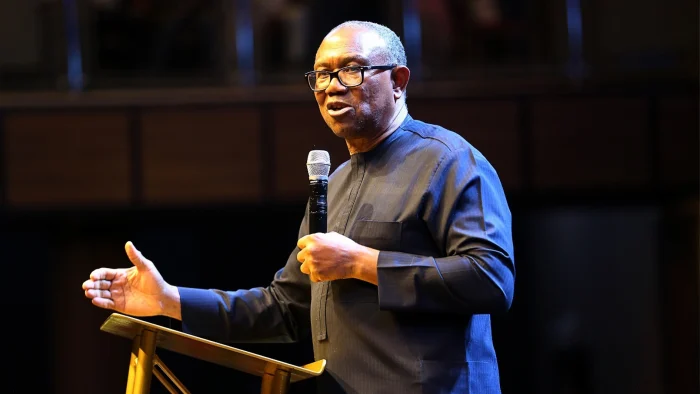
Former Labour Party presidential candidate says Africa’s greatest challenge is not a lack of resources but a leadership deficit, urging diaspora communities to become advocates for democratic accountability and institutional reforms.
By A1NEWS International
ABUJA, Nigeria / NEW YORK, United States — July 12, 2026
Former Labour Party presidential candidate Peter Obi has called on Africans living abroad to become active advocates for good governance, democratic accountability and credible elections, arguing that the continent’s future depends not on its abundant natural wealth but on the emergence of competent, transparent and visionary leadership.
Obi made the appeal during a keynote address delivered at the Mandela Hall of the African Union Permanent Observer Mission to the United Nations in New York, where he spoke on the theme: “The Role of the Diaspora African in Sustainable Development Across Africa.”
His remarks, later published on his official X account on Sunday, come at a time when many African nations are confronting persistent governance challenges, electoral disputes, youth unemployment, institutional weaknesses and growing demands for political reforms.
Addressing members of the African diaspora, policymakers and development stakeholders, Obi argued that Africans living abroad possess unique experiences and influence that can help shape democratic governance and sustainable development across the continent.
Africa Rich in Resources, Poor in Leadership
In his address, Obi rejected the notion that Africa’s developmental challenges stem from a shortage of resources.
Instead, he described the continent as one of the world’s richest regions in both natural and human capital.
According to him, Africa’s greatest asset is its youthful population, entrepreneurial potential and vast agricultural resources.
He noted that the continent is home to more than 1.5 billion people, including over one billion young people of productive age, while nearly one billion hectares of arable land remain available for cultivation, with approximately 60 percent still uncultivated.
Despite these enormous advantages, Obi observed that Africa continues to account for one of the highest concentrations of people living in extreme poverty.
He argued that the contradiction reflects a deeper governance crisis rather than a resource deficit.
“The question, therefore, is simple. With all these advantages, why has Africa not been able to lift its people out of poverty?” Obi asked.
According to him, the answer lies in what he described as “the missing link”—leadership characterised by competence, capacity, compassion, integrity and commitment to public service.
Diaspora Africans Have a Democratic Responsibility
Obi challenged Africans living overseas to move beyond remittances and humanitarian support by becoming stronger voices for democratic reforms in their countries of origin.
He noted that many members of the diaspora reside in countries where democratic institutions function effectively, accountability mechanisms are stronger and the rule of law is more firmly entrenched.
That exposure, he argued, places a responsibility on them to promote similar values across Africa.
According to Obi, diaspora communities should consistently engage political leaders, challenge poor governance and advocate institutional reforms whenever democratic principles are undermined.
He stressed that even where constitutional provisions prevent them from voting, their influence through advocacy, diplomacy, public engagement and international networks remains significant.
“It is time to become stronger advocates for good governance. Even where you cannot vote, your voices matter,” he said.
He further urged diaspora Africans to speak truth to political leaders during overseas engagements and demand greater accountability in governance.
Credible Elections Central to Africa’s Future
A major focus of Obi’s address was the importance of electoral integrity in strengthening democratic institutions.
He described free, fair and credible elections as the cornerstone of legitimate governments capable of implementing policies that improve citizens’ welfare.
According to him, electoral transparency provides the foundation upon which competent leadership, economic reforms and sustainable development can be built.
Obi therefore called on Africans abroad to remain actively involved in promoting electoral credibility across the continent through advocacy, civic education and constructive engagement.
He argued that strengthening electoral processes would ultimately improve governance, attract investment and enhance political stability.
Lessons from Asia’s Development Experience
Drawing comparisons with rapidly developing economies, Obi pointed to Japan, China and India as countries whose diaspora communities contributed significantly to national transformation.
He observed that governments in those countries created enabling environments that encouraged skilled professionals abroad to return home, invest or contribute their expertise to national development.
According to him, African governments can achieve similar outcomes by implementing policies that attract diaspora investment, encourage knowledge transfer and create opportunities for professionals in sectors such as healthcare, education, technology and entrepreneurship.
He said Africa possesses a vast reservoir of highly skilled professionals working in leading institutions around the world whose expertise could significantly accelerate development if effectively harnessed.
Beyond Remittances: Unlocking Diaspora Potential
Experts have consistently identified Africa’s diaspora community as one of the continent’s most valuable development assets.
Beyond billions of dollars in annual remittances, diaspora professionals contribute through investments, technology transfer, academic collaboration, healthcare delivery and business development.
Development economists argue that stronger governance, improved security, policy consistency and transparent institutions would encourage greater diaspora participation in national development initiatives.
Analysts also note that confidence in electoral integrity often influences investment decisions, with stable democracies generally attracting higher levels of foreign direct investment and diaspora capital.
Political Context Ahead of Nigeria’s 2027 Elections
Obi’s remarks come as political activities continue to gather momentum ahead of Nigeria’s 2027 general elections.
Calls for electoral reforms, stronger democratic institutions and greater accountability have become central issues in the country’s evolving political discourse.
Observers say increasing engagement by diaspora communities may further influence conversations around governance reforms, election monitoring, transparency and institutional accountability in Nigeria and across Africa.
Although the former Anambra State governor did not directly reference Nigeria’s forthcoming elections, his emphasis on credible electoral processes aligns with ongoing national debates about strengthening democratic institutions.
Peter Obi’s appeal to Africans in the diaspora extends beyond a call for civic engagement; it reflects a broader argument that sustainable development begins with accountable leadership and credible democratic institutions.
By urging diaspora communities to become advocates for electoral integrity and good governance, Obi challenged Africans abroad to leverage their global exposure and influence in support of institutional reforms capable of transforming the continent.
As Africa continues to confront complex political and economic challenges, the role of its global diaspora may increasingly become a critical factor in shaping democratic governance, strengthening institutions and advancing sustainable development across the continent.





Leave a Reply