
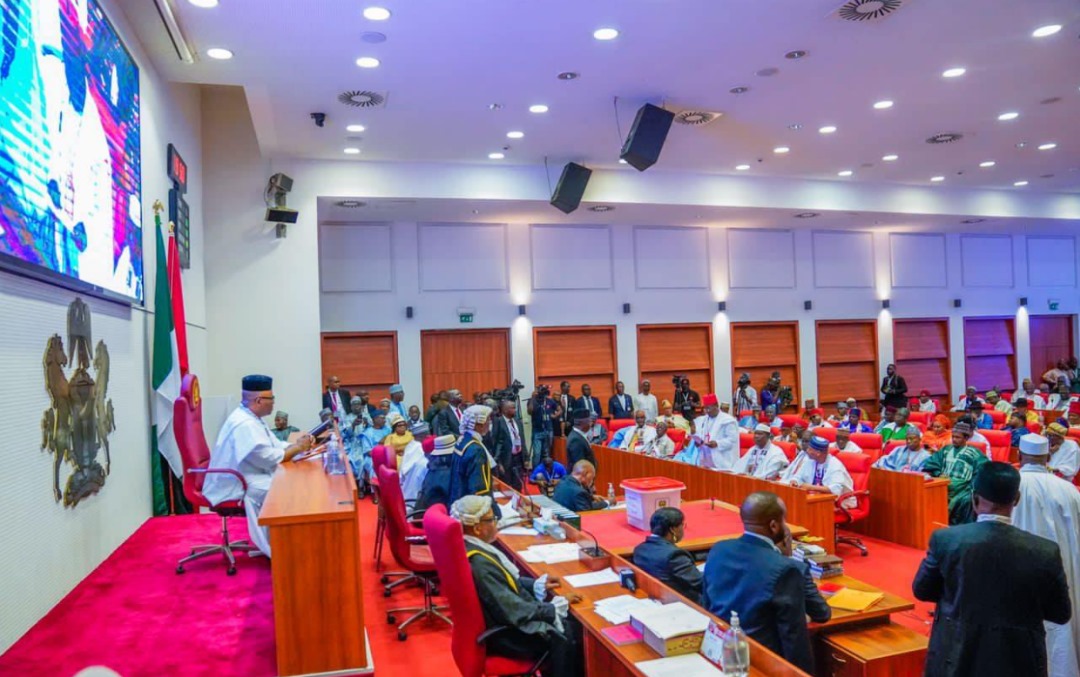
Upper chamber reverses disputed rule changes after lawmakers raise objections over alleged conflict with the 1999 Constitution.
By Umar Baba
ABUJA — May 8, 2026
The Nigerian Senate on Thursday rescinded controversial amendments made to its Standing Orders 2026 following mounting concerns among lawmakers that some provisions conflicted with the 1999 Constitution.
The decision came barely days after the upper legislative chamber approved amendments to portions of its rules, a move that sparked controversy and heated exchanges among senators during plenary sessions.
Senate Cites Constitutional Inconsistencies
Presenting the motion during plenary, Senate Leader Opeyemi Bamidele said a fresh legislative and constitutional review revealed that parts of the amendments could create legal inconsistencies.
According to him, provisions introduced under Order 2 Subsection 2 and Order 3 Subsection 1 appeared to conflict with Section 52 of the Constitution of the Federal Republic of Nigeria, 1999 (as amended).
“The Senate observes that upon further legislative and constitutional review, certain provisions introduced under Order 2 Subsection 2 and Order 3 Subsection 1 may give rise to constitutional inconsistencies and unintended tensions with the provisions of the Constitution,” Bamidele said.
He explained that the Senate retained the parliamentary authority to revisit and reverse previous decisions where necessary to protect the integrity of its legislative processes.
Chamber Rescinds Earlier Decision
Following deliberations, the Senate resolved to formally withdraw the amendments relating to the disputed sections of the Standing Orders.
The motion was seconded by Enyinnaya Abaribe.
Presiding over the session, Deputy Senate President Jibrin Barau described the reversal as necessary to ensure conformity with constitutional provisions.
“This is a very straightforward motion. It is just for us to go in conformity with the Constitution,” Barau stated.
He commended the Senate leadership for identifying the constitutional issues early and moving swiftly to address them.
Oshiomhole Criticises Amendment Process
However, former Edo State governor and senator representing Edo North, Adams Oshiomhole, faulted the process that led to the earlier amendments.
Oshiomhole argued that the Senate acted in haste to satisfy certain interests without allowing sufficient debate on the floor.
“The way we rushed the rules because certain people wanted certain things concluded is one flaw in this process,” he said.
His remarks triggered another round of exchanges among lawmakers during plenary.
In response, Bamidele invoked Rule 52(6) of the Senate Standing Orders, insisting that matters already decided upon could not be reopened without a substantive motion.
“If Senator Adams Oshiomhole had any issue with the earlier amendment, he ought to have brought a substantive motion for rescission,” Bamidele argued.
Senate Seeks to Avoid Further Controversy
The Senate Leader also expressed concern that controversies surrounding the amendments and the subsequent disagreements had overshadowed the legislative business of the upper chamber.
“Regardless of what was done in this hallowed chamber, what became the news was unnecessary drama, and we are not going to allow this to continue,” he stated.
The Senate Standing Orders regulate parliamentary procedures in the upper chamber, including debates, motions, voting procedures, disciplinary actions and conduct during plenary sessions.
The reversal of the disputed amendments underscores growing sensitivity within the Senate over constitutional compliance and internal parliamentary procedures as lawmakers seek to avoid further controversies capable of undermining the credibility of the legislative institution.






Leave a Reply