
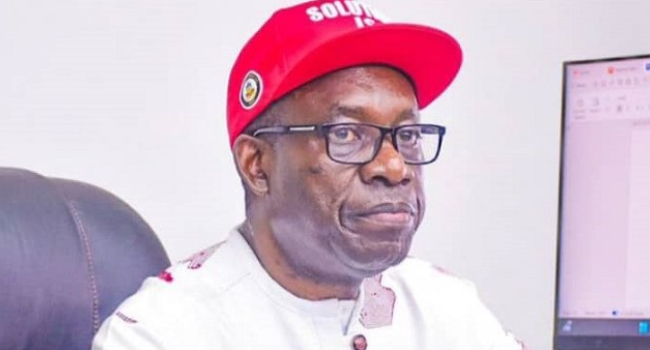
Aguocha cautions against forceful enforcement as governor threatens shop revocations over Monday shutdown defiance
By Oge Nkwocha | Onitsha, Nigeria
A fresh political and security tension is brewing in the South-East as a member of the House of Representatives, Obi Aguocha, has warned Anambra State Governor Chukwuma Soludo against adopting a forceful approach to end the Monday sit-at-home order.
The warning comes as the Anambra State Government intensifies enforcement measures, including the controversial closure of the Onitsha Main Market.
Aguocha Raises Alarm Over Rising Tensions
In a statement issued in Abuja, Aguocha expressed concern that the governor’s actions could destabilise what he described as a fragile peace gradually returning to the region.
According to the lawmaker, economic and social activities across the South-East had begun to recover through sustained engagement among stakeholders before the recent crackdown.
“Recent actions have unsettled the fragile peace achieved over time,” he said, warning that heavy-handed enforcement could reignite insecurity.
Link to Nnamdi Kanu’s Detention
Aguocha also tied the continued sit-at-home compliance to the detention of Nnamdi Kanu, leader of the Indigenous People of Biafra (IPOB).
He argued that failure to address underlying grievances, including Kanu’s case, could sustain agitation and cycles of unrest in the region.
“Until these root causes are addressed, the region may continue to experience recurring tensions,” he warned.
Soludo: ‘No Going Back’
Despite the criticism, Governor Soludo has maintained a firm stance, declaring that the Monday sit-at-home constitutes economic sabotage.
Speaking in Awka, the governor insisted that the closure of Onitsha Main Market would remain in effect and could escalate to revocation of shop ownership for defiant traders.
“We cannot continue to run a four-day economy,” Soludo said, stressing that the state must restore full commercial activity.
Threat of Shop Revocation
The governor disclosed plans to begin recertification of shop ownership, warning that traders who fail to open for business on Mondays risk losing their shops.
“If you are not ready to trade, others are willing,” he stated, signalling a tougher enforcement regime in the coming weeks.
Debate Over Legal Authority
Aguocha, however, challenged the legality of the state’s actions, arguing that the government lacks constitutional authority to compel private business owners to operate.
“The government cannot force or punish individuals over their business decisions,” he said, describing the policy as potentially unconstitutional and counterproductive.
Background: A Lingering Regional Challenge
The Monday sit-at-home began in 2021 following the arrest of Nnamdi Kanu. Although IPOB later announced its suspension, compliance has persisted due to fear, enforcement by non-state actors, and sporadic violence.
Successive governments in the South-East have struggled to fully restore normal economic activities, with enforcement efforts often triggering renewed tensions.
Rising Political Undercurrents
Governor Soludo has also alleged that certain political actors are sponsoring the sit-at-home for strategic gains, warning that such individuals would be exposed.
However, critics argue that coercive measures may deepen resistance rather than resolve the crisis.
The Bigger Picture
As the standoff intensifies, traders, residents, and security agencies are bracing for potential fallout from the policy.
The unfolding situation underscores the delicate balance between enforcing economic normalcy and managing deep-rooted political and security grievances in the South-East.









Leave a Reply