
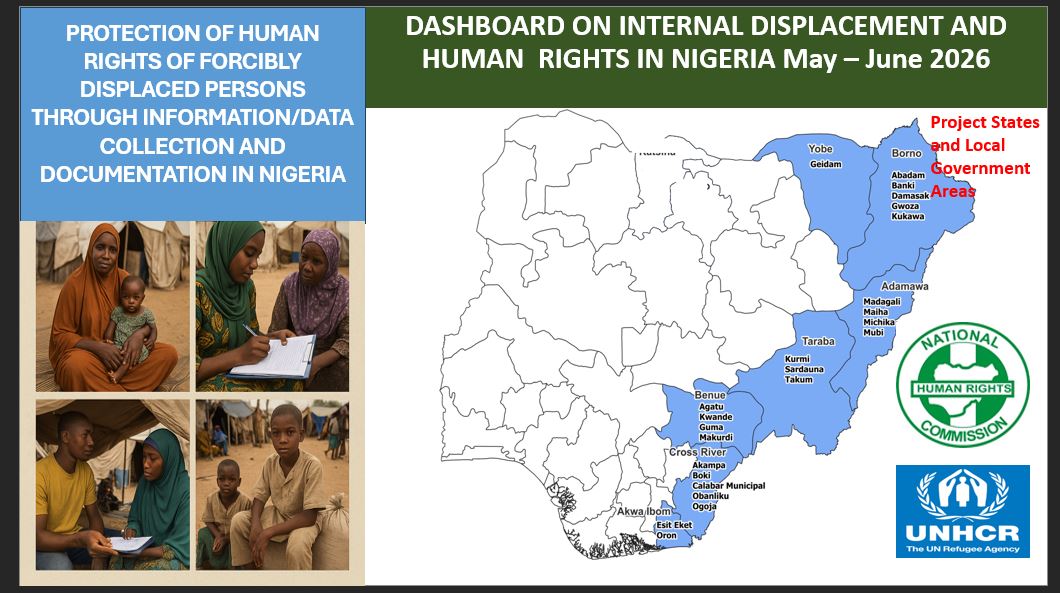
May–June 2026 NHRC-UNHCR dashboard reveals worsening insecurity, rising forced displacement, widespread rights violations and growing humanitarian concerns across Nigeria’s conflict-affected states.
By A1NEWS International
Abuja, Nigeria | July 29, 2026
Nigeria’s humanitarian crisis continues to deepen as fresh data released by the National Human Rights Commission (NHRC), with support from the United Nations High Commissioner for Refugees (UNHCR), paints a troubling picture of escalating insecurity, forced displacement and widespread human rights violations across several states.
The NHRC’s May–June 2026 Bi-Monthly Dashboard documents 7,764 newly displaced persons, 16,179 human rights incidents, over 5,640 displaced children, and thousands of refugees, asylum seekers and returnees within just two months, underscoring the enormous burden on humanitarian institutions and affected communities.
The report, covering Adamawa, Akwa Ibom, Benue, Borno, Cross River, Taraba and Yobe States, provides one of the most comprehensive official assessments of Nigeria’s internal displacement and human rights situation.
Conflict, Banditry and Climate Change Continue to Drive Displacement
According to the NHRC, insurgency, counter-insurgency operations, communal and ethnic conflicts, farmer-herder clashes, armed banditry, criminal violence and climate-related disasters remain the principal drivers of displacement across the monitored states.
The Commission also identified secondary displacement, where already displaced families are forced to flee repeatedly because of renewed violence or deteriorating humanitarian conditions.
Nearly 8,000 Nigerians Newly Displaced in Two Months
The dashboard recorded 7,764 internally displaced persons (IDPs) and forcibly displaced persons (FDPs) between May and June 2026.
State-by-state figures show:
- Borno: 3,630
- Benue: 2,977
- Taraba: 550
- Yobe: 306
- Adamawa: 225
- Cross River: 76
Borno and Benue alone accounted for more than 84 percent of all newly displaced persons recorded during the reporting period.
Women and Children Bear the Greatest Burden
The humanitarian emergency continues to disproportionately affect women and children.
The NHRC data shows:
- 4,057 female IDPs
- 3,707 male IDPs
- 5,640 displaced children
- 4,024 affected households
The figures reinforce long-standing concerns that women and children remain the most vulnerable victims of Nigeria’s multiple security crises.
Thousands Living as Refugees, Returnees and Asylum Seekers
Beyond internal displacement, the report documented:
- 118 asylum seekers
- 1,431 refugees
- 2,041 returnees
Adamawa recorded the highest number of returnees, while Benue hosted the largest refugee population among the project states.
More Than 16,000 Human Rights Violations Recorded
Perhaps the most disturbing finding in the report is the sheer scale of documented human rights violations.
The Commission recorded 16,179 human rights incidents, with Safety and Security violations accounting for 15,179 cases, representing more than 93 percent of all reported incidents.
Other violations included:
- Access to Education – 226
- Gender-Based Violence – 155
- Access to Socio-economic Rights – 137
- Documentation challenges – 101
- Access to Health – 93
- Child Protection – 90
- Social Cohesion – 64
- Right to Asylum – 58
- Freedom of Movement – 29
- Access to Justice – 22.
Yobe Emerges as Epicentre of Security Incidents
The dashboard identifies Yobe State as recording the overwhelming majority of safety and security incidents, with 15,117 cases, making it the highest among all monitored states.
The report also highlighted varying levels of gender-based violence across states, including domestic violence, spouse abandonment, emotional abuse, denial of resources, forced marriage and harassment, while noting that no rape cases were officially recorded during the reporting period.
NHRC Intensifies Community Interventions
To mitigate the crisis, the NHRC and its partners conducted extensive community outreach activities.
During the reporting period, officials carried out:
- 379 awareness sessions, reaching 7,379 people
- 82 key informant interviews, reaching 921 people
- 147 household interviews, involving 1,348 participants
- 72 detention monitoring visits, reaching 298 detainees.
These interventions focused on human rights awareness, protection monitoring, documentation, detention oversight and referrals for humanitarian assistance.
Some Positive Progress Despite Mounting Challenges
Despite the deteriorating security environment, the NHRC highlighted several achievements.
These include:
- Improved multi-sectoral coordination among humanitarian actors.
- Increased awareness of human rights and gender-based violence.
- Birth registration and civil documentation for displaced children.
- Referrals enabling displaced persons to obtain National Identification Numbers.
- Rescue of abused children.
- Intervention in unlawful detention cases leading to releases.
- Improved access to justice.
- Protection of widows’ inheritance rights through mediation.
- Strengthened peaceful coexistence between displaced persons and host communities.
Displacement Declines Slightly, But Crisis Remains Severe
Compared with March–April 2026, the report indicates:
- Displaced individuals declined from 8,472 to 7,764, representing an 8.36% reduction.
- Displaced children fell marginally from 5,772 to 5,640.
- Refugees increased by 18.8%.
- Asylum seekers dropped by 26.3%.
- Returnees declined slightly by 1.4%.
While the reduction in overall displacement may suggest modest improvements in some areas, humanitarian experts caution that the continued rise in refugee numbers and persistent insecurity indicate that Nigeria’s displacement crisis remains far from over.
The NHRC’s May–June 2026 dashboard provides compelling evidence that Nigeria’s humanitarian and human rights crisis remains one of the country’s most pressing national security challenges. Although targeted interventions have produced measurable gains in awareness, documentation, child protection and access to justice, the persistence of armed conflict, communal violence, criminality and climate-induced displacement continues to expose thousands of Nigerians to serious rights violations.
The findings underscore the urgent need for stronger security measures, expanded humanitarian assistance, durable solutions for displaced communities and greater accountability for human rights abuses if Nigeria is to reverse the cycle of displacement and vulnerability.









Leave a Reply