
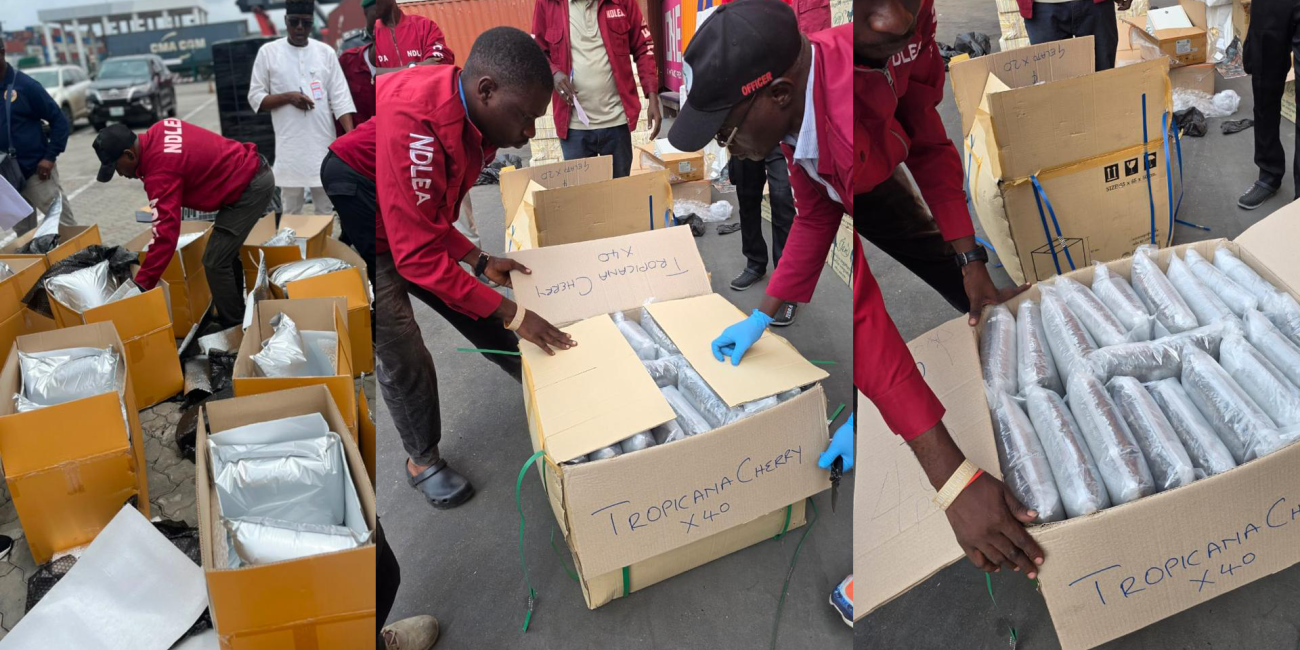
Two containers shipped from Thailand allegedly concealed 1.49 tonnes of synthetic cannabis in dry-fish, rice, spare-parts and paper consignments as NDLEA warns of new maritime trafficking corridor
By Anita Babalola
LAGOS, Nigeria — August 23, 2026
The National Drug Law Enforcement Agency (NDLEA) has intercepted 1,490.5 kilogrammes of suspected synthetic cannabis, popularly known as Thai Loud, in two containers at the Apapa and Lekki Deep Sea ports in Lagos, with the agency putting the combined street value of the seizures at more than ₦4.4 billion.
The interceptions, made during separate examinations on August 19 and August 21, involved containers shipped from the Port of Laem Chabang in Thailand.
According to the NDLEA, the seizures represent its first-ever interception of illicit drugs shipped from Thailand through Nigeria’s maritime corridor, raising concerns about the possible emergence of a new international trafficking route into the country.
The scale and concealment methods involved have also exposed the continuing challenge facing Nigeria’s maritime drug-control system, where legitimate cargo can provide cover for high-value illicit consignments.
Two Containers, One Emerging Trafficking Route
The two seizures were made at different Lagos ports but shared a critical link: both containers originated from Laem Chabang, Thailand.
At Apapa Port, NDLEA operatives, working alongside the Nigeria Customs Service and other agencies, examined a container on Friday, August 21.
The container had reportedly been declared as carrying legitimate commodities, including dry fish, rice, vehicle spare parts, turmeric soap and inverter batteries.
Instead, investigators allegedly discovered 1,090.5kg of Thai Loud packed in 54 cartons.
The cartons contained 2,181 sachets, with each sachet weighing approximately 500 grammes, according to the NDLEA.
The discovery represents the larger of the two consignments and highlights the potential sophistication of maritime trafficking operations in which illicit substances are concealed among apparently legitimate commercial goods.
Lekki Port Consignment Hidden Behind Paper
A second seizure occurred at the Lekki Deep Sea Port, where NDLEA’s Marine Special Operations Unit had placed a container on its watchlist following intelligence and monitoring.
The container was examined on Wednesday, August 19.
According to the agency, officers discovered seven pallets wrapped in black nylon.
Four of the pallets allegedly contained Thai Loud, amounting to 400kg packed in 96 cartons and 400 parcels.
The remaining three pallets contained 798 rims of A4 paper, which the NDLEA said had been used as cover for the illicit consignment.
The concealment method suggests an attempt to make the shipment appear consistent with ordinary commercial cargo while reducing the likelihood of detection during routine inspection.
N4.4 Billion Street Value Raises Alarm
The NDLEA said the combined street value of the seized Thai Loud exceeded ₦4.4 billion.
That valuation underscores the financial incentive for international drug syndicates to exploit Nigeria’s maritime infrastructure.
A shipment of this scale is unlikely to represent a casual or isolated operation. It points, at minimum, to an organised supply chain involving procurement, international shipping, concealment, port logistics and intended distribution.
The key investigative question now is not only who shipped the drugs, but also who was expected to receive and distribute them inside Nigeria.
Thailand-Nigeria Maritime Route Under Investigation
The agency described the seizures as its first-ever interception of illicit drugs shipped from Thailand through the maritime corridor.
Both containers originated from Laem Chabang, suggesting that investigators will need to examine whether the two consignments are connected.
Important areas of investigation could include:
- The exporters and consignors listed on the shipping documents.
- The declared importers and ultimate beneficiaries.
- Shipping and transshipment routes.
- Port documentation and cargo clearance records.
- Customs declarations.
- Freight-forwarding arrangements.
- Financial transactions linked to the shipments.
- Previous consignments associated with the same companies or individuals.
- The intended Nigerian distribution network.
If the consignments are linked to the same trafficking network, the case could reveal a previously under-detected international supply chain.
A Wider National Drug Interdiction Operation
The Lagos port seizures formed part of a much wider series of NDLEA operations reported across Nigeria.
The agency said its commands in several states recovered cannabis, cocaine, methamphetamine, tramadol, codeine, diazepam, flunitrazepam and other controlled substances.
The range of drugs intercepted illustrates the diversity of Nigeria’s illicit drug market—from locally cultivated cannabis to internationally trafficked synthetic substances and pharmaceutical drugs.
Akwa Ibom: Drugs Intercepted On High Seas
In Akwa Ibom State, NDLEA operatives reportedly intercepted a wooden boat on Friday, August 21, allegedly transporting illicit drugs towards fishing settlements in Cameroon.
Three suspects were arrested aboard the vessel.
The agency said 42.622kg of narcotics, including skunk and cocaine, was recovered.
One suspect, identified as 27-year-old Kingsley Effiong John, was allegedly found with 20 grammes of cocaine concealed inside a larger wrap of edible cassava fufu, alongside 435 grammes of skunk.
The incident highlights another dimension of Nigeria’s drug-control challenge: maritime trafficking does not occur only through major commercial ports but can also exploit coastal waterways and informal fishing routes.
Ondo Cannabis Farms Destroyed
In Ondo State, NDLEA operatives reportedly destroyed approximately 10,000kg of skunk cultivated across four hectares of cannabis farmland in Ijare Forest, Ifedore Local Government Area.
The agency also reported the recovery of another 210kg of skunk in Ita-Ogbolu, Akure North Local Government Area.
The destruction of large cannabis farms is significant because domestic cultivation provides a separate supply stream from imported drugs.
It also demonstrates that Nigeria’s drug problem has both international and domestic production components.
Kwara: Methamphetamine Intercepted
In Kwara State, NDLEA officers reportedly recovered 1.325kg of methamphetamine alongside quantities of cannabis from a Toyota Starlet intercepted along the Ogbomosho-Ilorin Expressway.
A 22-year-old suspect, Muhammadu Usman, was arrested in connection with the seizure.
The interception highlights the importance of Nigeria’s road network to the movement of illicit substances after they enter the country or are produced domestically.
Oyo: Elderly Suspect Arrested With Drug Cocktail
In Oyo State, officers reportedly arrested 65-year-old Adebayo Kaosarat with several controlled substances.
The NDLEA listed the seized substances as:
- 1.795kg of Scottish Loud;
- 1.66kg of tramadol;
- 600 grammes of codeine syrup;
- 125 grammes of diazepam; and
- 50 grammes of flunitrazepam.
The case demonstrates the increasingly diverse range of substances being intercepted in Nigeria’s illicit drug market.
Kano And Abia Operations
In Kano State, NDLEA operatives reportedly recovered 73.3kg of skunk packed in 98 blocks during a raid on Hadeija Road.
A 31-year-old suspect, Chibuzor Madueke, was arrested.
In Abia State, officers reportedly recovered 14.4kg of Loud, 2.3kg of Colorado, 386 grammes of tramadol and 134 grammes of rohypnol from the residence of 36-year-old Ikechukwu Anthony Iwuno in Umuahia South Local Government Area.
The seizures further demonstrate how illicit drug distribution networks operate across different regions and transportation corridors.
Seme Border: Family Members Arrested
The NDLEA also reported the arrest of three members of a family near the Seme border in Lagos.
The agency said 48kg of skunk was recovered during the operation.
Border areas remain particularly sensitive to drug-control agencies because traffickers can exploit legitimate cross-border movement and informal routes to transport illicit substances.
Abuja: 24,410 Tramadol Capsules Intercepted
In the Federal Capital Territory, NDLEA officers reportedly intercepted 24,410 tramadol capsules concealed inside three waybill packages.
The packages were reportedly hidden inside a Hummer bus travelling from Enugu to Zuba.
A follow-up operation allegedly led to the arrest of 28-year-old Sunday Eze, identified by the agency as the alleged owner of the consignment, in Kontagora, Niger State.
The operation demonstrates the importance of tracing consignments beyond the point of interception to identify their alleged owners and wider distribution networks.
The 101-Year-Old Cannabis Suspect
In a separate development, NDLEA Chairman/Chief Executive Officer Brig. Gen. Mohamed Buba Marwa (retd.) directed that a 101-year-old woman arrested in Ogun State for allegedly selling cannabis be granted bail and placed under counselling because of her advanced age.
Her daughter was reportedly also arrested over alleged involvement in drug dealing.
Marwa’s directive introduces a public-health and humanitarian dimension to drug enforcement, particularly regarding elderly suspects and the distinction between punishment, rehabilitation and treatment.
The Bigger Investigation: How Much Gets Through?
The Lagos seizures raise a broader question for Nigeria’s drug-control system.
If these consignments represent the first detected shipments from Thailand through the maritime corridor, investigators must determine whether the route is genuinely new—or whether previous shipments have passed through undetected.
That distinction is crucial.
The interception of nearly 1.5 tonnes of suspected synthetic cannabis demonstrates that trafficking organisations are willing to invest substantial resources in international logistics.
But a seizure only reveals the portion detected by authorities.
The more difficult investigative task is determining how many similar consignments may have entered the country through other ports, routes or concealment methods.
Port Security And Inter-Agency Coordination
The Apapa seizure involved the NDLEA, Customs and other government agencies, while the Lekki operation was reportedly driven by intelligence from the NDLEA’s Marine Special Operations Unit.
The operations demonstrate the importance of intelligence sharing across agencies responsible for Nigeria’s maritime borders.
However, the scale of the consignments also raises questions about the vulnerability of containerised cargo.
With thousands of containers moving through Nigeria’s ports, physical inspection of every shipment is impractical. Authorities therefore depend heavily on intelligence-led risk profiling, cargo documentation, scanning technology and targeted examinations.
The effectiveness of those systems will determine whether emerging trafficking routes are detected early or become entrenched.
Following The Money
The seizure of drugs worth more than ₦4.4 billion creates an opportunity for investigators to go beyond the physical recovery of narcotics.
A comprehensive investigation should follow the financial trail behind the shipments.
Who paid for the drugs?
Who financed transportation?
Who paid freight and port-related charges?
Who owns the importing companies?
Who was scheduled to clear the containers?
Where were the drugs expected to be distributed?
And are there links between the companies involved in the two Thailand-origin shipments?
Answering these questions could help investigators dismantle the networks rather than simply confiscate their products.
The interception of more than 1.49 tonnes of suspected Thai Loud at Apapa and Lekki ports is a major drug-control operation and a warning that international trafficking networks may be exploring new maritime routes into Nigeria.
The NDLEA’s claim that these represent its first seizures of illicit drugs shipped from Thailand through Nigeria’s maritime corridor makes the development particularly significant.
But the real test will come after the seizure.
Authorities must identify the importers, financiers, facilitators and intended distributors behind the consignments and determine whether the two containers are connected.
The investigation should also establish whether the Thailand-Nigeria corridor is genuinely new or merely newly detected.
For Nigeria’s ports, the case reinforces the need for intelligence-led cargo screening, stronger inter-agency cooperation and comprehensive monitoring of high-risk maritime routes.
For the NDLEA, the seizure is a success—but the ultimate measure of success will be whether the agency can use the evidence inside those containers to trace and dismantle the network that put them there.
EDITORIAL VERIFICATION NOTE:
The quantities, street-value estimates, concealment methods, arrests and operational details in this report are based on information attributed to the NDLEA. Allegations against arrested suspects remain allegations unless established by a court of law.











Leave a Reply