
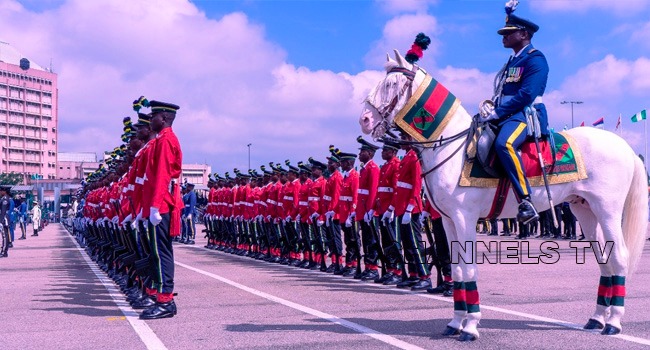
From initial denials to court-martial proceedings, unfolding plot raises questions on military discipline, transparency, and democratic stability
By Baron Stanley Eloagu | Abuja, Nigeria
Nigeria’s military has confirmed that several serving officers will face trial over an alleged plot to overthrow the government of Bola Ahmed Tinubu, marking a significant escalation in what is now one of the country’s most serious security developments since the return to civilian rule in 1999.
The confirmation by the Defence Headquarters signals a shift from earlier denials and places the matter firmly in the realm of military justice and national security scrutiny.
From Denial to Official Admission
The Defence Headquarters (DHQ) had initially dismissed reports linking the October 2025 arrests of military personnel to any coup attempt, describing them as routine disciplinary cases.
However, authorities have now confirmed that investigations uncovered an alleged coordinated plan to seize power, with implicated officers set to be arraigned before a military judicial panel in accordance with the Armed Forces Act.
Inside the Alleged Conspiracy
Security findings suggest the plot went beyond internal dissent, involving personnel drawn from the Army, Navy, and Air Force.
Investigators allege that the network conducted covert surveillance on critical national assets, including:
- The Presidential Villa (Aso Rock)
- Key military formations
- Major international airports
Sources also indicate that encrypted communication channels were used, alongside alleged financial inducements and operational documents outlining roles and targets.
Officials say these elements point to early-stage coup planning rather than isolated misconduct.
Regional Context Raises Stakes
The alleged plot has drawn international attention, particularly against the backdrop of recent coups across West and Central Africa.
Analysts warn that any instability in Nigeria—Africa’s largest economy—could have far-reaching regional implications.
The cancellation of the October 1, 2025 Independence Day parade further intensified speculation at the time, with observers now linking the decision to underlying security concerns.
Officers Under Investigation
Military authorities confirmed the detention of at least 16 officers across various ranks and service branches.
While official figures remain limited, security sources suggest the number of individuals connected to the alleged conspiracy may exceed 30, including non-commissioned officers and civilian collaborators.
Major General Samaila Uba stated that findings have been forwarded to appropriate authorities for prosecution under military law.
Leadership Shake-Up Sparks Questions
In October 2025, President Tinubu approved a major reshuffle of top military leadership.
Although described officially as routine, observers have linked the changes to the unfolding coup investigation, raising concerns about transparency and crisis management within the security establishment.
Legal and Political Implications
Under Nigeria’s military law, attempting to overthrow a constitutional government carries severe penalties, including life imprisonment or capital punishment in extreme cases.
Legal experts stress that due process and transparency will be critical to maintaining public confidence, especially given earlier contradictions in official statements.
Civil society groups and political stakeholders are calling for clarity on the timeline of events, intelligence handling, and how the alleged threat was neutralised.
What Happens Next
With investigations concluded, military authorities say the focus now shifts to court-martial proceedings aimed at enforcing discipline and safeguarding constitutional order.
Ongoing probes are also expected to examine:
- Financial networks linked to the suspects
- Possible civilian collaborators
- Any political connections
Officials emphasise that investigations do not equate to guilt, but insist that accountability is essential given the gravity of the allegations.
Global Attention on Nigeria
International observers are closely monitoring developments, focusing on:
- Nigeria’s democratic resilience
- Civil-military relations
- Regional security stability
- Transparency in handling the case
The outcome of the trials is expected to shape perceptions of Nigeria’s institutional strength and commitment to democratic governance.
From initial denials to confirmed court-martials, the alleged 2025 coup plot has evolved into a defining moment for Nigeria’s democracy.
How the military and government handle the trials—and how openly the process unfolds—could have lasting implications for national stability and international confidence.





Leave a Reply