
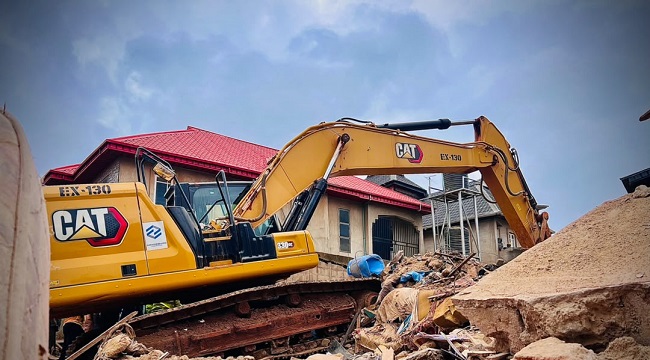
Rescue operations continue in Ogun after a building reportedly sank into the ground, while Anambra vows prosecution, demolition of unsafe structures and sweeping reforms following deadly hostel collapse.
By Kiki Oladele and Anayo Onyegbula
Ajuwon, Ogun State / Awka, Anambra State — July 28, 2026
Two separate building disasters in Ogun and Anambra states have once again exposed Nigeria’s deepening structural safety crisis, reigniting concerns over weak regulatory enforcement, substandard construction practices, poor urban planning and official negligence.
In Ogun State, at least three people lost their lives while twelve others, including two newborn babies, were rescued after a two-storey building reportedly sank into the ground following heavy rainfall and a thunderstorm in Ajuwon, Ifo Local Government Area.
Meanwhile, in Anambra State, the government has constituted a high-powered investigative panel and vowed to prosecute anyone found culpable in the collapse of a private student hostel near the Federal Polytechnic, Oko, where at least two people have died and fears remain that additional victims may still be trapped beneath the rubble.
Together, the incidents have renewed calls for stricter enforcement of Nigeria’s building regulations and greater accountability among developers, regulatory agencies and property owners.
Three Dead, Twelve Rescued After Ogun Building Reportedly Sank into the Ground
Heavy Rainfall Preceded Disaster
Residents of Baale Road in Ajuwon were thrown into panic on Monday afternoon after a two-storey residential building reportedly began sinking into the ground before collapsing following hours of heavy rainfall and a thunderstorm.
Eyewitnesses said the incident occurred at approximately 2:00 p.m., trapping occupants beneath the debris.
Emergency responders from multiple agencies immediately converged on the scene as frantic rescue efforts began.
NEMA Coordinates Large-Scale Rescue Operation
The South-West Zonal Director of the National Emergency Management Agency (NEMA), Saheed Akiode, confirmed that emergency personnel rescued 12 occupants alive, including two babies less than two months old, while three bodies had been recovered from the rubble.
According to him, rescue operations remained ongoing as officials worked to determine whether additional victims were still trapped beneath the collapsed structure.
“The operation is still ongoing, and we need to ensure that the building is brought down to ground level so that we can access everything underneath,” Akiode said.
He explained that NEMA immediately activated all emergency response mechanisms upon receiving reports of the incident, deploying personnel alongside other rescue agencies to coordinate search-and-recovery efforts.
Demolition Ordered to Prevent Further Collapse
Structural engineers assessing the site concluded that adjoining buildings posed an immediate danger to residents and rescue workers.
Consequently, emergency authorities from Ogun and Lagos States jointly approved the demolition of nearby structures to prevent secondary collapses.
The decision was announced jointly by:
- Ogun State Commissioner for Works and Infrastructure, Ade Akinsanya
- Permanent Secretary of the Lagos State Emergency Management Agency (LASEMA), Dr. Olufemi Oke-Osanyintolu
Heavy-duty excavation equipment has since been deployed to accelerate debris removal.
Meanwhile, anxious residents have begun evacuating personal belongings from neighbouring buildings as precautionary measures continue.
Investigators Probe Whether Soil Failure, Drainage or Structural Defects Triggered Collapse
Although the exact cause of the incident has yet to be officially determined, engineers and disaster management experts say several factors may have contributed to the disaster.
Among the issues expected to feature prominently during investigations are:
- Possible soil subsidence.
- Weak building foundations.
- Poor drainage systems.
- Water infiltration after prolonged rainfall.
- Structural design deficiencies.
- Possible regulatory violations.
Experts note that buildings described as having “sunk into the ground” often indicate serious foundation instability rather than conventional structural collapse.
The outcome of ongoing technical investigations is expected to determine whether negligence played a role.
Anambra Constitutes Independent Investigation Panel
Government Rejects Speculation
Following the collapse of Elite Five Star Lodge, a privately owned student hostel near the Federal Polytechnic, Oko, the Anambra State Government has inaugurated a multidisciplinary investigative panel to establish the precise cause of the disaster.
Commissioner for Physical Planning and Urban Development, Chijioke Ojukwu, said the panel comprises:
- Structural engineers.
- Architects.
- Builders.
- Town planners.
- Officials of the Ministry of Physical Planning.
- Representatives of the Anambra State Materials Testing Laboratory.
According to Ojukwu, the objective is to replace speculation with scientific findings and determine responsibility based on technical evidence.
Government Expands Investigation Beyond Collapsed Hostel
Authorities disclosed that the panel’s assignment extends beyond the collapsed building.
Residents have reportedly submitted intelligence identifying several nearby buildings suspected of exhibiting similar structural weaknesses.
The government says every identified building will undergo comprehensive structural integrity assessments.
Officials warned that any building found to pose danger to occupants would be demolished.
Management Accused of Ignoring Structural Warning Signs
Perhaps the most disturbing revelation emerging from preliminary investigations is the allegation that the hostel’s management was already aware of structural defects before the collapse.
According to Commissioner Ojukwu, rather than evacuating residents and notifying government authorities, management allegedly continued renting rooms and collecting payments.
If substantiated, the allegations could significantly strengthen possible criminal negligence prosecutions.
Authorities also disclosed that attempts to contact the management after the collapse have failed, with telephone numbers reportedly switched off.
The matter has now been handed over to the Nigeria Police Force.
Government Vows Criminal Prosecution and Tougher Sanctions
The Anambra State Government says individuals found responsible for the collapse will face prosecution.
Beyond criminal proceedings, government officials are proposing far-reaching reforms.
Among the measures under consideration are:
- Criminal prosecution of negligent developers.
- Revocation of land titles where buildings collapse due to proven negligence.
- Mandatory structural integrity testing.
- Strengthened building approval procedures.
- Increased monitoring of construction projects.
- Enhanced enforcement of professional standards.
Officials believe the reforms will serve as a deterrent against future violations.
Nigeria’s Building Collapse Crisis Persists
The Ogun and Anambra incidents add to Nigeria’s growing list of building failures recorded over the past decade.
Urban development experts say recurring collapses reveal systemic weaknesses that include:
- Poor regulatory enforcement.
- Use of substandard construction materials.
- Unqualified contractors.
- Weak professional supervision.
- Illegal building modifications.
- Corruption within approval processes.
- Failure to conduct routine structural inspections.
Professional bodies have repeatedly urged governments to enforce existing building codes rather than introducing new regulations without implementation.
Analysis: A National Infrastructure and Governance Challenge
While rescue operations often dominate public attention immediately after building collapses, experts argue that the larger issue lies in preventing such disasters before they occur.
Urban planners contend that Nigeria requires a proactive rather than reactive regulatory framework.
This would include routine inspections of aging buildings, stronger sanctions for violations, digital monitoring of construction approvals, independent structural audits and greater accountability for professionals involved in building projects.
Disaster management specialists also advocate improved public awareness to encourage residents to report visible structural defects before they escalate into catastrophic failures.
The tragedies in Ogun and Anambra are painful reminders that building collapses remain one of Nigeria’s most preventable disasters.
While emergency responders continue saving lives and governments promise investigations and prosecutions, the real test will be whether the findings translate into meaningful reforms capable of preventing future tragedies.
For grieving families, accountability cannot end with rescue operations or official condolences. It must result in stronger enforcement, safer construction practices and a regulatory system that prioritises human lives above profit.
Until then, every new building collapse will continue to raise uncomfortable questions about governance, professional ethics and the true cost of regulatory failure.







Leave a Reply