
By Umar Baba
ABUJA, Nigeria — Aug. 28, 2026 — The Federal Government has awarded contracts for the rehabilitation of 13 police training institutions nationwide, with work expected to run for three weeks, ahead of the Nigerian Police Force’s planned recommencement of training programmes.
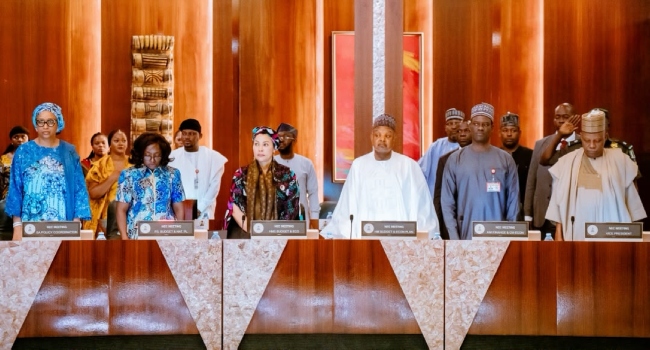
The announcement was made during the 160th meeting of the National Economic Council (NEC) in Abuja, chaired by Vice President Kashim Shettima, where the Council also endorsed the Revised National Social Protection Policy (NSPP: 2026–2030).
Federal officials say the rehabilitation effort is designed to bring police training facilities up to operational standard—ensuring the readiness of institutions that will host new training intakes for the Nigerian Police Force.
Rehabilitation set for three weeks, targeting training readiness
According to Stanley Nkwocha, Senior Special Assistant to the President on Media & Communications (Office of the Vice President), the updates on the police training institution rehabilitation were presented Thursday in Abuja during NEC’s deliberations.
The rehabilitation, Nkwocha explained, is expected to last three weeks, and is intended to “put the institutions in shape” for the next phase of training programmes under the Nigerian Police Force.
Officials framed the initiative as part of broader state-capacity building—arguing that training quality depends on the condition of facilities used for recruitment preparation, professional development, and ongoing skill-building.
NEC also endorses Revised National Social Protection Policy (2026–2030)
While the police training rehabilitation dominated parts of the discussion, the NEC meeting delivered another major policy outcome: endorsement of the Revised National Social Protection Policy (NSPP: 2026–2030) as presented by Abubakar Bagudu, the Minister of Budget and Economic Planning.
The federal government described the policy framework as a national blueprint aimed at improving how social protection is coordinated, financed, implemented, monitored, and made accountable across the federation.
Key recommendations under the NSPP: 2026–2030 include aligning state-level social protection systems—including policies, laws, budgets, and implementation plans—with the revised national framework.
Proposed creation of National Social Protection Council
The endorsed policy proposes establishing a National Social Protection Council to provide overarching oversight for coordination and execution of social protection programmes.
As outlined for the council’s governance:
- Vice President Shettima is proposed to chair the Council.
- Ministers including budget and economic planning, labour and employment, and humanitarian affairs and poverty reduction are to serve as vice chairs.
- The Federal Ministry of Budget and Economic Planning would serve as the Secretariat.
- Six governors, representing each geopolitical zone, would serve as members.
Officials say the structure is expected to strengthen intergovernmental collaboration, reduce duplication of efforts, and improve service delivery to vulnerable groups.
Sub-headlines: Shettima warns on continuity and measurable outcomes
NEC urged to sustain reforms beyond announcements
In his address to members of NEC, Vice President Shettima emphasized that reforms must not end at policy declarations, but must translate into tangible economic and social improvements.
He argued that public confidence is earned through continuity—especially where unfinished programmes require follow-through rather than replacement by newer priorities.
“While attention may reveal a problem, continuity determines whether the problem yields to policy,” Shettima said, according to remarks recorded from the meeting.
Macro progress must reach households through jobs and stronger purchasing power
Shettima also underscored that macroeconomic improvements must ultimately be felt at the household level—through jobs creation, increased purchasing power, business confidence, and stronger local economies.
The Vice President warned that without measurable outcomes visible to ordinary Nigerians, economic progress risks becoming politically ineffective.
He stated that “numbers become politically meaningful” when citizens can clearly identify themselves in the improvement.
No new priority should displace old responsibilities
The Vice President further urged the council to maintain follow-through on existing government responsibilities, stressing that accountability includes honoring earlier commitments.
“Continuity is a form of accountability: yesterday’s promise still deserves a place on today’s table, and no new priority absolves us of an old responsibility,” he said.
Tinubu tasked NEC to convert policies into outcomes
Shettima also recalled that President Bola Tinubu assigned NEC the responsibility of ensuring productive cooperation across Nigeria’s federation and converting policies into visible outcomes for the public.
“A government that remembers earns the confidence of its people because its promises do not expire when the microphones are switched off,” the Vice President said.
The rehabilitation of the 13 police training institutions and the endorsement of the NSPP: 2026–2030 signal a dual-track federal approach: strengthening security training capacity while also tightening social protection governance.
However, officials themselves framed the central test as execution—whether policy announcements will be followed by measurable improvements Nigerians can experience through better institutions, stronger livelihoods, and improved social support systems.











Leave a Reply