

Analysis of Niger State’s 2026 Mid-Year Budget Implementation Report reveals sharp disparity between administrative spending and investment in water infrastructure, raising concerns over public service priorities amid persistent shortages of potable water.
By Zakari Musa
MINNA, Nigeria — August 5, 2026
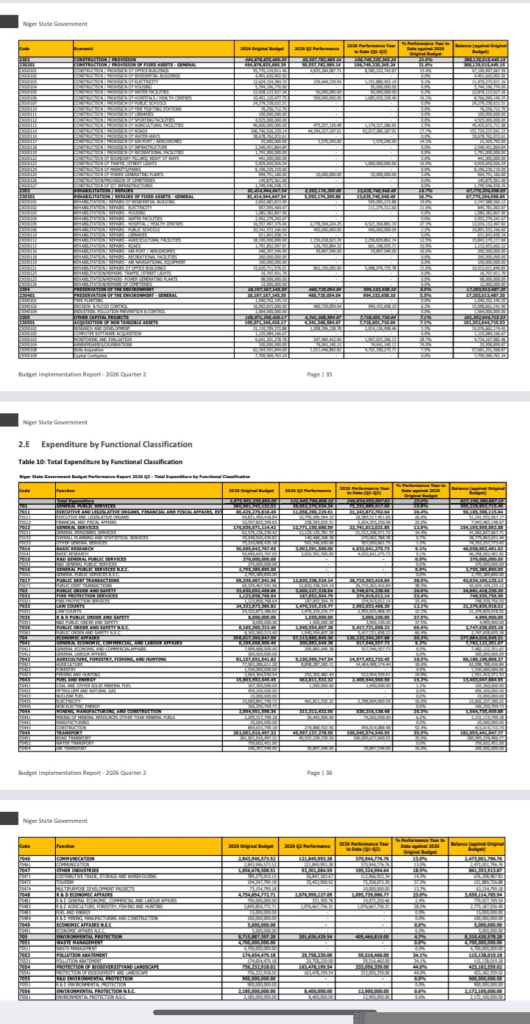
An analysis of the Niger State Government’s 2026 Second Quarter Budget Implementation Report has revealed a striking disparity between expenditure on administrative costs and investment in critical water infrastructure, with the state spending ₦2.69 billion on honorarium and sitting allowances while releasing only ₦50 million for the construction of water facilities during the first six months of the year.
The budget performance figures also indicate that no funds were released for the rehabilitation of existing water infrastructure despite a budgetary allocation of ₦2.95 billion, raising fresh questions about the state’s commitment to improving access to potable water in communities that continue to grapple with chronic shortages.
The spending pattern has renewed debate over public expenditure priorities in a state where inadequate water supply has long contributed to outbreaks of waterborne diseases and forced many residents to depend on unsafe water sources.
Administrative Spending Outpaces Water Infrastructure
According to the budget implementation report, Niger State recorded ₦2,694,832,210.36 in expenditure under the Honorarium and Sitting Allowance budget line between January and June 2026.
The amount represents 14.4 per cent of the ₦18.75 billion appropriated for the item in the 2026 budget.
In contrast, the government allocated ₦22.93 billion for the construction and provision of water facilities but released only ₦50 million, representing 0.2 per cent implementation, leaving ₦22.88 billion unspent midway into the fiscal year.
The figures show that expenditure on honorarium and sitting allowances exceeded spending on new water infrastructure by more than 53 times during the same period.
Zero Spending on Rehabilitation of Water Facilities
Beyond the minimal investment in new projects, the report shows that no expenditure was recorded under the budget line for the rehabilitation and repair of water facilities.
Although ₦2.95 billion was budgeted for the programme, implementation remained at zero per cent as of the end of the second quarter.
The absence of funding for rehabilitation has raised concerns given the deteriorating condition of many public water schemes across the state.
Billions Spent on Administrative Costs
The report indicates that recurrent expenditure continued at a significant pace across several administrative budget lines.
Among the highest expenditures were:
- ₦5.91 billion spent on subscriptions to professional bodies, representing 62.2% of the annual allocation.
- ₦3.76 billion on welfare packages.
- ₦1.25 billion on local medical expenses.
- ₦918.66 million on publicity and advertisements.
- ₦406.96 million on refreshments and meals.
- ₦110.16 million on postage and courier services.
- ₦79.69 million on foreign scholarship schemes.
- ₦45.21 million on sporting activities.
- ₦11.17 million on special days and celebrations.
- ₦300,000 on direct teaching and laboratory costs.
Overall, recurrent expenditure under the “Expenses General” category stood at ₦15.19 billion, representing 20.9 per cent implementation of the ₦72.69 billion budget.
Capital Budget Shows Mixed Performance
The state’s overall capital expenditure also reflected uneven implementation.
Out of a capital budget of ₦783.69 billion, only ₦151.23 billion had been spent by the end of June, representing 19.3 per cent implementation.
Major capital expenditures included:
- ₦106.75 billion for construction and provision of fixed assets.
- ₦8.59 billion for office building construction.
- ₦4.52 billion for rehabilitation of hospitals and health centres.
- ₦2.26 billion for rehabilitation of agricultural facilities.
- ₦1.69 billion for construction of hospitals and health centres.
- ₦1.17 billion for agricultural facilities.
- ₦1.15 billion for electricity projects.
However, several critical sectors received little or no funding.
Schools, Libraries, Markets and Water Projects Neglected
The implementation report shows zero expenditure on several important infrastructure projects, including:
- Residential housing.
- Public schools.
- Fire stations.
- Libraries.
- Sporting facilities.
- Markets.
- Recreational centres.
- ICT infrastructure.
- Waterways.
- Boundary pillars.
- Power generation projects.
Similarly, only ₦450 million was released for the rehabilitation of public schools out of an allocation exceeding ₦20 billion, representing just 2.2 per cent implementation.
The limited releases have prompted questions about the pace of infrastructure delivery across multiple sectors.
Debt Servicing Consumes ₦26.7 Billion
The report further reveals that the Niger State Government spent ₦26.72 billion servicing public debt during the first half of 2026.
The payments included:
- ₦11.76 billion on domestic interest.
- ₦8.27 billion on repayment of domestic principal.
- ₦4.35 billion on repayment of foreign principal.
- ₦2.34 billion on foreign interest obligations.
Debt servicing therefore consumed significantly more resources than allocations released for several key development sectors combined.
Water Crisis Persists Across Niger State
The spending pattern comes against the backdrop of persistent challenges in access to clean drinking water across many communities in Niger State.
Several rural and semi-urban communities continue to rely on rivers, streams and ponds, while others reportedly share water sources with livestock.
Public health experts have consistently warned that inadequate access to potable water contributes to recurring outbreaks of cholera, diarrhoea and other waterborne diseases.
The lack of sustained investment in water infrastructure has therefore remained a major public policy concern.
Bi-Water Scheme Still Awaiting Funding
The latest report also follows concerns raised over the implementation of the state’s Bi-Water Scheme, designed to improve access to safe drinking water in underserved communities.
In the 2025 budget, the state allocated ₦1.4 billion for the rehabilitation of nine Bi-Water schemes.
However, budget implementation records showed that no funds were released for the project during the first nine months of that fiscal year.
Likewise, a ₦125 million allocation for tools and equipment supporting the scheme also recorded no expenditure.
The recurring pattern has fuelled concerns about the pace of investment in one of the state’s most critical public utilities.
Budget Priorities Under Scrutiny
Public finance analysts note that budget allocations alone do not translate into development unless accompanied by timely implementation.
They argue that while administrative expenditures are necessary for governance, persistent underfunding of essential public services—particularly water, health and education infrastructure—can have long-term social and economic consequences.
Access to safe water remains central to public health, environmental sustainability and rural development.
Consequently, the disparity between administrative spending and investment in water infrastructure is likely to attract increased public scrutiny as the fiscal year progresses.
The Niger State Government’s mid-year budget performance presents a mixed picture of fiscal implementation.
While billions of naira were expended on administrative costs, welfare, debt servicing and selected infrastructure projects, investment in water infrastructure remained minimal despite substantial budgetary allocations.
With only ₦50 million released for new water facilities and zero expenditure recorded for the rehabilitation of existing water systems by the midpoint of the fiscal year, questions are likely to persist over budget execution priorities and the state’s ability to address longstanding challenges in access to potable water.
As implementation of the 2026 budget continues, stakeholders are expected to closely monitor whether funding for critical public services improves during the second half of the year.




Leave a Reply