

Fresh bilateral security agreement targets terrorism, cross-border crimes, and regional instability as both nations deepen military cooperation.
By A1NEWS International
Abuja/Yaoundé | June 30, 2026
Nigeria, Cameroon Strengthen Military Alliance with Landmark Defence Cooperation Agreement
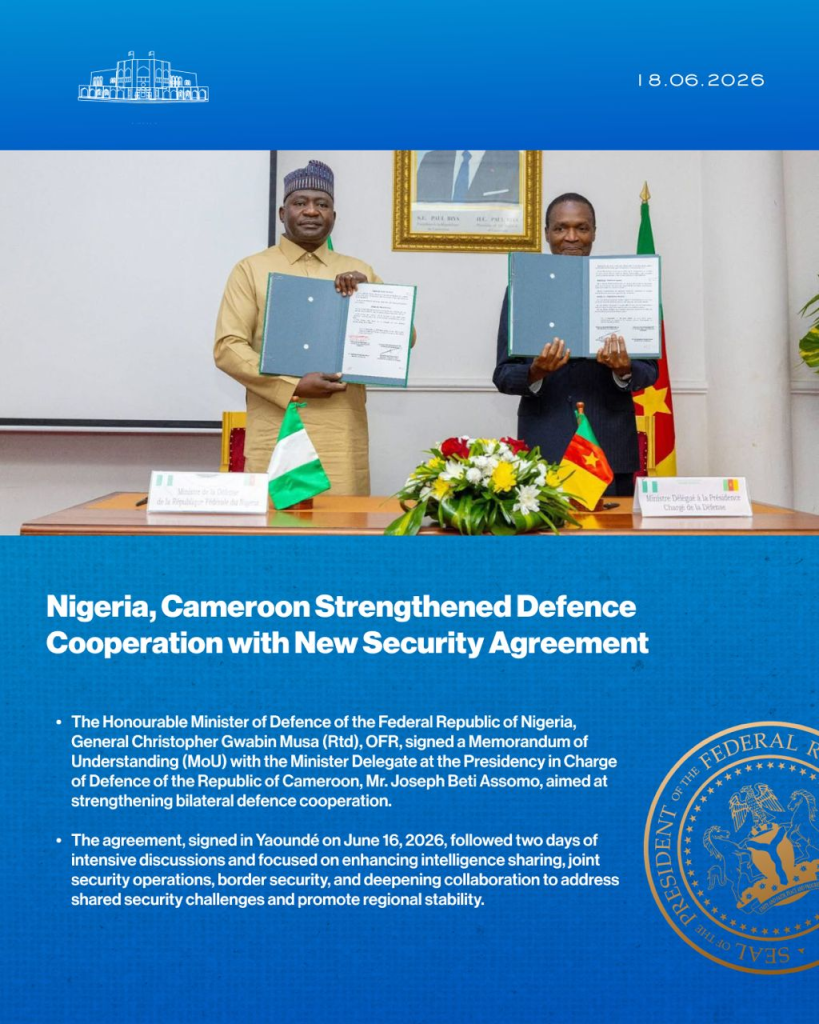
Nigeria and Cameroon have taken a significant step toward strengthening regional security following the signing of a new Memorandum of Understanding (MoU) designed to deepen military collaboration, improve intelligence sharing, and coordinate joint operations against common security threats.
The agreement, signed in Yaoundé on June 16, 2026, comes at a time when both countries continue to confront terrorism, insurgency, banditry, arms trafficking, and other transnational crimes affecting the Lake Chad Basin and their shared border communities.
Nigeria’s Minister of Defence, General Christopher Gwabin Musa (Rtd.), OFR, signed the agreement alongside Cameroon’s Minister Delegate at the Presidency in charge of Defence, Joseph Beti Assomo, following two days of high-level bilateral defence consultations.
The renewed partnership underscores growing efforts by both governments to strengthen regional stability through closer military and intelligence cooperation.
Agreement Targets Shared Security Threats
According to information released after the signing ceremony, the new defence framework is expected to strengthen cooperation in several critical areas, including:
- Intelligence sharing on terrorist activities.
- Joint military operations.
- Border surveillance and security.
- Counter-terrorism initiatives.
- Capacity building and military training.
- Strategic defence collaboration.
- Regional peace and stability.
Security analysts believe the agreement reflects increasing recognition that criminal networks operating across Nigeria and Cameroon cannot be effectively tackled by either country acting alone.
The two countries share an extensive international border stretching over 1,500 kilometres, making coordinated security operations essential to preventing the movement of insurgents, illegal arms, smugglers and other transnational criminal groups.
Why the Agreement Matters
The timing of the MoU is particularly significant.
For years, Nigeria and Cameroon have jointly confronted the activities of Boko Haram and the Islamic State West Africa Province (ISWAP), whose fighters have repeatedly exploited porous borders to evade military operations.
Both countries are members of the Multinational Joint Task Force (MNJTF), alongside Chad and Niger, established to combat insurgency within the Lake Chad region.
Despite notable military successes, security experts argue that intelligence gaps and limited cross-border coordination have continued to create opportunities for insurgent movements.
The latest agreement seeks to bridge those operational gaps through more structured military cooperation.
Focus on Intelligence Sharing
Perhaps the most critical component of the new partnership is enhanced intelligence sharing.
Modern security experts increasingly identify intelligence cooperation as one of the most effective tools in combating terrorism, kidnapping, human trafficking, arms smuggling and organised crime.
By establishing faster channels for exchanging operational intelligence, both countries hope to detect threats earlier and coordinate military responses more efficiently.
Military officials believe such cooperation could significantly improve surveillance across border regions frequently exploited by criminal groups.
Border Security Takes Centre Stage
The Nigeria-Cameroon border remains one of West Africa’s busiest and most challenging security corridors.
Communities on both sides maintain strong ethnic, cultural and commercial ties, making legitimate movement common while also creating opportunities for illegal activities.
The agreement seeks to enhance border monitoring through coordinated patrols, information exchange and operational planning.
Security observers note that improved cooperation could help reduce:
- Illegal arms trafficking.
- Cross-border kidnapping.
- Human trafficking.
- Smuggling of contraband.
- Terrorist infiltration.
Regional Stability Beyond Bilateral Relations
Beyond protecting national borders, the agreement carries broader implications for Central and West African security.
Instability in one country often spills across neighbouring states, making regional collaboration increasingly necessary.
The renewed Nigeria-Cameroon partnership complements wider African Union and regional security initiatives aimed at combating violent extremism and strengthening collective defence mechanisms.
Observers say successful implementation could serve as a model for enhanced defence cooperation among countries facing similar security challenges across the continent.
Challenges Ahead
While the signing of the agreement marks an important diplomatic milestone, analysts caution that its success will ultimately depend on implementation.
Previous regional security agreements have sometimes faced challenges, including:
- Funding constraints.
- Intelligence coordination gaps.
- Logistical limitations.
- Differences in operational procedures.
- Political and administrative bottlenecks.
Experts argue that sustained political commitment, adequate military resources and regular bilateral engagement will be essential to translating the agreement into measurable security improvements.
The Nigeria-Cameroon defence agreement represents another strategic effort to strengthen collective security against evolving regional threats.
As terrorism, organised crime and cross-border insecurity continue to challenge both nations, closer military cooperation, enhanced intelligence sharing and coordinated border operations could play a decisive role in improving security across the Lake Chad Basin and beyond.
The effectiveness of the pact, however, will ultimately be measured not by the signing ceremony but by tangible improvements in regional peace, reduced cross-border criminality and sustained operational collaboration between the armed forces of both countries.










Leave a Reply