
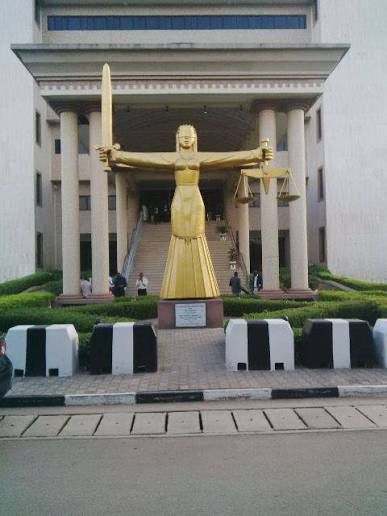
Federal High Court convicts four members of an Al-Shabaab-linked terrorist cell over the 2022 St. Francis Catholic Church massacre that left more than 40 worshippers dead, while traditional and political leaders describe the verdict as long-awaited justice for victims.
By Angela Udende / June 4, 2026
Abuja, Nigeria — Nearly four years after one of Nigeria’s deadliest attacks on a place of worship, the Federal High Court sitting in Abuja has sentenced four terrorists to death by hanging for their roles in the June 5, 2022 massacre at St. Francis Catholic Church, Owo, Ondo State.
The landmark judgment, delivered by Justice Emeka Nwite on Wednesday, brings a significant legal conclusion to a case that shocked Nigeria and drew international condemnation after gunmen invaded a Pentecost service and unleashed carnage that claimed more than 40 lives while leaving over 100 worshippers injured.
The court found four defendants guilty of terrorism-related offences and ruled that the prosecution had successfully established their involvement beyond reasonable doubt.
The judgment has been widely welcomed by victims’ families, community leaders, security stakeholders, and government officials who see it as a major victory in Nigeria’s fight against terrorism.
FOUR CONVICTED, ONE ACQUITTED
Justice Nwite convicted and sentenced the following defendants to death by hanging:
- Idris Abdulmalik Omeiza, 25
- Al Qasim Idris, 20
- Jamiu Abdulmalik, 26
- Abdulhaleem Idris, 25
The four were convicted on a nine-count terrorism charge filed by the Department of State Services (DSS) on behalf of the Federal Government.
However, the court discharged and acquitted the fifth defendant, Momoh Otuho Abubakar, 47, after determining that the prosecution failed to provide sufficient evidence linking him to the terrorist operation.
The ruling underscored the court’s insistence on proof beyond reasonable doubt while distinguishing between those found culpable and those against whom evidence was insufficient.
COURT LINKS CONVICTS TO TERRORIST CELL
According to the judgment, evidence presented before the court established that the convicted individuals were active members of an Al-Shabaab-linked terrorist cell operating within parts of Kogi State.
The court found that they participated directly in planning and executing the attack on St. Francis Catholic Church during a packed Pentecost Sunday service.
Justice Nwite held that the totality of evidence, including witness testimonies, forensic examinations, confessional statements, and digital communications, firmly connected the defendants to the operation.
The judge concluded that the prosecution successfully proved its case and demonstrated the defendants’ involvement in terrorist activities.
HORROR INSIDE ST. FRANCIS CATHOLIC CHURCH
The attack remains one of the darkest chapters in Ondo State’s history.
On June 5, 2022, worshippers gathered at St. Francis Catholic Church in Owo for a Pentecost service when heavily armed attackers stormed the premises.
According to court records and witness testimony, the assailants detonated explosive devices inside the church and opened fire on congregants.
The resulting chaos left dozens dead and scores injured as terrified worshippers struggled to escape.
One of the prosecution witnesses, a Catholic priest who survived the attack, gave chilling testimony describing how at least three explosive devices detonated inside the church, triggering panic, confusion, and widespread casualties.
The testimony formed part of the evidence that prosecutors relied upon to establish the terrorists’ role in the massacre.
DSS PRESENTS FORENSIC AND DIGITAL EVIDENCE
The Department of State Services built its case through an extensive investigation involving multiple witnesses and forensic analysis.
During the trial, prosecutors called 11 witnesses and tendered 23 exhibits before the court.
Among the exhibits admitted into evidence was a communication device allegedly containing exchanges between the suspects before and after the attack.
Investigators also presented digital forensic reports, intelligence findings, and confessional statements that the court found credible and relevant to the prosecution’s case.
Legal analysts say the successful use of digital and forensic evidence highlights the growing importance of technology-driven investigations in terrorism prosecutions.
OLowo OF OWO: “JUSTICE HAS FINALLY BEEN SERVED”
Reacting to the judgment, the Olowo of Owo Kingdom, His Imperial Majesty Oba Ajibade Gbadegesin Ogunoye III, described the verdict as a welcome development and a significant step toward healing.
The monarch said the judgment offers a measure of closure to the kingdom and to families who have endured years of grief following the massacre.
According to a statement issued by his Special Assistant on Media, Sam Adewale, the traditional ruler expressed satisfaction that the judicial process had finally delivered justice.
The monarch further noted that the ruling would bring relief to affected families and allow the souls of those who perished in the attack to rest in peace.
He also commended the judiciary and security agencies, particularly the DSS, for ensuring the successful investigation and prosecution of the perpetrators.
ONDO GOVERNOR HAILS LANDMARK VERDICT
Ondo State Governor, Lucky Aiyedatiwa, also welcomed the judgment, describing it as a victory for justice and accountability.
The governor stated that the conviction demonstrates that acts of terrorism will not go unpunished and provides renewed hope to victims and their families.
According to him, the verdict reinforces public confidence in the rule of law and strengthens the determination of authorities to confront violent extremism wherever it occurs.
He emphasized that although no judgment can erase the pain suffered by survivors and bereaved families, accountability remains an essential component of national healing.
SECURITY LESSONS FROM THE OWO ATTACK
Security experts say the Owo church massacre exposed significant vulnerabilities in the protection of public spaces and places of worship.
Analysts argue that while the convictions represent a major legal success, they also highlight the need for continuous investment in intelligence gathering, counterterrorism operations, surveillance technology, and inter-agency collaboration.
The attack became a wake-up call for security agencies and policymakers regarding the evolving threat posed by extremist networks operating across different parts of Nigeria.
Experts further stress that proactive prevention remains more effective than post-attack prosecution.
A TEST OF NIGERIA’S COUNTERTERRORISM CAPACITY
The successful prosecution of the Owo church attackers is being viewed as a significant test of Nigeria’s ability to investigate, prosecute, and secure convictions in complex terrorism cases.
For years, victims’ families and civil society groups had demanded accountability and justice.
The judgment demonstrates that lengthy investigations and difficult prosecutions can ultimately yield results when supported by evidence-based investigations and effective collaboration among security institutions.
The death sentences handed to four terrorists involved in the Owo church massacre mark a defining moment in Nigeria’s fight against terrorism and violent extremism.
While the verdict cannot undo the tragedy that claimed dozens of innocent lives, it provides a measure of justice for victims and reassurance that perpetrators of such heinous crimes can be held accountable.
As the nation reflects on the judgment, many Nigerians hope it will serve not only as punishment for those convicted but also as a powerful deterrent against future acts of terror.





Leave a Reply