
FG targets infrastructure, security, and growth as capital spending hits 50% of total budget
By Umar Baba | Abuja, Nigeria
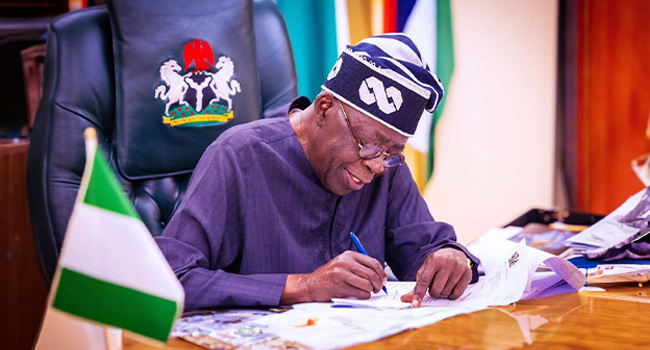
President Bola Ahmed Tinubu has signed the 2026 Appropriation Act into law, approving a total expenditure of ₦68.32 trillion.
He also extended the implementation of the 2025 budget to June 30, 2026, to allow completion of ongoing projects.
The approval was disclosed in a statement by the President’s Special Adviser on Information and Strategy, Bayo Onanuga, on Friday.
The 2026 budget allocates ₦4.799 trillion for statutory transfers, ₦15.8 trillion for debt servicing, ₦15.4 trillion for recurrent expenditure, and ₦32.2 trillion for capital projects through the Development Fund.
According to the presidency, capital expenditure accounts for about 50 per cent of the total budget, reflecting a policy shift toward infrastructure development, economic growth, and national security.
Tinubu also signed the Appropriation (Repeal and Enactment) (Amendment) Bill, 2026, extending the capital component of the 2025 budget from March 31 to June 30, 2026.
The extension is intended to enable Ministries, Departments, and Agencies (MDAs) to complete ongoing projects and ensure optimal utilisation of allocated funds.
The President directed MDAs to adhere strictly to transparency, fiscal discipline, and value-for-money principles in budget execution, warning against delays and inefficiencies.
He commended the National Assembly for the timely passage of the budget and reiterated the need for sustained executive-legislative collaboration in driving national development.
The administration also indicated that part of the budget deficit would be financed through external borrowing, following approval of a foreign loan plan exceeding $21 billion.
Minister of Information and National Orientation, Mohammed Idris, described the budget as a “Budget of Consolidation, Renewed Resilience and Shared Prosperity,” aimed at strengthening ongoing reforms.
Budget Size Rises by ₦9.85tn
The approved ₦68.32 trillion budget represents an increase of ₦9.85 trillion over the initial ₦58.47 trillion proposal submitted to the National Assembly.
It is also ₦13.33 trillion higher than the 2025 budget, signalling an expansionary fiscal stance.
The fiscal framework is anchored on oil production of 1.84 million barrels per day, a crude benchmark of $64.85 per barrel, and an exchange rate of ₦1,400 to the dollar.
Focus on Security, Agriculture, Infrastructure
The government said the budget prioritises investment in security, agriculture, and critical infrastructure.
Tinubu emphasised that security spending would be tied to measurable outcomes, while agriculture would receive support through mechanisation, irrigation, and value-chain development.
He also stressed that food security remains central to national stability and economic resilience.
The 2026 budget reflects an aggressive fiscal expansion aimed at stimulating growth amid economic pressures. However, its success will depend on implementation efficiency, revenue performance, and debt sustainability. The extension of the 2025 budget highlights persistent execution gaps, a recurring challenge in Nigeria’s public finance management.













Leave a Reply