
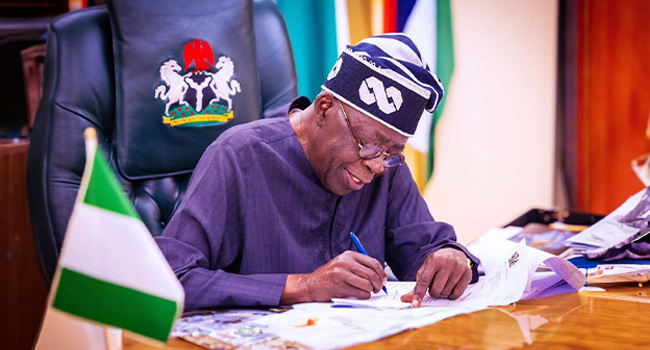
President launches five coordinated initiatives backed by World Bank funding to tackle poverty, strengthen community resilience, improve healthcare, expand education and support displaced Nigerians under the Renewed Hope Agenda.
By Umar Baba
ABUJA, Nigeria – July 17, 2026
President Bola Ahmed Tinubu has unveiled a $3.05 billion package of anti-poverty and human capital development programmes, describing the initiatives as a major step toward translating Nigeria’s ongoing economic reforms into tangible improvements in the lives of millions of citizens.
The coordinated intervention, launched in Abuja on Thursday, comprises five interconnected programmes targeting poverty reduction, economic resilience, healthcare, education, governance reforms and support for internally displaced persons (IDPs).
Speaking through the Minister of Finance and Coordinating Minister of the Economy, Mr. Wale Edun (Note: the source attributes the speech to Taiwo Oyedele, but the Minister of Finance is Wale Edun while Taiwo Oyedele serves as Chairman of the Presidential Fiscal Policy and Tax Reforms Committee. This report retains the source attribution but readers should note this discrepancy.), President Tinubu said the initiatives are designed to ensure that Nigeria’s recent macroeconomic gains translate into improved livelihoods at the grassroots.
The programmes are expected to receive significant support from the World Bank and other development partners.
Five Programmes Form Single National Poverty Reduction Strategy
According to the President, the newly launched interventions include:
- Nigeria Community Action for Resilience and Economic Stimulus Additional Financing (NG-CARES AF);
- Solutions for Internally Displaced Persons and Host Communities (SOLID);
- HOPE-GOV;
- HOPE Primary Healthcare (HOPE-PHC); and
- HOPE Education (HOPE-EDU).
Collectively branded under the Human Capital Opportunities for Prosperity and Equity (HOPE) initiative, the programmes represent what Tinubu described as a unified national strategy to reduce poverty while strengthening healthcare, education and community resilience.
“This is not just a set of programmes; these are promises kept,” the President stated.
He added:
“On our Renewed Hope Agenda, we came into office pledging to reform our economy, secure the nation and invest in our people. Today, we act on that pledge.”
Breakdown of the $3.05 Billion Intervention
Government officials disclosed that the funding package consists of:
NG-CARES Additional Financing – $1.25 Billion
The programme will provide additional support for:
- Smallholder farmers;
- Micro, Small and Medium Enterprises (MSMEs);
- Community livelihood projects; and
- Economic recovery initiatives.
The intervention is expected to strengthen local economies and enhance resilience against economic shocks.
SOLID Programme – $300 Million
The Solutions for Internally Displaced Persons and Host Communities (SOLID) programme will support:
- Internally Displaced Persons (IDPs);
- Host communities;
- Livelihood restoration;
- Social protection; and
- Community reintegration.
Officials say the initiative seeks to move vulnerable populations from humanitarian dependence to sustainable economic recovery.
HOPE Package – $1.5 Billion
The three-component HOPE programme focuses on:
- Primary healthcare;
- Foundational education;
- Teacher development;
- Governance reforms; and
- Improved public service delivery.
The initiative is intended to strengthen Nigeria’s human capital development strategy.
Tinubu: Economic Reforms Creating Foundation for Inclusive Growth
President Tinubu said the programmes build upon recent economic reforms implemented by his administration.
According to him, improvements in macroeconomic indicators—including stronger foreign reserves, easing inflationary pressures and improved economic performance—provide the foundation for broader national development.
“These are not abstract figures; they are the foundation for the next phase of our national development.”
He also disclosed that the Federal Government’s expanded cash transfer programme has now reached approximately 15 million vulnerable households nationwide.
The President urged federal, state and local governments, alongside development partners, to prioritize effective implementation and accountability.
“Delivery and accountability will determine the success of these programmes.”
Healthcare Programme Targets 40 Million Nigerians
The Coordinating Minister of Health and Social Welfare, Prof. Muhammad Ali Pate, disclosed that the $570 million HOPE-PHC programme is expected to improve access to quality primary healthcare for approximately 40 million Nigerians.
He said beneficiaries would include:
- Women;
- Children;
- Adolescents; and
- Rural communities.
According to Pate, the programme aims to:
- Reduce maternal mortality;
- Lower under-five mortality;
- Upgrade primary healthcare facilities; and
- Improve service delivery through performance-based financing.
Education Programme to Benefit 30 Million Pupils
Minister of Education Dr. Tunji Alausa announced that the $562 million HOPE-EDU initiative will directly impact nearly:
- 30 million pupils;
- 500,000 teachers; and
- 65,000 public schools nationwide.
The programme will focus on improving learning outcomes, strengthening teacher capacity and enhancing governance within Nigeria’s public education system.
Budget Minister Describes Programme as Whole-of-Government Response
Minister of Budget and Economic Planning Senator Atiku Bagudu described the interventions as a comprehensive response to:
- Poverty;
- Rising cost of living;
- Human capital deficits; and
- Socio-economic inequality.
According to him:
“These programmes represent another milestone in translating the Renewed Hope Agenda into concrete interventions that directly touch the lives of poor and vulnerable Nigerians.”
Governors, National Assembly Pledge Support
Speaking on behalf of the Nigeria Governors’ Forum (NGF), Ondo State Governor Lucky Aiyedatiwa reaffirmed the commitment of state governments to collaborate with the Federal Government and development partners to ensure successful implementation.
Similarly, Senate President Godswill Akpabio, represented by Senator Mohammed Sani Musa, pledged legislative support through:
- Timely appropriations;
- Strong oversight;
- Enabling legislation; and
- Monitoring of programme implementation.
Akpabio stressed that measurable outcomes—not political promises—should define the programmes’ success.
World Bank Reaffirms Support
The World Bank Country Director for Nigeria, Matthew Verghis, welcomed the initiatives, noting that Nigeria’s greatest resource remains its people.
He reaffirmed the institution’s commitment to supporting reforms that strengthen:
- Healthcare;
- Education;
- Social protection; and
- Human capital development.
Experts Stress Need for Transparency
Development economists say the success of the $3.05 billion intervention will depend largely on:
- Transparent implementation;
- Effective monitoring;
- Independent evaluation;
- Community participation; and
- Accountability in the management of public resources.
They argue that while previous poverty alleviation programmes have produced mixed results, improved governance and stronger oversight could enhance the impact of the latest initiatives.
Analysts also note that sustained investment in healthcare, education and livelihoods remains essential to reducing multidimensional poverty and fostering inclusive economic growth.
The unveiling of the $3.05 billion anti-poverty and human capital development package marks one of the Federal Government’s most ambitious social investment initiatives under the Renewed Hope Agenda.
If effectively implemented, the programmes have the potential to expand healthcare access, improve educational outcomes, strengthen community resilience and provide critical support for millions of vulnerable Nigerians.
However, stakeholders say the ultimate measure of success will lie not in the scale of the funding but in the ability of government institutions to deliver measurable improvements in the lives of citizens through transparency, accountability and efficient execution.









Leave a Reply