
June 12 Protest: #EndBadGovernance Movement Accuses Tinubu’s Policies of Fueling Terrorism, Poverty and Mass Abductions
Activists Demand Nationwide Action Against Insecurity, Economic Hardship as Democracy Day Protests Loom
By A1NEWS International
ABUJA, Nigeria — June 12, 2026
A coalition of civil society organisations, labour activists, students’ groups and community-based organisations operating under the banner of the #EndBadGovernance Movement has launched a blistering attack on the administration of President Bola Ahmed Tinubu, alleging that worsening economic conditions under his government are fueling terrorism, banditry, kidnapping and mass abductions across Nigeria.
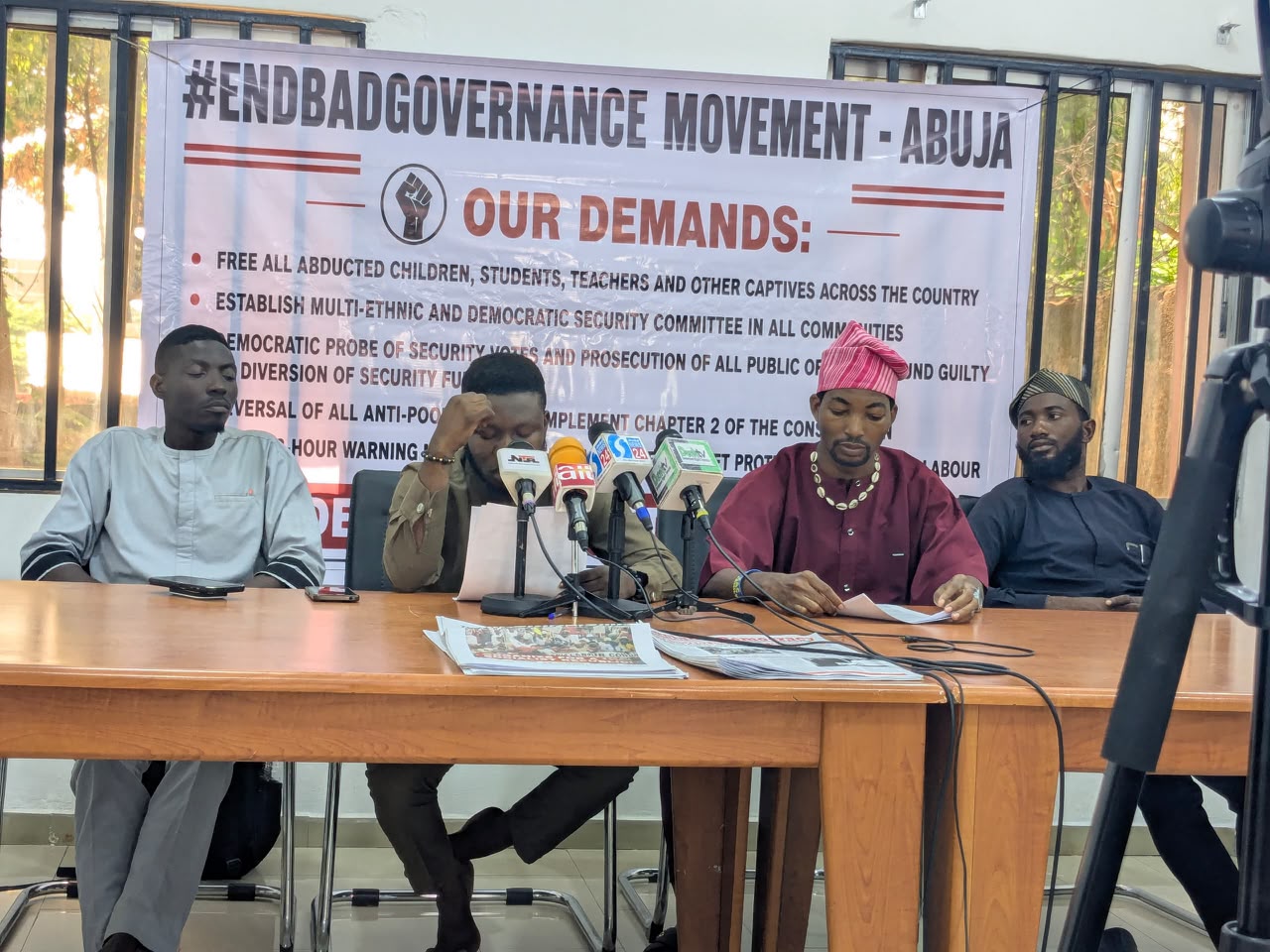
The coalition made the accusations during a press conference in Abuja ahead of planned nationwide June 12 Democracy Day protests, calling on Nigerians to mobilise against what it described as the interconnected crises of insecurity, poverty and economic mismanagement.
The activists argued that soaring inflation, rising unemployment, declining living standards and widespread poverty have created fertile recruitment grounds for criminal gangs, insurgent groups and kidnappers, worsening the country’s already fragile security situation.
Coalition Links Economic Hardship to Rising Insecurity
Addressing journalists alongside representatives of labour unions, civil society groups, student organisations and community leaders, the coalition expressed solidarity with thousands of victims affected by terrorism, banditry and kidnapping across the country.
According to the groups, Nigeria is witnessing an alarming escalation in mass abductions, attacks on rural communities and violent crimes that have displaced families, crippled local economies and disrupted education in several states.
They argued that while insecurity predates the current administration, deteriorating socio-economic conditions have significantly intensified the crisis.
“This tragedy is occurring against the background of the impoverishment of the masses by the vicious administration of Tinubu and the entire ruling class,” the coalition declared.
The activists maintained that increasing hardship has left many young Nigerians vulnerable to recruitment by criminal networks that exploit desperation, joblessness and social exclusion.
Communities Under Siege as Kidnappings Escalate
The coalition painted a grim picture of communities across the country where schools have been shut down, farmlands abandoned and economic activities disrupted due to persistent attacks by armed groups.
According to the activists, schoolchildren, teachers, farmers, traders and workers continue to be abducted with alarming frequency, while many victims remain in captivity for extended periods.
The groups cited recent incidents in Oyo, Ekiti, Kwara and Borno states, arguing that the recurring pattern of abductions demonstrates the inability of security agencies to adequately protect vulnerable populations.
They demanded the immediate and unconditional release of all abducted Nigerians currently being held by kidnappers, bandits and terrorist groups.
Security Agencies Under Scrutiny
The coalition accused security institutions of failing to effectively prevent attacks and rescue victims despite significant budgetary allocations to the sector over the years.
According to the activists, the continued success of criminal groups raises serious questions about the efficiency and accountability of Nigeria’s security architecture.
“The failure of government to ensure the rescue of victims and protection of communities has further emboldened these criminal groups to perpetrate more atrocities,” the coalition stated.
The groups called on federal and state authorities to deploy all available resources to secure the release of abducted citizens and restore confidence in public security institutions.
Demand for Audit of Security Votes
In one of their strongest demands, the activists called for a comprehensive public investigation into security votes and other security-related expenditures at both federal and state levels.
They questioned how billions of naira appropriated annually for security have failed to translate into improved safety and protection for ordinary Nigerians.
The coalition argued that transparency and accountability in security spending are essential if the country hopes to effectively confront insecurity and rebuild public trust.
Analysts note that security votes have long remained one of Nigeria’s most controversial public expenditure items, often shielded from public scrutiny despite persistent security challenges.
Safe Schools Initiative Faces Fresh Questions
The groups also expressed concerns about the effectiveness of the Safe Schools Initiative established after the abduction of more than 270 schoolgirls from Chibok, Borno State, in 2014.
According to the coalition, despite substantial funding and repeated government commitments, schools in several parts of the country remain vulnerable to attacks, kidnappings and security breaches.
The activists cited recent incidents involving students and teachers as evidence that the initiative has not delivered the level of protection originally envisioned.
They called for a comprehensive review of the programme to determine how allocated funds have been utilised and whether existing strategies are achieving their intended objectives.
Anti-Poor Policies Blamed for Deepening Crisis
Beyond security concerns, the coalition accused the Tinubu administration of implementing economic policies that have worsened the living conditions of millions of Nigerians.
The groups pointed to the removal of fuel subsidies, rising fuel prices, surging inflation and increasing costs of essential goods and services as factors contributing to widespread hardship.
According to the activists, ordinary Nigerians have experienced severe economic shocks since the current administration took office, while social protection mechanisms remain inadequate.
They argued that insecurity cannot be separated from broader socio-economic realities.
“The fight against insecurity must also be a fight against poverty, unemployment, poor healthcare, inadequate housing and the collapse of public education,” the coalition maintained.
Call for Community-Based Security Structures
As part of its proposed solutions, the coalition advocated the establishment of democratically elected and multi-ethnic community security committees across local governments, wards and communities nationwide.
The activists proposed that such bodies should include workers, youths, women, farmers, teachers, religious leaders and traditional institutions.
According to them, community participation would strengthen intelligence gathering, improve local vigilance and enhance collaboration between citizens and formal security agencies.
Labour Unions Urged to Lead Resistance
The coalition called on the Nigeria Labour Congress (NLC), the Trade Union Congress (TUC) and the Nigeria Union of Teachers (NUT) to declare a 48-hour nationwide warning strike and coordinate mass protests against insecurity and economic hardship.
The activists argued that organised labour has a responsibility to champion the interests of workers and vulnerable citizens affected by the country’s worsening socio-economic conditions.
They maintained that collective action remains necessary to compel authorities to implement meaningful reforms.
June 12 Protest Positioned as Call for Systemic Change
Beyond immediate demands, the #EndBadGovernance Movement argued that Nigeria’s security crisis is rooted in deeper structural and governance failures.
The coalition contended that decades of poor governance, inequality, unemployment and underdevelopment have created conditions that enable criminal enterprises to flourish.
According to the activists, vulnerable communities lacking access to quality education, employment opportunities and social services remain particularly susceptible to insecurity.
The movement therefore called on workers, students, youths, farmers, civil society organisations and concerned Nigerians to participate in the June 12 protests as a demonstration against both economic hardship and insecurity.
Among their demands are the release of all abductees, public audits of security expenditures, reversal of policies perceived as anti-poor, increased investment in education and healthcare, expanded job creation programmes and the development of an independent political platform representing the interests of ordinary Nigerians.
As Nigeria marks another Democracy Day, the planned June 12 protests are shaping up to become a major test of public sentiment regarding the Tinubu administration’s handling of the economy and national security. While government officials have defended ongoing reforms as necessary for long-term economic recovery, activists insist that worsening poverty and insecurity require urgent intervention. The growing debate underscores the widening national conversation about governance, accountability and the future direction of Nigeria’s democracy.














Leave a Reply