
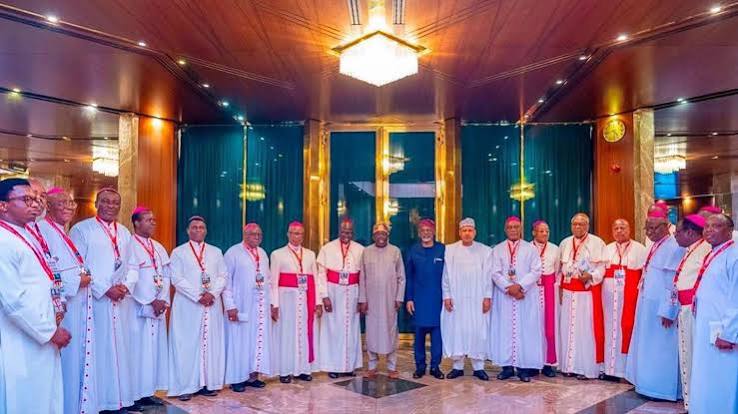
Presidency accuses Catholic bishops of breaching confidentiality after closed-door meeting, while Cardinal Onaiyekan insists church leaders have a moral duty to tell the President the truth about insecurity, economic hardship and governance.
By Amanda Jacobs
ABUJA, Nigeria – August 2, 2026
Introduction
A fresh confrontation has erupted between the Presidency and the Catholic Bishops’ Conference of Nigeria (CBCN) following comments by the Archbishop Emeritus of the Catholic Archdiocese of Abuja, Cardinal John Onaiyekan, who publicly disclosed details of a recent private meeting with President Bola Ahmed Tinubu.
The dispute has exposed deep divisions over the state of Nigeria’s economy, worsening insecurity, governance, and the role of religious leaders in holding elected governments accountable.
While the Presidency insists that the bishops’ assessment represents only one perspective and accused the clerics of violating the confidentiality of a high-level engagement, the Catholic Church maintains that it has a constitutional and moral obligation to speak truth to power regardless of political consequences.
The exchange has reignited debate over freedom of expression, government accountability and whether Nigeria’s political leadership is receiving an accurate picture of conditions facing ordinary citizens.
Inside the Closed-Door Meeting
The controversy stems from a meeting held on July 28, 2026, at the Presidential Villa, Abuja, between President Tinubu and a delegation of the Catholic Bishops’ Conference of Nigeria.
During an interview on Arise Television’s Prime Time, Cardinal Onaiyekan revealed that the bishops presented a carefully prepared memorandum highlighting what they described as worsening:
- Economic hardship
- Insecurity
- Poverty
- Democratic concerns
- Governance challenges
According to the Cardinal, the President disagreed with much of their assessment, insisting that his administration was making measurable progress.
“We Told Him What Nigerians Are Experiencing” — Onaiyekan
Cardinal Onaiyekan emphasized that the presentation was not an individual opinion but the collective position of the Catholic Bishops’ Conference.
He explained that the document underwent extensive consultations before it was presented.
According to him, the bishops had no political ambitions or personal interests but were simply fulfilling their pastoral responsibility to speak on issues affecting Nigerians.
The cleric argued that religious leaders cannot remain silent while citizens struggle under economic hardship and insecurity.
He maintained that the Church’s responsibility extends beyond preaching religious doctrines to addressing social justice and the welfare of the people.
“The Economy Is Not Helping The Poor”
One of the strongest concerns raised during the meeting, according to Onaiyekan, centered on the country’s economic situation.
The bishops reportedly informed President Tinubu that millions of Nigerians continue to face severe hardship despite government reforms.
According to the Cardinal, the President defended his administration’s economic policies and insisted the country was making progress.
“We told him what Nigerians are experiencing,” Onaiyekan stated, adding that the bishops intentionally presented realities from communities across Nigeria rather than optimistic official reports.
“Too Many People Tell The President Only Good News”
Perhaps the most controversial part of the Cardinal’s interview was his suggestion that many people surrounding President Tinubu shield him from the country’s true realities.
According to Onaiyekan, the bishops believed it was their responsibility to provide an honest assessment instead of flattering the President.
He suggested that the President appeared uncomfortable during the meeting because the message differed significantly from what he usually hears from political associates.
The Cardinal maintained that genuine leadership requires listening to uncomfortable truths.
Presidency Fires Back
The Presidency responded swiftly through separate statements issued by presidential aides Temitope Ajayi and Daniel Bwala.
The government rejected suggestions that President Tinubu was disconnected from the realities facing Nigerians.
Instead, it argued that the administration possesses extensive intelligence and economic data unavailable to the public.
Ajayi stated that the President receives daily security briefings, economic reports, policy assessments and regular updates from government agencies.
According to him, Tinubu also personally reads newspapers, watches television and consults widely before making decisions.
“The Bishops Are Not The Sole Custodians Of Truth”
Ajayi argued that while the Catholic bishops are respected stakeholders, their conclusions should not be treated as unquestionable.
He maintained that:
- Their assessment represents one perspective.
- Government data shows measurable progress.
- Fiscal reforms have improved state finances.
- Salary and pension payments have become more regular.
- Economic recovery remains a gradual process.
According to the Presidency, disagreement over policy outcomes should not be interpreted as government insensitivity.
Confidentiality Controversy
Beyond the policy disagreements, the Presidency criticized Cardinal Onaiyekan for publicly discussing the private meeting.
Officials described the disclosure as inconsistent with the confidential nature of presidential engagements.
The government argued that such meetings are intended to encourage frank conversations rather than public controversy.
Daniel Bwala Links Church Position To Politics
Presidential spokesman Daniel Bwala took a more political approach.
He alleged that elements within the Catholic Church openly supported Labour Party presidential candidate Peter Obi during the 2023 elections.
According to Bwala, Onaiyekan’s criticism should therefore be viewed within that broader political context.
He argued that many other Christian organizations have remained politically neutral.
Bwala also defended Tinubu’s economic optimism, insisting that official statistics support government claims of gradual recovery.
Matthew Kukah Declines Comment
The Bishop of the Roman Catholic Diocese of Sokoto, Matthew Kukah, who also attended the meeting with President Tinubu, declined to comment publicly.
He simply stated that, having been part of the delegation, he had no separate position to express beyond the collective presentation already made.
Opposition Criticises Tinubu’s Response
Meanwhile, Lagos Central Senatorial candidate of the Nigeria Democratic Congress (NDC), Ladipo Johnson, criticized President Tinubu’s reported advice that struggling Nigerians should seek assistance from churches.
Johnson described the remarks as insensitive.
According to him, addressing economic hardship remains the constitutional responsibility of government rather than religious institutions.
He argued that millions of Nigerians continue to struggle with:
- Rising inflation
- High food prices
- Declining purchasing power
- Persistent unemployment
Growing Debate Over Government Accountability
The exchange between the Presidency and the Catholic bishops reflects broader national debates over:
- Economic reforms
- Rising cost of living
- Security challenges
- Freedom of criticism
- Church-state relations
- Democratic accountability
Religious organizations have historically played influential roles in Nigeria’s political development, often serving as independent voices during periods of national crisis.
Political analysts note that disagreements between governments and faith-based institutions are not unusual in democratic societies, particularly where socioeconomic conditions generate competing narratives over policy performance.
The public disagreement between the Presidency and the Catholic Bishops’ Conference has highlighted the widening gap between official assessments of Nigeria’s economic recovery and the experiences reported by many citizens and civil society groups.
While the Tinubu administration insists that reforms are beginning to yield positive results, the Catholic bishops maintain that widespread hardship, insecurity and declining living standards continue to define daily life for millions of Nigerians.
As both sides defend their positions, the controversy underscores the growing importance of transparency, constructive dialogue and independent institutions in shaping public confidence ahead of the country’s evolving political landscape.



Leave a Reply