
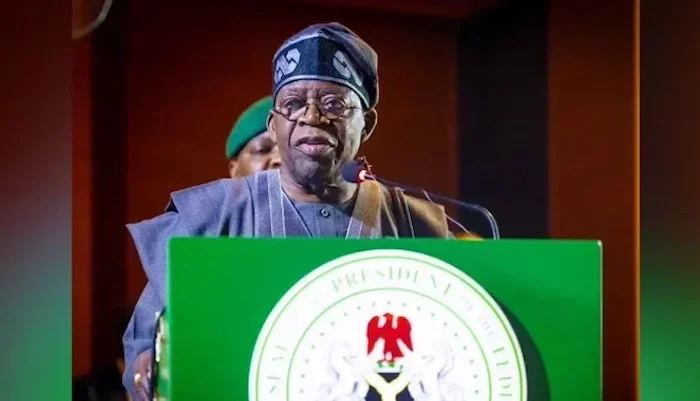
President insists Nigeria has turned economic corner after subsidy removal and FX reforms, but critics warn of deepening poverty, insecurity, and democratic strain across the federation.
By John Ishaku / May 29, 2026
Abuja, Nigeria — President Bola Tinubu has mounted a strong defence of his administration’s sweeping economic reforms, arguing that Nigeria narrowly avoided fiscal collapse and is now stabilising after what he described as “necessary but painful” policy choices.
But the President’s claims have triggered renewed political and civic backlash, with opposition voices, regional blocs, labour-linked critics, and state actors warning that the reforms have deepened economic hardship, worsened insecurity, and intensified public distrust in governance.
ECONOMIC REFORM DEFENCE AND FISCAL WARNING SIGNS
Tinubu, in a nationwide address marking three years in office, said his government inherited structural distortions including subsidy burdens, forex instability, rising debt servicing, and weakening public finances.
He defended the removal of fuel subsidy, citing daily expenditure levels running into billions of naira, and described the former forex regime as a system enabling arbitrage and large-scale rent-seeking.
According to him, continued subsidy and multiple exchange rates would have pushed Nigeria toward fiscal breakdown.
However, critics argue that while macroeconomic indicators show partial stabilisation, the real economy continues to suffer from inflationary pressure, declining purchasing power, and rising poverty levels.
COST OF LIVING CRISIS AND PUBLIC STRAIN
The President acknowledged that reforms triggered severe inflation and hardship across households and businesses.
He said the government is aware of public sacrifices and insists the economy is now better positioned for growth.
Yet across civil society and opposition circles, there is growing concern that economic gains have not translated into improved living standards, especially in food security, transportation, and wages.
INFRASTRUCTURE AND SECTOR CLAIMS
Tinubu highlighted ongoing infrastructure projects including thousands of kilometres of federal roads, rail expansion works, and major coastal and highway projects.
He also pointed to capital market growth, claiming significant increases in market capitalisation and listed company performance.
In the oil and gas sector, he cited renewed investor interest and the advancement of LNG expansion projects, alongside increased domestic refining capacity aimed at reducing import dependence.
Energy sector reforms, according to the Presidency, are also being extended into transmission upgrades and renewable energy expansion.
SECURITY: PROGRESS CLAIMS VS. FIELD REALITY
On security, Tinubu said military operations have intensified against armed groups, oil thieves, and kidnappers, leading to improved conditions in some areas.
However, security analysts and opposition groups argue that mass abductions, rural attacks, and highway insecurity remain widespread, particularly in northern and central regions.
The divergence between official statements and ground reports continues to fuel political tension over governance performance.
EDUCATION, HEALTH, AND SOCIAL INTERVENTIONS
The President highlighted interventions in education financing, including student loan schemes benefiting over a million beneficiaries.
He also referenced housing delivery programmes, agricultural support schemes, and healthcare upgrades through primary health centre revitalisation and expanded insurance coverage.
Despite these initiatives, stakeholders in education and health sectors maintain that systemic underfunding and insecurity continue to undermine service delivery.
CRITICS RAISE DEMOCRACY AND SECURITY CONCERNS
Afenifere’s Position
The pan-Yoruba socio-political group, Afenifere, accused the administration of worsening insecurity, economic hardship, and democratic decline.
It raised concerns over killings, kidnappings, and institutional weakening, arguing that governance structures are drifting away from democratic accountability.
The group also criticised what it described as insufficient progress on restructuring Nigeria’s security architecture, including the absence of state policing.
APC DEFENCE LINE
An APC chieftain, however, defended the administration, arguing that Tinubu’s reforms reflect long-delayed but necessary economic corrections avoided by previous governments.
He insisted that opposition narratives ignore the structural roots of Nigeria’s economic crisis and instead focus on short-term hardship.
STATE POLICE DEBATE REIGNITED
Oyo State Governor Seyi Makinde intensified the debate on security restructuring, urging the Federal Government to stop delaying state police reforms.
He argued that states already possess legislative capacity to establish localized policing systems, citing the Amotekun security framework as a working model in the South-West.
Makinde’s comments add fresh pressure on the federal system as insecurity continues to dominate national discourse.
INVESTIGATIVE CONTEXT: POLICY GAINS VS. SOCIAL COST
A closer reading of the policy trajectory reveals a widening gap between macroeconomic stabilisation efforts and microeconomic realities.
While fiscal indicators and market confidence suggest partial recovery, household-level data points to sustained hardship, rising inequality, and growing insecurity pressures.
This duality remains the central tension defining Tinubu’s reform agenda.
Three years into the administration, Nigeria’s economic direction remains sharply contested.
The government frames its reforms as foundational corrections required to prevent systemic collapse. Critics, however, view the same reforms as catalysts for deepening hardship and social instability.
As the country approaches a politically sensitive cycle leading to 2027, the debate is shifting from policy justification to performance accountability — with economic survival, security, and governance legitimacy at the centre of national discourse.








Leave a Reply